DOCUMENTARY RESEARCH · UNITED STATES
The numbers need their context
Each chart describes a particular study and endpoint. Do not compare different trial populations as though they were randomized together.
STUDY DATA · GLP-1 Treatment Desk
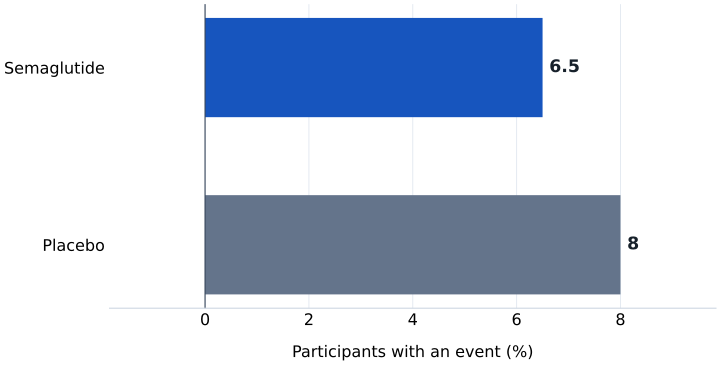
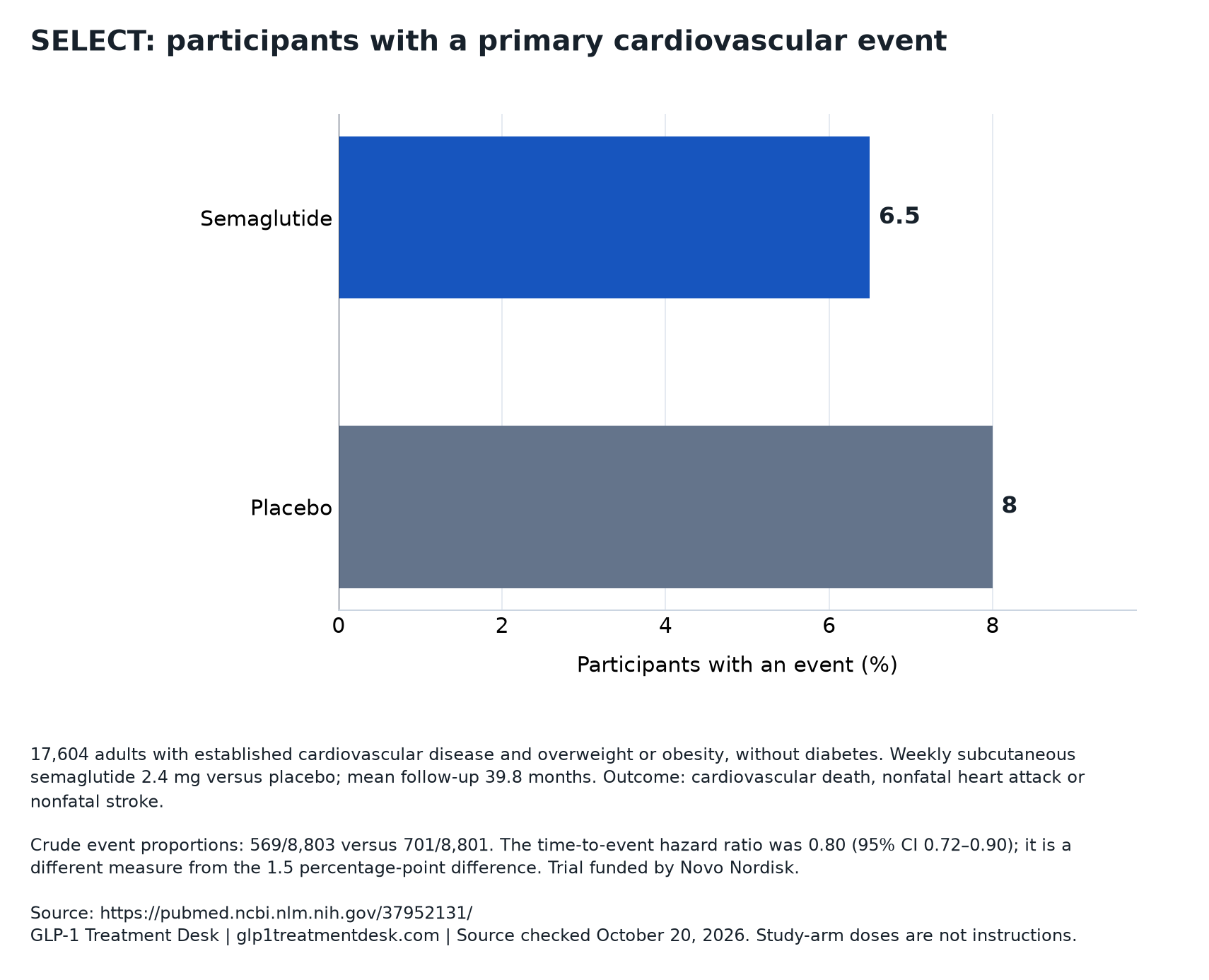
SELECT: participants with a primary cardiovascular event
17,604 adults with established cardiovascular disease and overweight or obesity, without diabetes. Weekly subcutaneous semaglutide 2.4 mg versus placebo; mean follow-up 39.8 months. Outcome: cardiovascular death, nonfatal heart attack or nonfatal stroke.
| Study group | Participants with an event (%) |
|---|---|
| Semaglutide | 6.5 |
| Placebo | 8 |
Crude event proportions: 569/8,803 versus 701/8,801. The time-to-event hazard ratio was 0.80 (95% CI 0.72–0.90); it is a different measure from the 1.5 percentage-point difference. Trial funded by Novo Nordisk.
Original visualization of published aggregate data. No individual prediction or provider performance is represented. Original research ↗
STUDY DATA · GLP-1 Treatment Desk
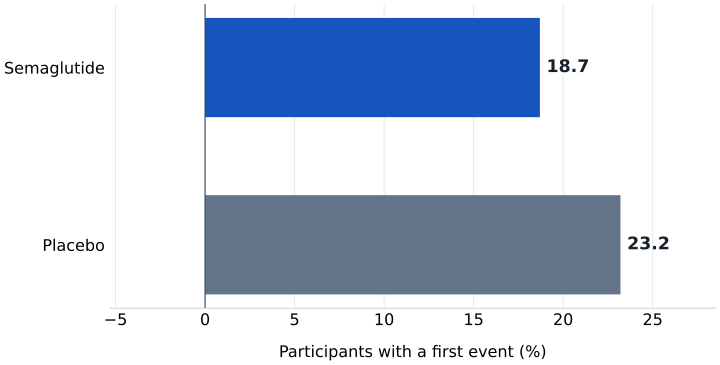
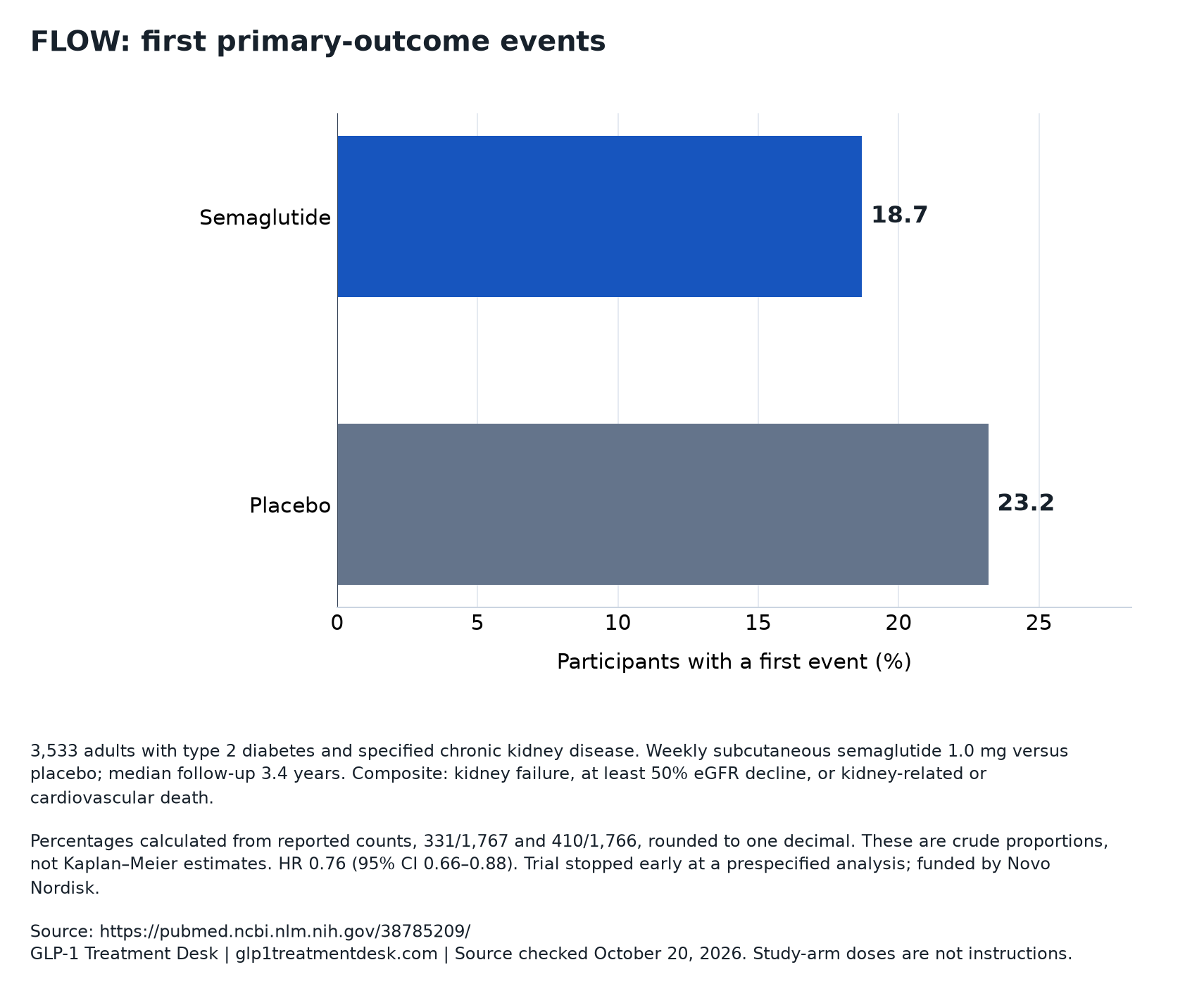
FLOW: first primary-outcome events
3,533 adults with type 2 diabetes and specified chronic kidney disease. Weekly subcutaneous semaglutide 1.0 mg versus placebo; median follow-up 3.4 years. Composite: kidney failure, at least 50% eGFR decline, or kidney-related or cardiovascular death.
| Study group | Participants with a first event (%) |
|---|---|
| Semaglutide | 18.7 |
| Placebo | 23.2 |
Percentages calculated from reported counts, 331/1,767 and 410/1,766, rounded to one decimal. These are crude proportions, not Kaplan–Meier estimates. HR 0.76 (95% CI 0.66–0.88). Trial stopped early at a prespecified analysis; funded by Novo Nordisk.
Original visualization of published aggregate data. No individual prediction or provider performance is represented. Original research ↗
STUDY DATA · GLP-1 Treatment Desk
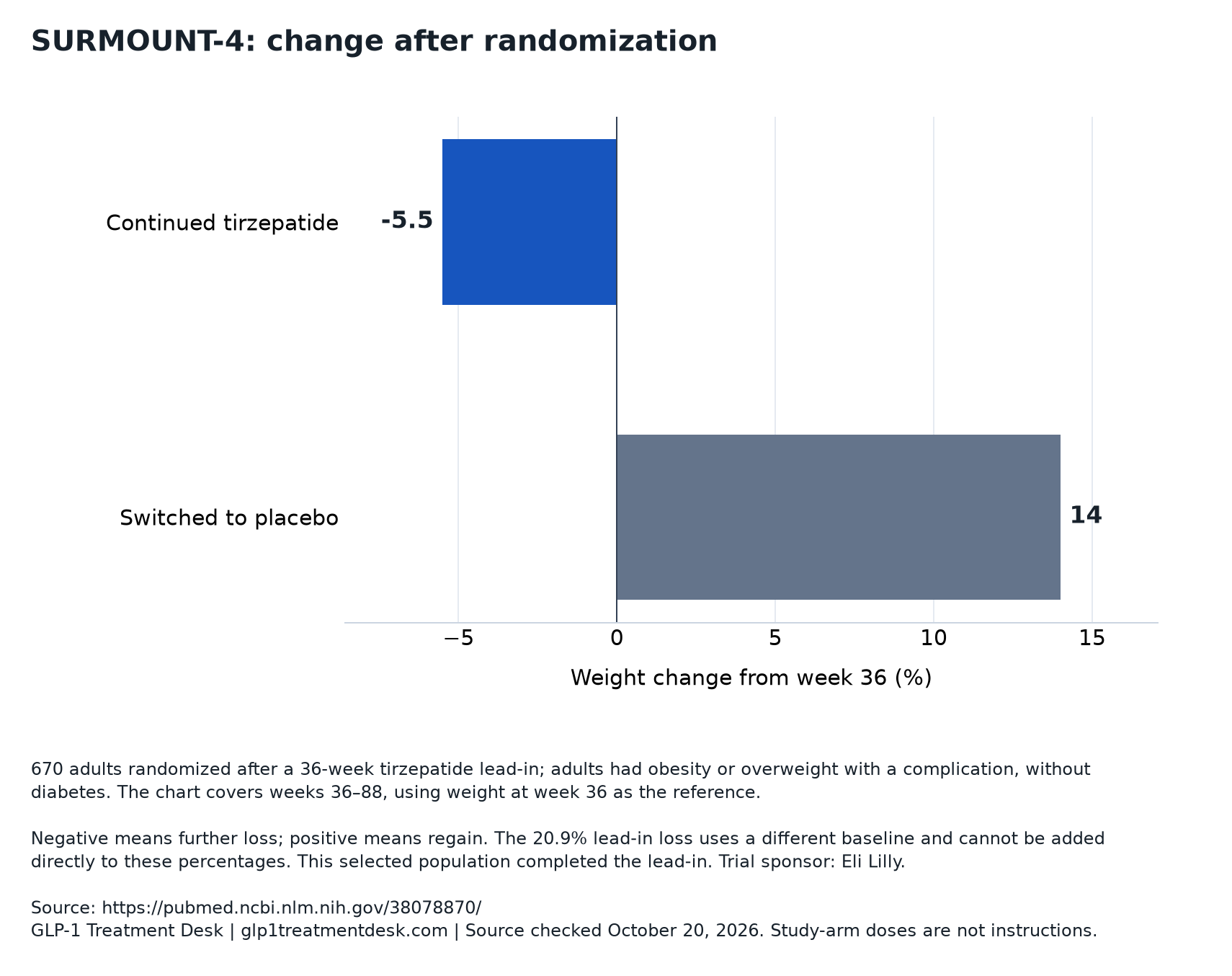
SURMOUNT-4: change after randomization
670 adults randomized after a 36-week tirzepatide lead-in; adults had obesity or overweight with a complication, without diabetes. The chart covers weeks 36–88, using weight at week 36 as the reference.
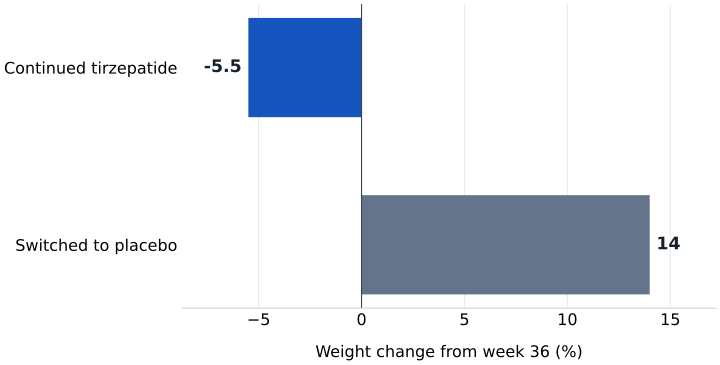
| Study group | Weight change from week 36 (%) |
|---|---|
| Continued tirzepatide | -5.5 |
| Switched to placebo | 14 |
Negative means further loss; positive means regain. The 20.9% lead-in loss uses a different baseline and cannot be added directly to these percentages. This selected population completed the lead-in. Trial sponsor: Eli Lilly.
Original visualization of published aggregate data. No individual prediction or provider performance is represented. Original research ↗
STUDY DATA · GLP-1 Treatment Desk
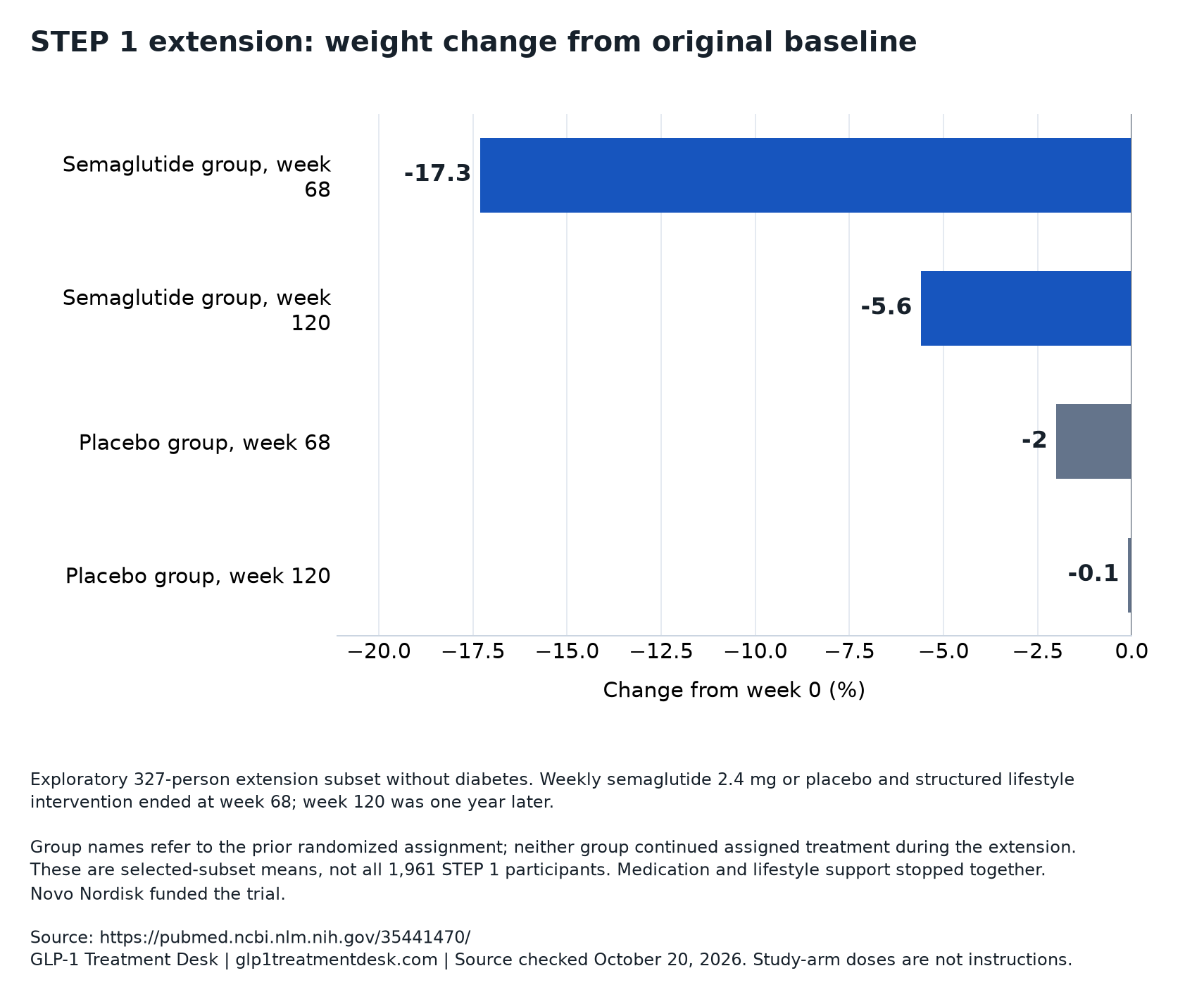
STEP 1 extension: weight change from original baseline
Exploratory 327-person extension subset without diabetes. Weekly semaglutide 2.4 mg or placebo and structured lifestyle intervention ended at week 68; week 120 was one year later.
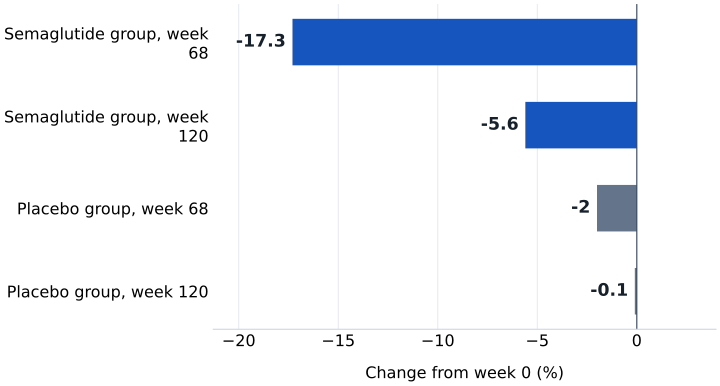
| Study group | Change from week 0 (%) |
|---|---|
| Semaglutide group, week 68 | -17.3 |
| Semaglutide group, week 120 | -5.6 |
| Placebo group, week 68 | -2 |
| Placebo group, week 120 | -0.1 |
Group names refer to the prior randomized assignment; neither group continued assigned treatment during the extension. These are selected-subset means, not all 1,961 STEP 1 participants. Medication and lifestyle support stopped together. Novo Nordisk funded the trial.
Original visualization of published aggregate data. No individual prediction or provider performance is represented. Original research ↗
STUDY DATA · GLP-1 Treatment Desk
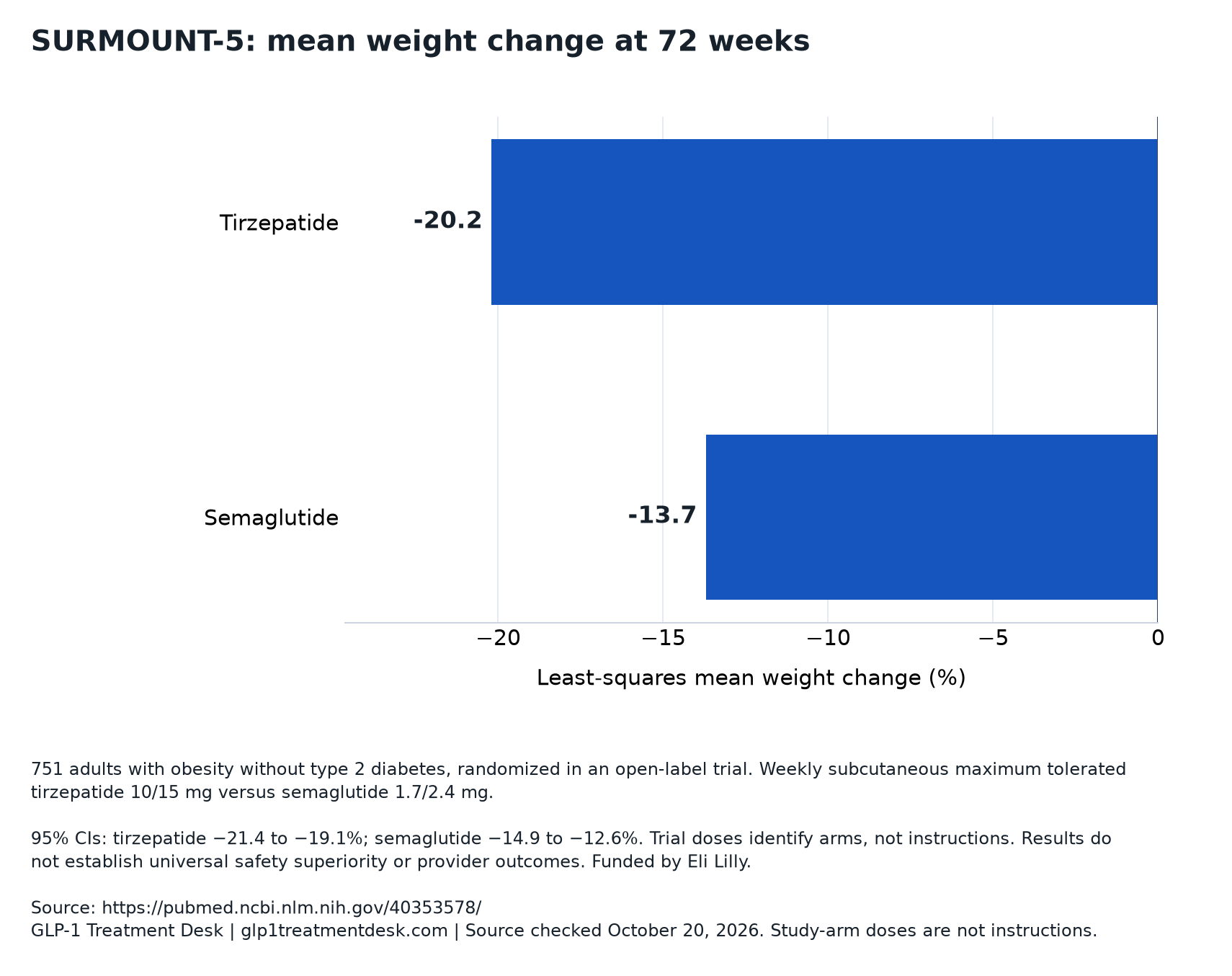
SURMOUNT-5: mean weight change at 72 weeks
751 adults with obesity without type 2 diabetes, randomized in an open-label trial. Weekly subcutaneous maximum tolerated tirzepatide 10/15 mg versus semaglutide 1.7/2.4 mg.
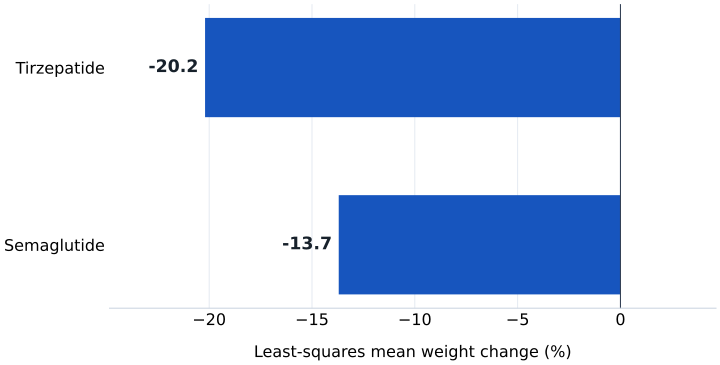
| Study group | Least-squares mean weight change (%) |
|---|---|
| Tirzepatide | -20.2 |
| Semaglutide | -13.7 |
95% CIs: tirzepatide −21.4 to −19.1%; semaglutide −14.9 to −12.6%. Trial doses identify arms, not instructions. Results do not establish universal safety superiority or provider outcomes. Funded by Eli Lilly.
Original visualization of published aggregate data. No individual prediction or provider performance is represented. Original research ↗
STUDY DATA · GLP-1 Treatment Desk
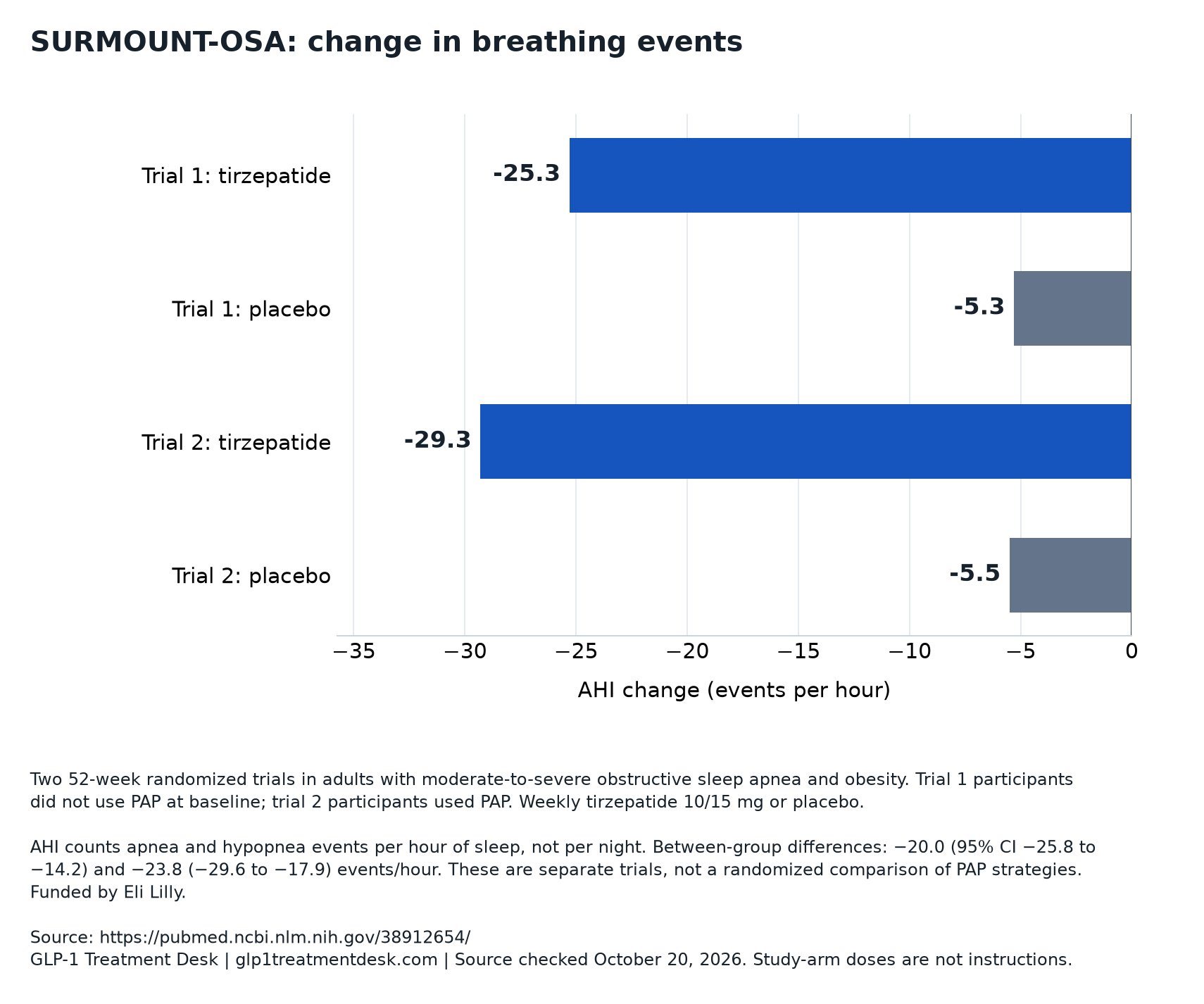
SURMOUNT-OSA: change in breathing events
Two 52-week randomized trials in adults with moderate-to-severe obstructive sleep apnea and obesity. Trial 1 participants did not use PAP at baseline; trial 2 participants used PAP. Weekly tirzepatide 10/15 mg or placebo.
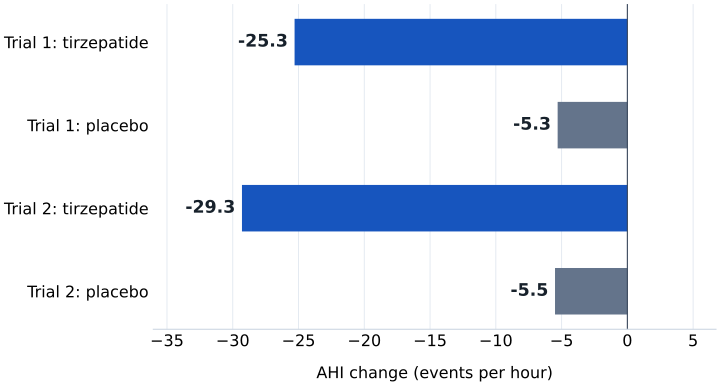
| Study group | AHI change (events per hour) |
|---|---|
| Trial 1: tirzepatide | -25.3 |
| Trial 1: placebo | -5.3 |
| Trial 2: tirzepatide | -29.3 |
| Trial 2: placebo | -5.5 |
AHI counts apnea and hypopnea events per hour of sleep, not per night. Between-group differences: −20.0 (95% CI −25.8 to −14.2) and −23.8 (−29.6 to −17.9) events/hour. These are separate trials, not a randomized comparison of PAP strategies. Funded by Eli Lilly.
Original visualization of published aggregate data. No individual prediction or provider performance is represented. Original research ↗
STUDY DATA · GLP-1 Treatment Desk
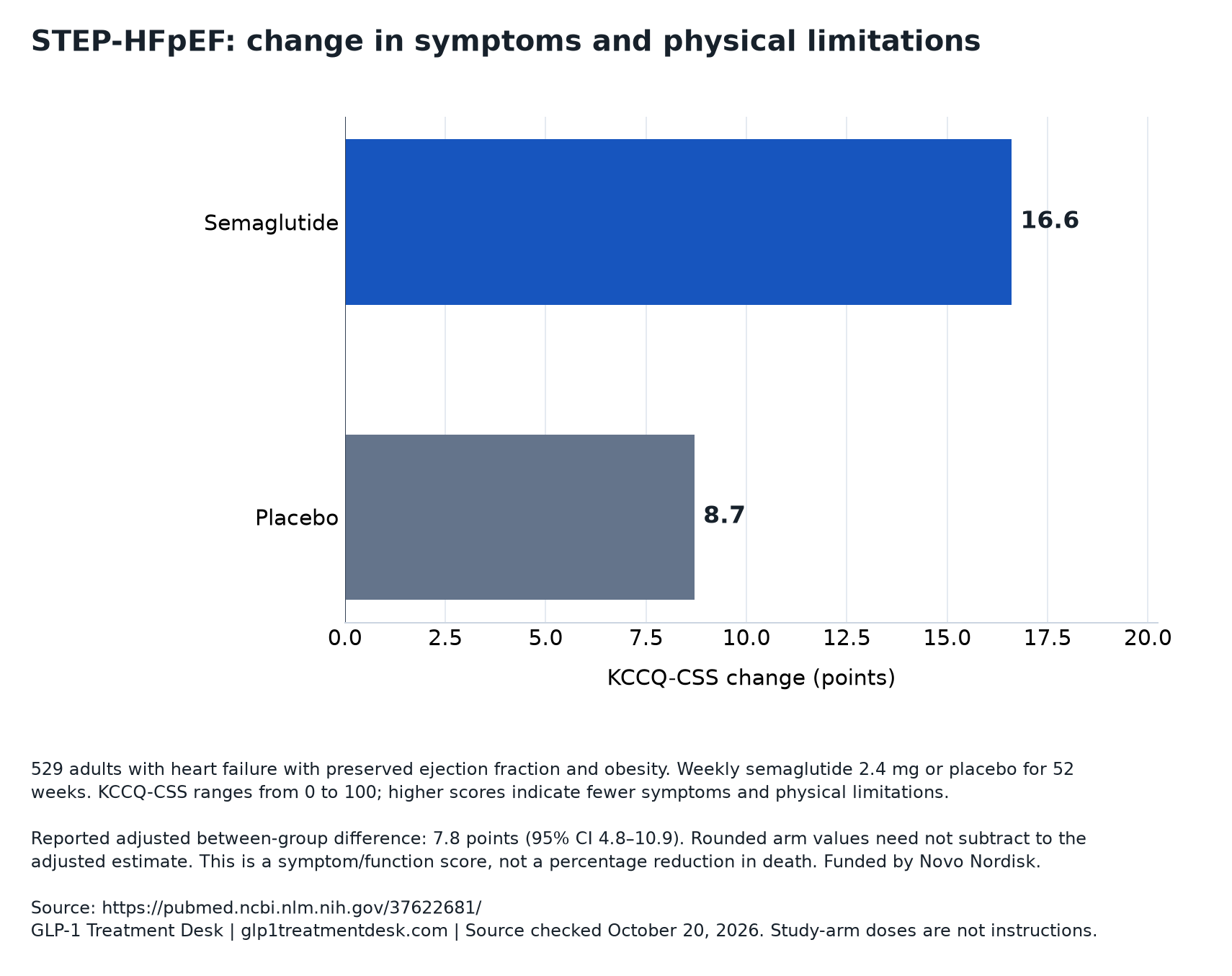
STEP-HFpEF: change in symptoms and physical limitations
529 adults with heart failure with preserved ejection fraction and obesity. Weekly semaglutide 2.4 mg or placebo for 52 weeks. KCCQ-CSS ranges from 0 to 100; higher scores indicate fewer symptoms and physical limitations.
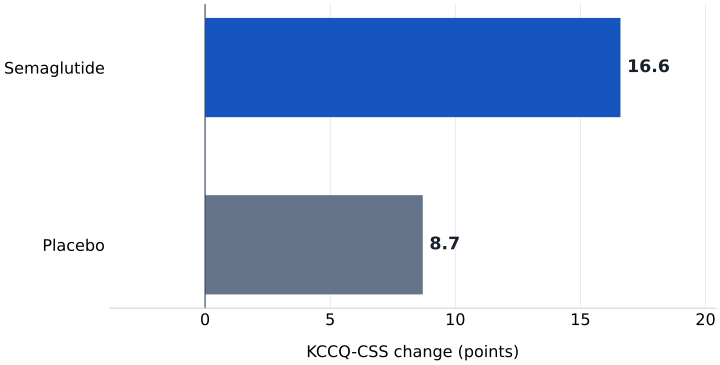
| Study group | KCCQ-CSS change (points) |
|---|---|
| Semaglutide | 16.6 |
| Placebo | 8.7 |
Reported adjusted between-group difference: 7.8 points (95% CI 4.8–10.9). Rounded arm values need not subtract to the adjusted estimate. This is a symptom/function score, not a percentage reduction in death. Funded by Novo Nordisk.
Original visualization of published aggregate data. No individual prediction or provider performance is represented. Original research ↗
STUDY DATA · GLP-1 Treatment Desk
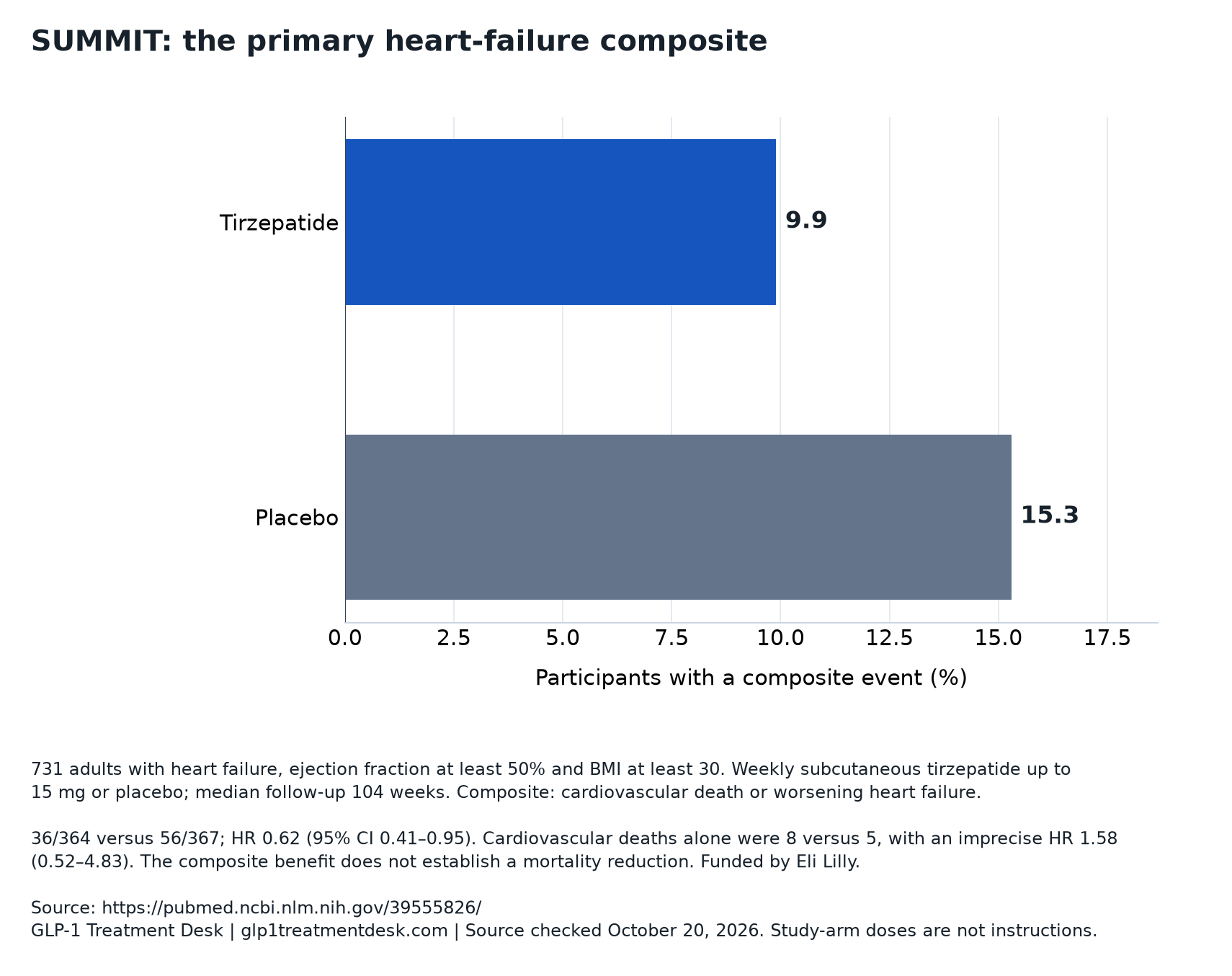
SUMMIT: the primary heart-failure composite
731 adults with heart failure, ejection fraction at least 50% and BMI at least 30. Weekly subcutaneous tirzepatide up to 15 mg or placebo; median follow-up 104 weeks. Composite: cardiovascular death or worsening heart failure.
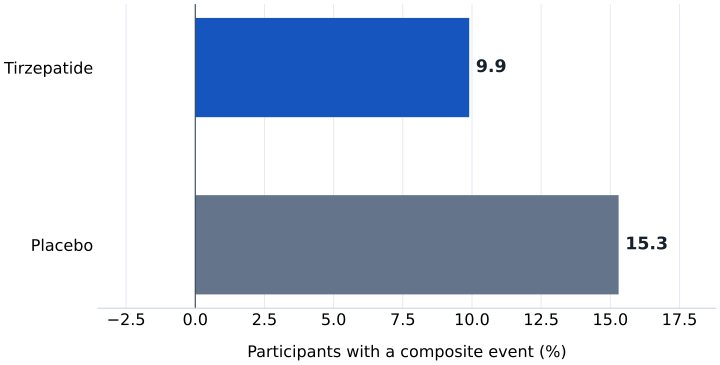
| Study group | Participants with a composite event (%) |
|---|---|
| Tirzepatide | 9.9 |
| Placebo | 15.3 |
36/364 versus 56/367; HR 0.62 (95% CI 0.41–0.95). Cardiovascular deaths alone were 8 versus 5, with an imprecise HR 1.58 (0.52–4.83). The composite benefit does not establish a mortality reduction. Funded by Eli Lilly.
Original visualization of published aggregate data. No individual prediction or provider performance is represented. Original research ↗
STUDY DATA · GLP-1 Treatment Desk
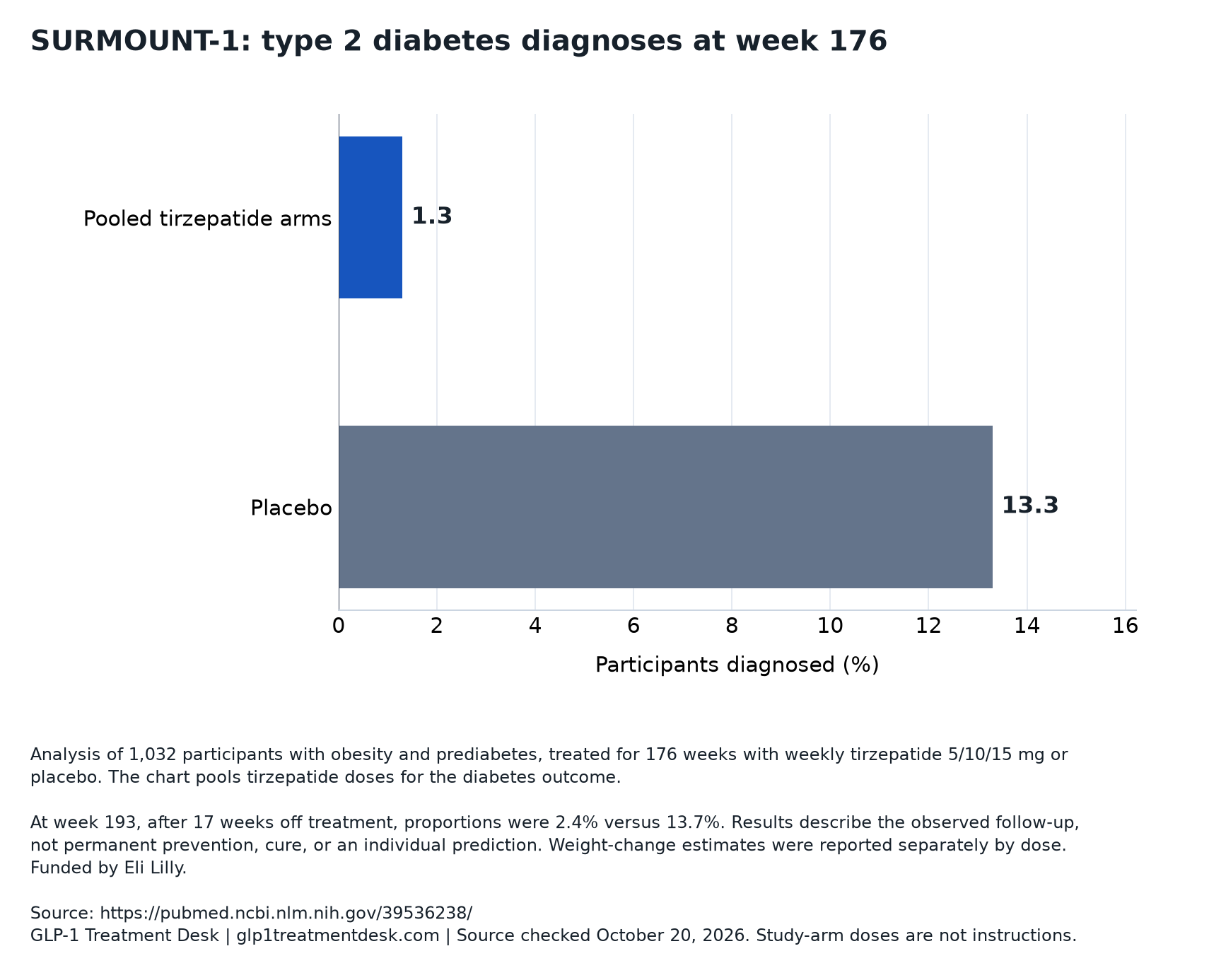
SURMOUNT-1: type 2 diabetes diagnoses at week 176
Analysis of 1,032 participants with obesity and prediabetes, treated for 176 weeks with weekly tirzepatide 5/10/15 mg or placebo. The chart pools tirzepatide doses for the diabetes outcome.
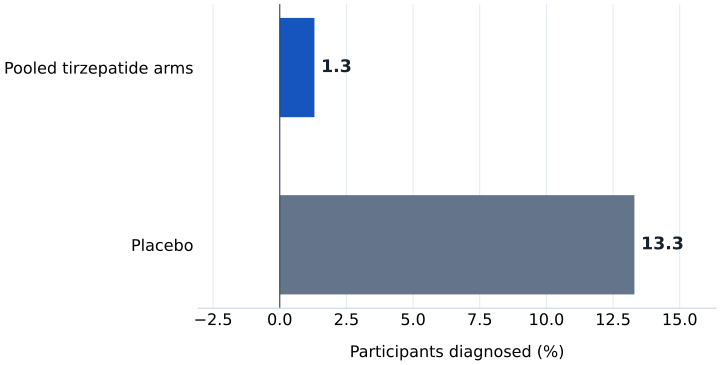
| Study group | Participants diagnosed (%) |
|---|---|
| Pooled tirzepatide arms | 1.3 |
| Placebo | 13.3 |
At week 193, after 17 weeks off treatment, proportions were 2.4% versus 13.7%. Results describe the observed follow-up, not permanent prevention, cure, or an individual prediction. Weight-change estimates were reported separately by dose. Funded by Eli Lilly.
Original visualization of published aggregate data. No individual prediction or provider performance is represented. Original research ↗
STUDY DATA · GLP-1 Treatment Desk
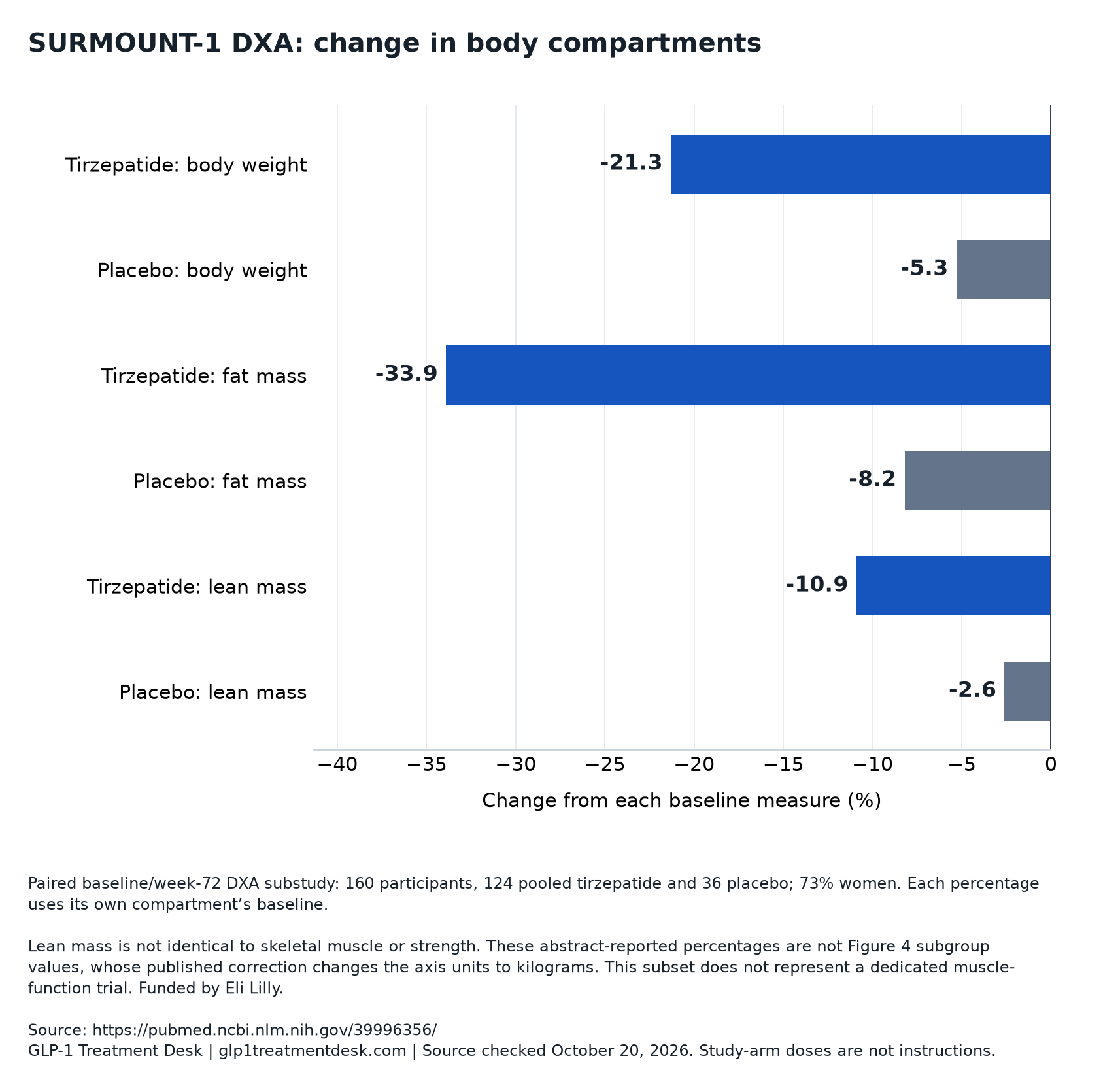
SURMOUNT-1 DXA: change in body compartments
Paired baseline/week-72 DXA substudy: 160 participants, 124 pooled tirzepatide and 36 placebo; 73% women. Each percentage uses its own compartment’s baseline.
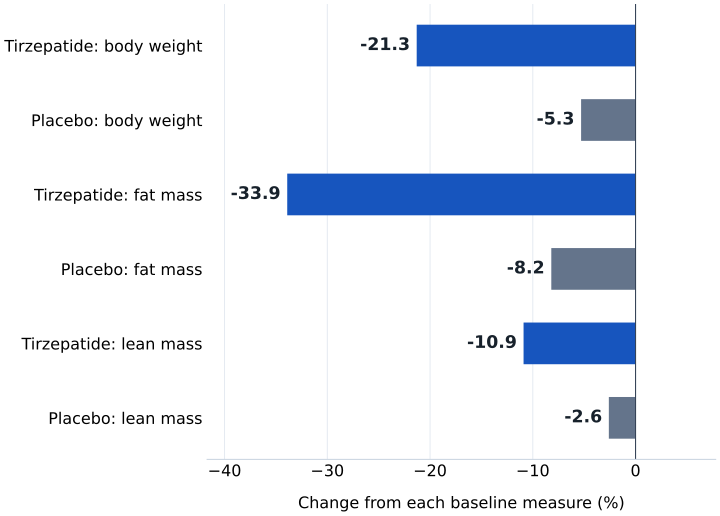
| Study group | Change from each baseline measure (%) |
|---|---|
| Tirzepatide: body weight | -21.3 |
| Placebo: body weight | -5.3 |
| Tirzepatide: fat mass | -33.9 |
| Placebo: fat mass | -8.2 |
| Tirzepatide: lean mass | -10.9 |
| Placebo: lean mass | -2.6 |
Lean mass is not identical to skeletal muscle or strength. These abstract-reported percentages are not Figure 4 subgroup values, whose published correction changes the axis units to kilograms. This subset does not represent a dedicated muscle-function trial. Funded by Eli Lilly.
Original visualization of published aggregate data. No individual prediction or provider performance is represented. Original research ↗
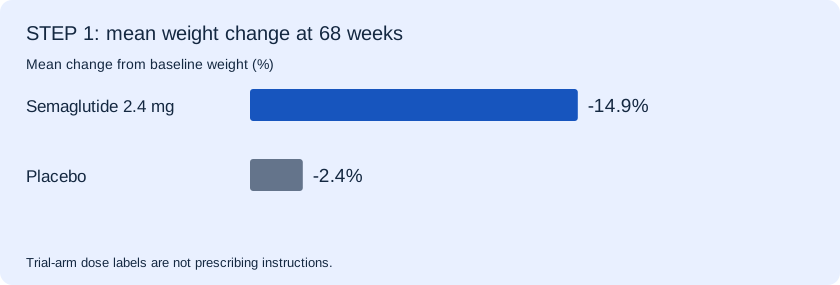
STEP 1: mean weight change at 68 weeks
Double-blind randomized trial of 1,961 adults with obesity or overweight and a weight-related condition, without diabetes. Both groups received lifestyle intervention. The semaglutide study arm used a weekly subcutaneous injection; the dose identifies the trial arm, not instructions for use.
Gastrointestinal events led to discontinuation in 4.5% of the semaglutide group and 0.8% of the placebo group. Funded by Novo Nordisk. These averages are not individual predictions or outcomes measured for a reviewed provider or compounded product.
Read the original study ↗View the underlying data table
| Study group | Mean weight change (%) | Stopped for GI events (%) |
|---|---|---|
| Semaglutide 2.4 mg | -14.9 | 4.5 |
| Placebo | -2.4 | 0.8 |
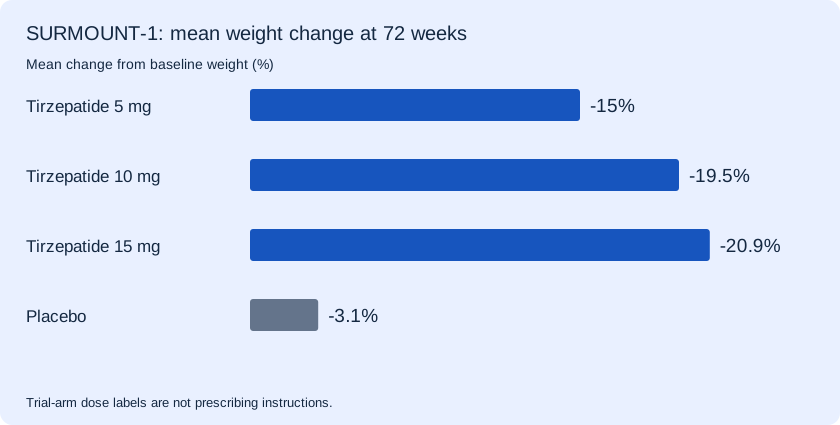
SURMOUNT-1: mean weight change at 72 weeks
Double-blind randomized trial of 2,539 adults with obesity or overweight and a weight-related complication, excluding diabetes. Tirzepatide study groups received weekly subcutaneous injections. Doses identify trial groups, not instructions for use.
Gastrointestinal adverse events were most common. Discontinuation due to adverse events was 4.3%, 7.1% and 6.2% in the respective tirzepatide groups and 2.6% with placebo. Funded by Eli Lilly. These results do not establish provider or compounded-product outcomes. This is not a head-to-head comparison with STEP 1.
Read the original study ↗View the underlying data table
| Study group | Mean weight change (%) | Stopped for adverse events (%) |
|---|---|---|
| Tirzepatide 5 mg | -15 | 4.3 |
| Tirzepatide 10 mg | -19.5 | 7.1 |
| Tirzepatide 15 mg | -20.9 | 6.2 |
| Placebo | -3.1 | 2.6 |