The STEP 1 extension is often reduced to a stark message: stop semaglutide and the weight comes back. Its findings deserve a closer reading. In an exploratory follow-up of 327 treatment completers, substantial average regain occurred over the year after both study medication and structured lifestyle support ended. Yet participants previously assigned semaglutide remained, on average, below their starting weight, and individual outcomes varied considerably.
For clinical care continuity, the important question is not simply whether regain happened. It is what treatment stopped, whose outcomes were measured, what remained improved, and which conclusions the design can support. This analysis draws on the full published STEP 1 extension article, the indexed primary report abstracts for STEP 1 and the tirzepatide maintenance trials, and official FDA material. Those sources offer different levels of detail; they do not establish a universal treatment duration or a personalized stopping strategy.
At a glance
- Extension population
- The exploratory analysis included 327 adults who had completed 68 weeks of treatment, compared with 1,961 people originally randomized in STEP 1.Sources: [2]
- What ended
- At week 68, study semaglutide or placebo and the structured lifestyle intervention were discontinued together.Sources: [2]
- Average regain
- The former semaglutide group regained 11.6 percentage points of baseline body weight after losing 17.3% during treatment—approximately two-thirds of the earlier loss.Sources: [2]
- Residual weight loss
- At week 120, average weight remained 5.6% below baseline in the former semaglutide group; 95 of 197 participants with onsite measurements retained at least 5% weight loss.Sources: [2]
The original trial asked whether treatment produced weight loss
STEP 1 randomized 1,961 adults without diabetes to once-weekly subcutaneous semaglutide 2.4 mg or placebo for 68 weeks, with lifestyle intervention in both groups. The dose identifies the studied injection arm, not a treatment instruction. Eligible participants had a body mass index of at least 30, or at least 27 with a weight-related condition. Randomization was 2:1, and treatment assignment was masked to participants and investigators.
The coprimary endpoints were percentage weight change and achieving at least 5% weight reduction. The main analysis assessed treatment assignment regardless of discontinuation or rescue interventions. Average weight change was −14.9% with semaglutide versus −2.4% with placebo: an estimated difference of −12.4 percentage points, with a 95% confidence interval from −13.4 to −11.5. That interval describes uncertainty around the average between-group effect, not the range of individual responses. Novo Nordisk funded STEP 1, including its extension.
The extension followed selected completers, not everyone randomized
The extension shifted from testing treatment efficacy to observing what happened afterward. Participants had to complete treatment at week 68, consent to follow-up, and meet extension eligibility criteria. Sites came from five countries: Canada, Germany, the United Kingdom, the United States, and Japan. US and Japanese sites were selected for high recruitment in the main trial. Of 333 people entering the extension, 327 attended at least one qualifying follow-up visit and entered the analysis.
Those 327 represented about one-sixth of the original randomized population. Their baseline characteristics were broadly similar to the larger trial, but completing treatment is itself a selection step. The extension group had lost more weight during semaglutide treatment than the full randomized group: 17.3% versus 14.9%. Similar demographics therefore do not make the groups interchangeable. People who stopped earlier because of tolerability, access, limited response, or other circumstances were not represented by this treatment-completer design.
STUDY DATA · GLP-1 Treatment Desk
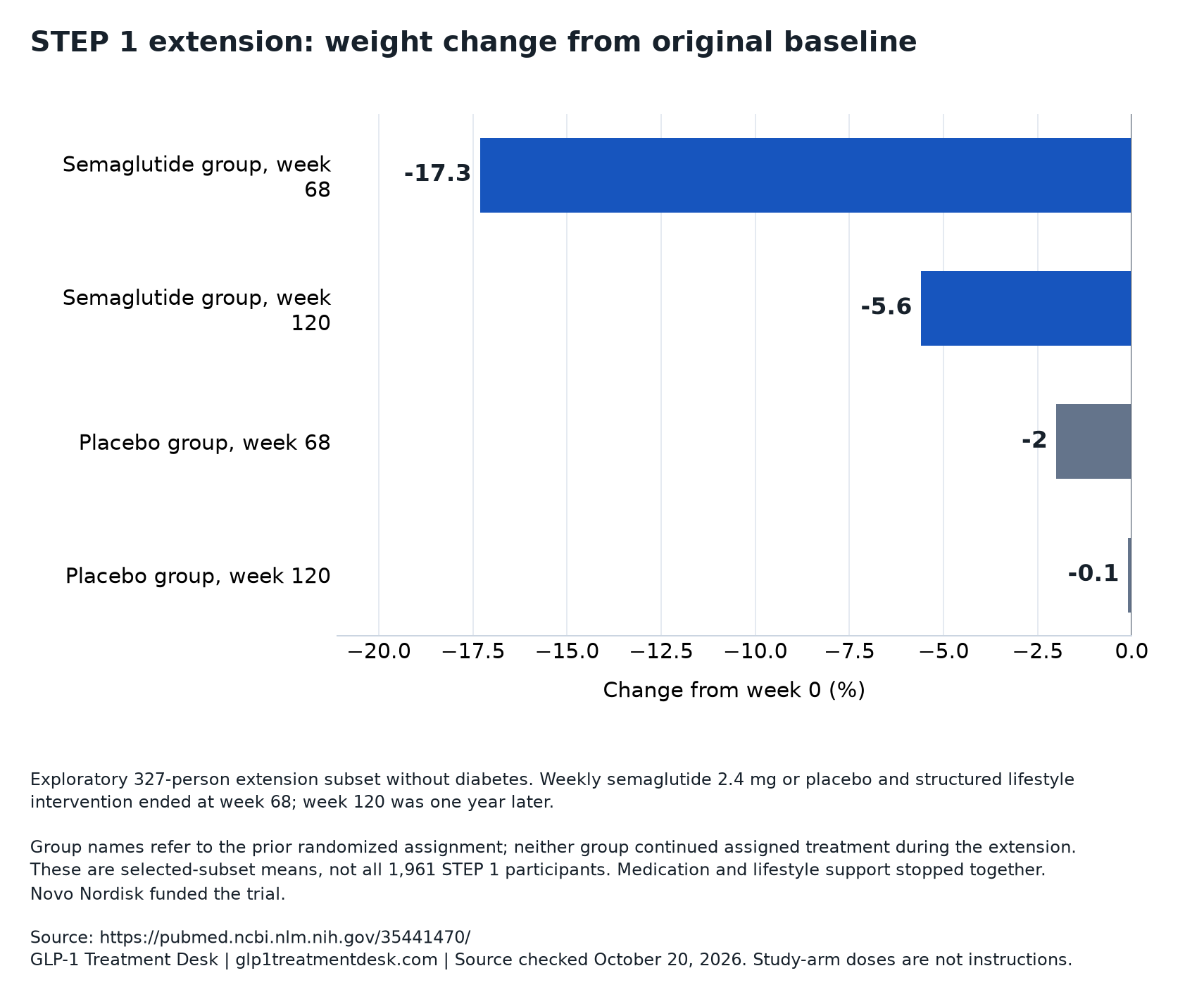
STEP 1 extension: weight change from original baseline
Exploratory 327-person extension subset without diabetes. Weekly semaglutide 2.4 mg or placebo and structured lifestyle intervention ended at week 68; week 120 was one year later.
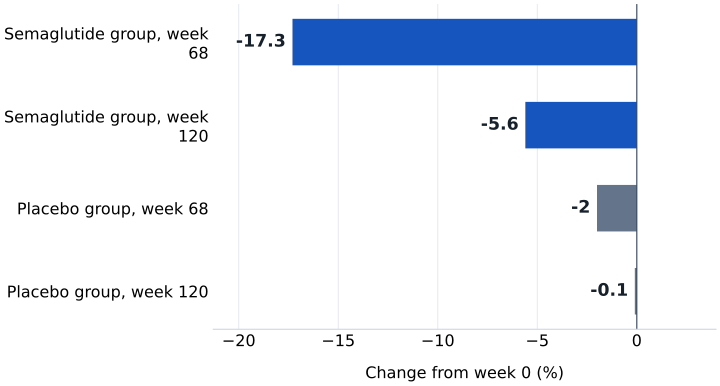
| Study group | Change from week 0 (%) |
|---|---|
| Semaglutide group, week 68 | -17.3 |
| Semaglutide group, week 120 | -5.6 |
| Placebo group, week 68 | -2 |
| Placebo group, week 120 | -0.1 |
Group names refer to the prior randomized assignment; neither group continued assigned treatment during the extension. These are selected-subset means, not all 1,961 STEP 1 participants. Medication and lifestyle support stopped together. Novo Nordisk funded the trial.
Original visualization of published aggregate data. No individual prediction or provider performance is represented. Original research ↗
Medication and structured support stopped at the same time
At week 68, participants stopped study medication and the trial’s structured lifestyle intervention. Follow-up continued to week 120, providing 52 weeks of off-treatment observation. The structured intervention had included regular diet and physical activity counseling. Its withdrawal did not mean participants necessarily abandoned every behavior they had adopted, but it removed an organized source of support at the same time that medication ended.
This simultaneous change limits causal separation. The extension cannot calculate how much regain resulted from medication withdrawal alone, withdrawal of counseling alone, or their combination. Participation in outside lifestyle interventions was not recorded. Original treatment assignments remained masked until extension completion, but nobody was newly randomized at week 68 to continue semaglutide. Interpretation: continuity includes more than prescription availability. The guide to ongoing support provides a framework for asking what support actually continues, without treating this study as a test of any particular service.
| Feature | Main STEP 1 phase | Off-treatment extension |
|---|---|---|
| Duration | Baseline through week 68 | Week 68 through week 120 |
| Treatment comparison | Randomized semaglutide versus placebo | Observation by original assignment; no continuation randomization |
| Structured lifestyle intervention | Provided in both groups | Discontinued |
| Analysis population | 1,961 originally randomized | 327 qualifying treatment completers |
| Main purpose | Assess weight-loss efficacy | Explore weight and cardiometabolic changes after withdrawal |
Two-thirds regained is a fraction of lost weight
In the extension analysis, the semaglutide group’s average loss during treatment was 17.3% of baseline weight. Over the next year, average regain was 11.6 percentage points on that same baseline-weight scale. Dividing 11.6 by 17.3 gives approximately 0.67, the basis for the two-thirds description. It does not mean participants gained 67% of their starting body weight, and it does not mean two-thirds of participants regained everything.
For an arithmetic illustration—not an individual prediction—consider a baseline weight indexed to 100 units. A 17.3% reduction brings it to 82.7. Regaining 11.6 baseline-weight units brings it near 94.3, still below 100. The report’s separately calculated net mean loss was 5.6%; rounding and differing available observations mean headline averages need not subtract perfectly. The placebo group lost 2.0% during treatment, regained 1.9 percentage points, and finished with a reported net loss of 0.1%.
| Measure | Former semaglutide group | Former placebo group |
|---|---|---|
| Mean loss, baseline to week 68 | 17.3% of baseline weight | 2.0% of baseline weight |
| Mean regain, week 68 to week 120 | 11.6 percentage points of baseline weight | 1.9 percentage points of baseline weight |
| Mean net loss, baseline to week 120 | 5.6% of baseline weight | 0.1% of baseline weight |
| At least 5% below baseline at week 120 | 48.2%: 95 of 197 measured participants | 22.6%: 21 of 93 measured participants |
Average regain coexisted with substantial variation
The average trajectory was not a universal trajectory. The standard deviation of regain in the former semaglutide group was 7.7 percentage points, while the standard deviation of net weight loss at week 120 was 8.9%. A standard deviation describes spread among observations; it is not a confidence interval around the mean. These wide distributions warn against turning the group average into a forecast for one person.
Among participants measured onsite at week 120, 48.2% of the former semaglutide group remained at least 5% below baseline weight. Exploratory analyses also found that participants with larger initial losses tended to regain more afterward yet retain greater net losses. That is compatible with substantial regain and lasting residual loss occurring together. It does not identify a reliable individual predictor. Follow-up ended after one year off treatment, so an apparent slowing of average regain near the end cannot establish a permanent plateau.
Cardiometabolic changes did not all follow one pattern
The extension measured blood pressure, HbA1c, lipids, and C-reactive protein, an inflammatory marker. In the former semaglutide group, mean systolic blood pressure moved from 129 mm Hg at baseline to 121 at week 68 and 131 at week 120. Mean HbA1c, a measure of longer-term blood glucose, moved from 5.7% to 5.2% and then 5.6%. These patterns show that weight regain coincided with loss of some measured improvements, but not an identical reversal in every variable.
Some lipid and inflammatory-marker improvements remained relative to baseline. Among participants with baseline prediabetes, 93.6% in the semaglutide group had normal-range HbA1c at week 68, compared with 43.3% at week 120; corresponding placebo proportions were 41.5% and 34.0%. These are observed categories among participants assessed, not proof of permanent diabetes prevention or a measured mechanism. The extension studied risk markers, not a cardiovascular-event endpoint. The guide to interpreting clinical studies helps distinguish a changing laboratory measure from a demonstrated change in clinical outcomes.
Missing measurements and exploratory analyses shape confidence
Although 312 of 333 extension entrants completed follow-up, only 290 had onsite data at week 120: 197 in the former semaglutide group and 93 in the former placebo group. Another 22 completed final contact by telephone or email. Pandemic-related telephone visits were offered, but self-reported measurements were excluded from analyses. High completion therefore did not mean complete measured outcomes.
Post-withdrawal endpoints were summarized descriptively from observed data, without a formal sample-size power calculation or confirmatory significance testing. The headline regain estimates were reported with standard deviations, not confidence intervals establishing a precise withdrawal effect. Other weight-management medications were permitted, and some participants used them. Excluding these users produced a similar weight pattern, which is reassuring but does not eliminate every observational uncertainty. The sample was 67.0% female and 75.8% White, and diabetes was excluded. Results may not describe early discontinuers, people with diabetes, or populations with different clinical and demographic characteristics equally well.
Randomized withdrawal trials answer a different question
SURMOUNT-4 provides complementary evidence using tirzepatide, not semaglutide. After a 36-week open-label period with weekly subcutaneous tirzepatide at a maximum tolerated 10 or 15 mg, 670 participants were randomized to continue treatment or switch to placebo for 52 weeks. Weight changed by −5.5% versus +14.0% from randomization, an estimated difference of −19.4 percentage points (95% confidence interval, −21.2 to −17.7). Crucially, those changes use week-36 weight as the denominator. The SURMOUNT-4 analysis explains this randomized continuation comparison.
SURMOUNT-MAINTAIN tested another design: after 60 weeks of tirzepatide, 378 participants were randomized to continue the maximum tolerated dose, receive 5 mg, or switch to placebo. Estimated baseline-to-week-112 losses were 21.9%, 16.6%, and 9.9%, respectively; their 95% confidence intervals were 20.3–23.5%, 15.1–18.0%, and 8.8–11.1%. Rescue treatment rules complicate interpretation. This Eli Lilly-funded trial and SURMOUNT-4 reported mostly mild-to-moderate gastrointestinal adverse events. These indexed abstracts support the importance of maintenance research, not a semaglutide tapering recommendation. Nor are they head-to-head comparisons, as discussed in the direct-comparison study guide.
Tolerability and product identity remain separate questions
A withdrawal study cannot establish that continuing medication is risk-free. In the main STEP 1 report, nausea and diarrhea were the most common semaglutide adverse events; they were typically transient and mild to moderate. Gastrointestinal events caused 59 participants receiving semaglutide, or 4.5%, to discontinue, compared with five receiving placebo, or 0.8%. The extension did not systematically collect adverse events, so it cannot provide a comprehensive safety comparison after stopping.
The results also belong to the studied subcutaneous formulation and trial conditions. They do not automatically establish outcomes for oral routes, other formulations, compounded preparations, or particular providers. FDA states that compounded drugs are not approved or reviewed before marketing for safety, effectiveness, or quality, and identifies concerns involving dosing errors and semaglutide salt ingredients. Adverse-event reports alone cannot establish rates or causation. The product, route, and pharmacy guide separates identity checks from assumptions based only on an ingredient name.
Care continuity is a responsibility question, not a trial endpoint
Editorial interpretation: the extension makes continuity worth discussing before an interruption, but it did not study insurance rules, subscription contracts, telehealth platforms, or billing policies. A payment cancellation and a clinical handoff are different events. Useful documentary questions include who retains the treatment history, who receives reports of changing weight or symptoms, and which clinician remains responsible when a program relationship changes. The changing-plans guide explores those responsibilities without prescribing a treatment schedule.
A transferable history would distinguish the actual product and route, treatment exposure, weight trajectory, tolerability, and support received. That mirrors the scientific need to know what changed and when. Readers comparing service documents can use the Ro review to examine stated terms and care responsibilities—not as evidence that a provider offers the studied product or reproduces trial outcomes. The extension supports taking interruption seriously; it does not show that every interruption has the same consequences or that continued medication is the only possible individualized care decision.
Questions & answers
Does two-thirds average regain mean everyone regained most of their weight?
No. Two-thirds describes the ratio of average regained weight to average earlier loss in this selected group. Outcomes varied, and 95 of 197 former semaglutide participants measured onsite at week 120 still weighed at least 5% less than at baseline. Neither statistic establishes what will happen to a particular person.
Can STEP 1 separate stopping semaglutide from losing lifestyle support?
No. Both ended at week 68, and outside lifestyle interventions were not recorded. The extension therefore describes their combined withdrawal context. It did not randomly compare stopping medication while retaining counseling with stopping both, so it cannot assign a numerical share of regain to either change.
Does this prove semaglutide must be used indefinitely?
No. Substantial average regain supports the importance of long-term management, but one year of observational follow-up cannot establish lifelong necessity for everyone. The study did not test every maintenance approach, define an optimal duration, or determine which individuals could sustain a particular outcome after stopping.
Why is the extension’s 17.3% loss different from STEP 1’s 14.9%?
The 17.3% figure describes the selected extension group that completed treatment; 14.9% is the main trial’s estimated semaglutide-group change under an analysis covering randomized participants regardless of discontinuation or rescue intervention. Different populations and analysis approaches answer different questions. The extension figure should not replace the main efficacy estimate.
Do tirzepatide maintenance results explain how to reduce semaglutide?
No. SURMOUNT-MAINTAIN studied specific tirzepatide arms after a tirzepatide weight-loss period, with rescue rules and a defined statistical approach. It did not test semaglutide dose reduction. Its findings inform maintenance science but cannot be converted into a semaglutide tapering plan or applied automatically to another formulation.
Our assessment
The strongest reading of the STEP 1 extension is that substantial weight regain and erosion of several cardiometabolic improvements were common after semaglutide and structured lifestyle support ended in selected treatment completers. Residual average loss and considerable individual variation were also real findings. Together, these results support planning for ongoing clinical responsibility and acknowledging obesity’s long-term management needs. They do not establish inevitable complete regain, lifelong medication for every person, or a tested stopping strategy.
Sources & documentation
Scientific and official sources consulted October 20, 2026. Study findings apply to the populations, products and time periods described; they are not provider outcome data.
- Once-Weekly Semaglutide in Adults with Overweight or Obesity. ↗
- Weight regain and cardiometabolic effects after withdrawal of semaglutide: The STEP 1 trial extension. ↗
- Continued Treatment With Tirzepatide for Maintenance of Weight Reduction in Adults With Obesity: The SURMOUNT-4 Randomized Clinical Trial. ↗
- Tirzepatide for maintenance of bodyweight reduction in people with obesity in the USA (SURMOUNT-MAINTAIN): a multicentre, double-blind, randomised, placebo-controlled trial. ↗
- FDA concerns about unapproved GLP-1 drugs ↗