SURMOUNT-5 answered an important question more directly than separate placebo-controlled studies could: how do injectable tirzepatide and injectable semaglutide compare when randomly assigned within the same obesity trial? Among 751 adults with obesity but without type 2 diabetes, the reported average weight reduction at 72 weeks was greater with tirzepatide. That is meaningful comparative evidence, but it is not a ranking of every possible benefit, every safety outcome, or the services that deliver treatment.
The practical value lies in reading the result at the right level. The study compared maximum tolerated injectable regimens, measured specific outcomes, and followed participants for a defined period. This analysis uses the indexed primary report abstracts and available official FDA material; it does not reflect examination of full protocols, supplements, or full trial articles. Those boundaries matter when interpreting statistical estimates, tolerability, and questions about who remains responsible for care.
At a glance
- Direct randomized comparison
- SURMOUNT-5 randomized 751 adults with obesity but without type 2 diabetes, in a 1:1 ratio, to tirzepatide or semaglutide in an open-label phase 3b trial.Sources: [1]
- Regimens studied
- Participants received once-weekly subcutaneous maximum tolerated tirzepatide, 10 or 15 mg, or semaglutide, 1.7 or 2.4 mg, for 72 weeks. These doses identify trial arms, not treatment instructions.Sources: [1]
- Primary weight result
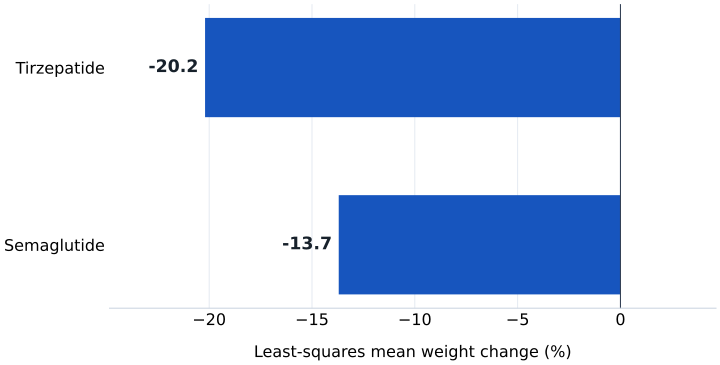
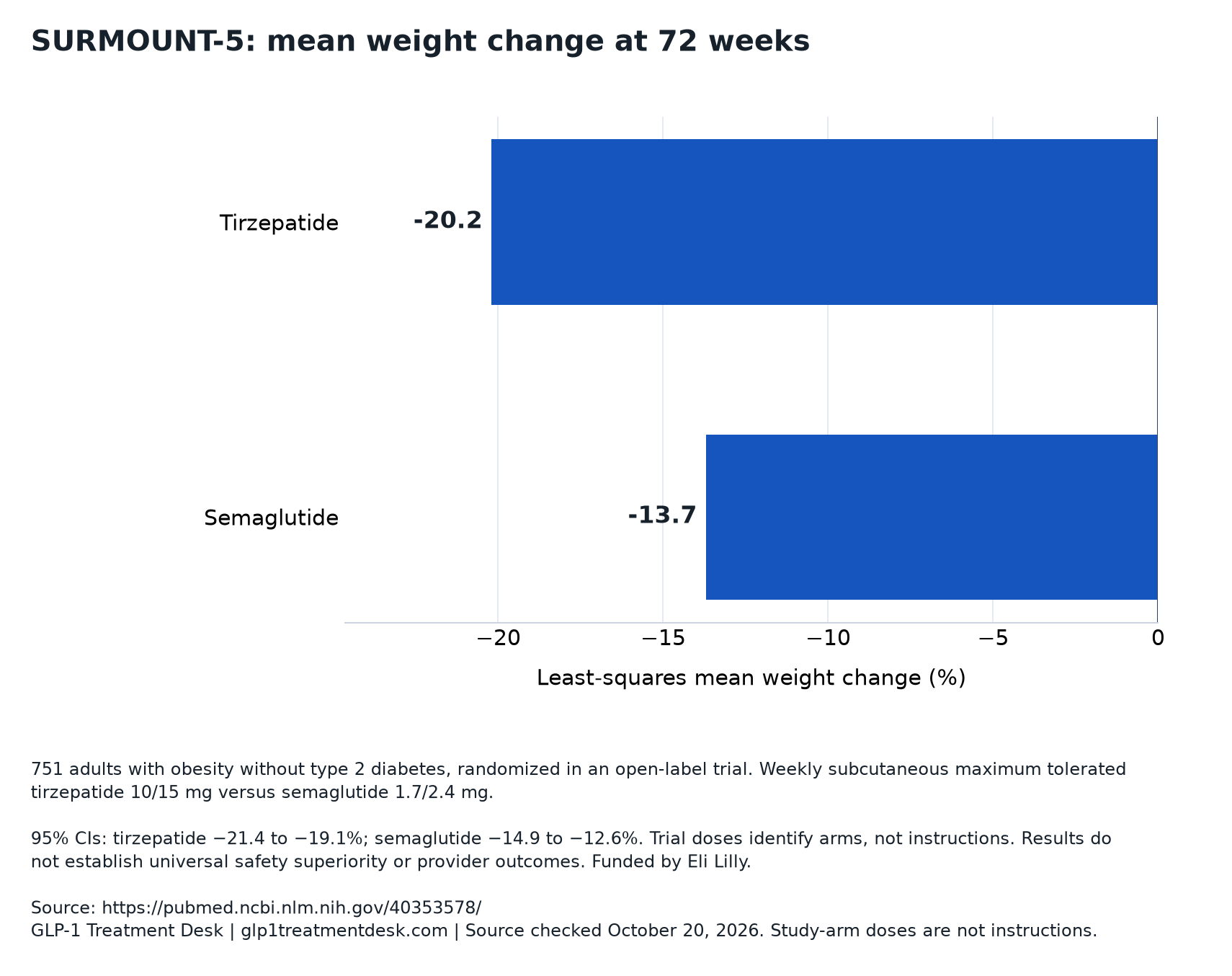
- Least-squares mean weight change was −20.2% with tirzepatide versus −13.7% with semaglutide, a 6.5-percentage-point separation between reported estimates.Sources: [1]
- Waist result
- Least-squares mean waist change was −18.4 cm with tirzepatide and −13.0 cm with semaglutide at week 72.Sources: [1]
- Safety and sponsorship
- Gastrointestinal events were most common in both groups, usually mild to moderate and primarily during dose escalation. Eli Lilly funded the trial.Sources: [1]
Randomization makes this more than a comparison of two headlines
SURMOUNT-5 was a phase 3b controlled trial: participants were randomly assigned to one of two active treatments rather than choosing their medication. The 1:1 allocation created groups intended to be comparable at the start. Randomization reduces systematic differences that might otherwise influence weight change, such as one treatment being selected more often by people with different clinical histories.
The population was adults with obesity without type 2 diabetes. That definition is central to the conclusion, not a footnote. The indexed abstract does not provide the full age distribution, detailed baseline characteristics, or all eligibility restrictions. It therefore supports a conclusion about the enrolled population, not an assumption that the same numerical advantage applies to everyone seeking obesity treatment.
Because both groups were studied within one trial, the comparison shares an outcome definition and a 72-week observation period. This is stronger evidence for relative weight efficacy than placing results from unrelated studies side by side. It does not remove uncertainty about populations or circumstances that the trial did not examine.
Open-label treatment changes how the evidence should be read
Open-label means that treatment assignment was not concealed from participants and investigators. This differs from a double-blind trial, in which those groups generally do not know which assigned intervention a participant receives. Knowledge of treatment can influence expectations, symptom reporting, adherence, and behavior, even when an outcome is measured rather than simply reported.
Body weight is less dependent on personal judgment than an outcome such as perceived well-being. That makes the weight finding informative, but it does not make the trial immune to open-label effects. The abstract cannot establish whether awareness of assignment changed engagement, discontinuation, or other behaviors, or how much any such changes contributed to the result.
Randomization and blinding address different problems. Randomization helps balance starting characteristics; blinding limits influences arising after assignment. The appropriate interpretation is neither that open-label design invalidates the findings nor that randomization eliminates all possible bias. SURMOUNT-5 provides a direct randomized comparison with a clearly identified design limitation.
STUDY DATA · GLP-1 Treatment Desk
SURMOUNT-5: mean weight change at 72 weeks
751 adults with obesity without type 2 diabetes, randomized in an open-label trial. Weekly subcutaneous maximum tolerated tirzepatide 10/15 mg versus semaglutide 1.7/2.4 mg.
| Study group | Least-squares mean weight change (%) |
|---|---|
| Tirzepatide | -20.2 |
| Semaglutide | -13.7 |
95% CIs: tirzepatide −21.4 to −19.1%; semaglutide −14.9 to −12.6%. Trial doses identify arms, not instructions. Results do not establish universal safety superiority or provider outcomes. Funded by Eli Lilly.
Original visualization of published aggregate data. No individual prediction or provider performance is represented. Original research ↗
Maximum tolerated regimens are not fixed-dose equivalence tests
The trial compared once-weekly injections under the skin. Tirzepatide participants received a maximum tolerated dose of 10 or 15 mg; semaglutide participants received 1.7 or 2.4 mg. These are descriptions of the experimental regimens, not directions for starting, escalating, or switching medication.
This design asks how the two treatment strategies perform when participants use the specified maximum tolerated options. It does not establish a milligram-for-milligram comparison: milligrams measure drug mass, not equivalent biological activity across different medicines. Nor does it isolate the contribution of each possible maintenance dose within a treatment group.
The abstract does not report how many participants finished at each dose or provide dose-specific head-to-head estimates. A reader therefore cannot use its overall result to predict the outcome at one particular dose. The product and route verification guide helps frame a separate practical question: whether the formulation being discussed actually matches the route and product context of the evidence.
What the 6.5-percentage-point difference means
The primary endpoint was percentage change in body weight from baseline to week 72. The reported least-squares means were −20.2% for tirzepatide and −13.7% for semaglutide. A least-squares mean is a statistical model’s estimated group average, rather than necessarily the simple arithmetic average of everyone’s observed weight change.
Subtracting the two reported estimates gives 6.5 percentage points more weight reduction with tirzepatide. That is not a 6.5% relative improvement. For illustration only, applying those percentages to the same hypothetical starting weight of 100 kg gives reductions of 20.2 kg and 13.7 kg. This arithmetic explains the scale of the comparison; it does not predict an individual’s outcome.
The abstract reports P<0.001 for the weight comparison. That supports evidence of a between-group difference under the statistical analysis, but it does not measure the probability that a particular person will do better with one drug. The size and uncertainty of the estimates remain more informative than the significance threshold alone.
| Measure | Tirzepatide | Semaglutide |
|---|---|---|
| Least-squares mean weight change | −20.2%; 95% CI −21.4 to −19.1 | −13.7%; 95% CI −14.9 to −12.6 |
| Least-squares mean waist change | −18.4 cm; 95% CI −19.6 to −17.2 | −13.0 cm; 95% CI −14.3 to −11.7 |
| Weight-loss thresholds assessed | At least 10%, 15%, 20%, and 25%; more likely than with semaglutide | Same thresholds; exact proportions not supplied in the abstract |
Confidence intervals do not describe everyone’s likely response
The 95% confidence interval for the tirzepatide weight estimate was −21.4% to −19.1%; for semaglutide it was −14.9% to −12.6%. These intervals express statistical uncertainty around estimated group means. They are not ranges containing 95% of participants’ weight changes, and they do not show how widely individual responses varied.
The reported abstract gives confidence intervals for each treatment estimate, but not a confidence interval for the between-group difference itself. It would be inappropriate to manufacture that interval by subtracting endpoints. Although the treatment estimates are clearly separated, a formal interval for their contrast requires the relevant model information.
Participants assigned tirzepatide were also more likely to reach each prespecified weight-loss threshold: at least 10%, 15%, 20%, and 25%. This adds information beyond an average because it examines different levels of response. However, the abstract supplies no exact proportions for those comparisons, so it cannot support absolute responder differences or a number needed to treat.
Waist change strengthens the finding without proving other outcomes
Waist circumference was a key secondary endpoint. The estimated reduction was 18.4 cm with tirzepatide versus 13.0 cm with semaglutide, a 5.4-cm separation between reported estimates. The respective 95% confidence intervals were −19.6 to −17.2 cm and −14.3 to −11.7 cm, with P<0.001 for the comparison.
Agreement between weight and waist outcomes supports the conclusion that the treatment groups differed in more than one measured dimension of body size. But a waist measurement does not directly quantify visceral fat, muscle mass, strength, or physical function. Nor does the abstract establish whether the extra waist reduction caused improvements in any clinical event.
This distinction matters when comparing scientific questions. An outcomes trial such as SELECT’s cardiovascular study asks about major clinical events, not simply a change on the scale. Likewise, the separate question examined in randomized withdrawal and maintenance research should not be treated as answered by a 72-week active-treatment comparison.
Tolerability is a real result, not a universal safety ranking
The most common adverse events in both SURMOUNT-5 groups were gastrointestinal. Most were mild to moderate and occurred primarily during dose escalation. Those findings identify a clinically relevant pattern, but mild or moderate does not mean inconsequential: symptoms can still affect daily activities and willingness to continue treatment.
The abstract does not provide detailed comparative rates for individual symptoms, serious adverse events, or adverse-event discontinuation. It therefore cannot establish that one regimen is universally safer. A larger average weight reduction and a better overall safety profile are different claims requiring different evidence.
Other trials illustrate why adverse-effect details matter without supplying a substitute head-to-head estimate. In STEP 1, gastrointestinal events caused discontinuation in 4.5% with semaglutide versus 0.8% with placebo. In SURMOUNT-1, adverse events caused discontinuation in 4.3%, 7.1%, and 6.2% across tirzepatide doses, versus 2.6% with placebo. Different designs prevent a reliable safety ranking from these percentages. The follow-up and tolerability guide addresses the separate responsibility question: who receives and responds to concerns?
Earlier placebo trials provide context, not a replacement comparison
STEP 1 randomized 1,961 adults without diabetes to semaglutide or placebo for 68 weeks, alongside lifestyle intervention. Weight change was −14.9% versus −2.4%, with a reported estimated difference of −12.4 percentage points and 95% CI −13.4 to −11.5. Novo Nordisk funded that double-blind trial.
SURMOUNT-1 randomized 2,539 adults without diabetes to three tirzepatide doses or placebo for 72 weeks, including 20 weeks of escalation. Mean weight changes were −15.0%, −19.5%, and −20.9% at 5, 10, and 15 mg, versus −3.1% with placebo. Eli Lilly supported the trial. These findings established efficacy against placebo rather than against semaglutide.
It is tempting to subtract the best-looking number from each older trial. That approach mixes different participants, follow-up periods, dosing designs, and analyses. Both older abstracts explicitly describe treatment-effect approaches that account for discontinuation; the SURMOUNT-5 abstract gives less methodological detail. Its direct randomized comparison is therefore the more relevant evidence for the specific head-to-head question.
| Trial | Comparison and follow-up | Main question relevant here |
|---|---|---|
| SURMOUNT-5 | Tirzepatide versus semaglutide; 72 weeks | Which assigned injectable regimen produced greater weight reduction? |
| STEP 1 | Semaglutide versus placebo; 68 weeks | Did semaglutide improve weight outcomes beyond placebo plus lifestyle intervention? |
| SURMOUNT-1 | Three tirzepatide doses versus placebo; 72 weeks | Did tirzepatide improve weight outcomes across studied doses? |
| SELECT | Semaglutide versus placebo; mean follow-up 39.8 months | Were major cardiovascular events reduced in people with established cardiovascular disease? |
Greater weight loss does not settle the cardiovascular comparison
SELECT enrolled 17,604 people aged 45 or older with established cardiovascular disease, BMI of at least 27, and no history of diabetes. It compared weekly injectable semaglutide 2.4 mg with placebo. Its primary endpoint combined cardiovascular death, nonfatal heart attack, and nonfatal stroke, analyzed as time to a first event.
Over mean follow-up of 39.8 months, the endpoint occurred in 6.5% of semaglutide participants and 8.0% of placebo participants. The hazard ratio was 0.80, with 95% CI 0.72 to 0.90. That indicates a lower event hazard over follow-up, not a 20-percentage-point reduction in event probability. The observed proportions differed by 1.5 percentage points.
A lower composite endpoint does not prove that every component improved individually. SELECT also reported adverse events leading to permanent treatment discontinuation in 16.6% versus 8.2%. Funded by Novo Nordisk, it neither compared semaglutide with tirzepatide nor established that SURMOUNT-5’s weight advantage translates into a cardiovascular advantage. These results inform different parts of a clinical discussion.
Translating trial evidence into continuity questions
The unresolved scientific questions include comparative outcomes beyond 72 weeks, detailed tolerability differences, and how results vary across clinical histories. The abstract also leaves important implementation details unreported. Averages cannot establish who will tolerate a regimen, what happens during an interruption, or the comparative consequences of changing treatment.
Editorial interpretation: a useful care discussion separates the evidence for a medicine from responsibility for reviewing history, responding to symptoms, documenting decisions, and transferring records. The care journey guide maps those responsibilities. For a service-specific document check, the Ro review can help readers examine stated terms; the trial does not validate that provider, its services, or its outcomes.
The formulation boundary is equally important. These injectable trial findings do not establish effectiveness for oral routes or equivalence for compounded preparations. FDA states that compounded drugs are not approved or reviewed before marketing for safety, effectiveness, or quality, and identifies dosing errors and semaglutide salt concerns. Such reports alone cannot establish event rates or causation. Neither a shared ingredient name nor a service contract recreates the tested intervention.
Questions & answers
Does SURMOUNT-5 mean everyone will lose more weight with tirzepatide?
No. It establishes a difference between estimated group averages in the enrolled population, not a guaranteed ordering for each person. Individual response distributions are not provided in the abstract. Tirzepatide also performed better at the reported weight-loss thresholds, but exact response proportions were not available there.
Why did the investigators use maximum tolerated doses?
The design compares two regimens that allow specified dose options according to tolerability rather than requiring one fixed final dose for everyone. That makes tolerability part of the strategy being evaluated. The abstract does not provide enough dose-level detail to determine how each allowed dose contributed to the overall difference.
Can the study tell someone which medication to switch to?
Not by itself. The reported comparison concerns randomized assignment to the studied regimens, not a dedicated trial of switching between them. It does not provide switching instructions or establish outcomes after a particular treatment history. Clinical history, prior response, and tolerability remain distinct from the average comparative efficacy result.
Does a 72-week result show that the difference will persist indefinitely?
No. It identifies the difference at the prespecified endpoint during the study period. The abstract does not establish a lifetime trajectory, outcomes after treatment ends, or whether the between-group gap widens or narrows later. Longer-term comparative follow-up would be needed to answer those questions directly.
Can a compounded or oral product claim the same results?
These trials do not establish that claim. SURMOUNT-5 tested specified once-weekly subcutaneous regimens. FDA notes that compounded products are not FDA approved and are not reviewed before marketing for safety, effectiveness, or quality. Evidence for the studied injections does not automatically transfer to another formulation, route, or preparation.
Our assessment
SURMOUNT-5 provides direct randomized evidence that the studied tirzepatide regimen produced greater average weight and waist reductions than the studied semaglutide regimen over 72 weeks in adults with obesity without type 2 diabetes. Its strength is the shared trial comparison; its boundaries include open-label treatment, limited detail in the indexed abstract, and endpoints that do not resolve every health outcome. Editorial interpretation: the most useful next step is not a provider ranking, but a clear distinction between expected benefits, tolerability uncertainty, the actual formulation, and responsibility for ongoing care.
Sources & documentation
Scientific and official sources consulted October 20, 2026. Study findings apply to the populations, products and time periods described; they are not provider outcome data.
- Tirzepatide as Compared with Semaglutide for the Treatment of Obesity. ↗
- FDA concerns about unapproved GLP-1 drugs ↗
- Semaglutide and Cardiovascular Outcomes in Obesity without Diabetes. ↗
- Once-Weekly Semaglutide in Adults with Overweight or Obesity. ↗
- Tirzepatide Once Weekly for the Treatment of Obesity. ↗