SELECT asked a question that a weight-loss measurement cannot answer: could semaglutide reduce serious cardiovascular events in adults with overweight or obesity who already had cardiovascular disease but did not have diabetes? Among 17,604 participants, the answer favored semaglutide over placebo. The result concerned cardiovascular death, nonfatal heart attack, or nonfatal stroke—not simply a change on the scale.
The finding also raises practical questions about continuity: whose medical history resembles the trial population, who reviews treatment-related problems, and how responsibility follows a person across care settings. This analysis uses the indexed primary report abstracts and available official FDA material, rather than a review of all trial protocols, supplements, or full texts. The central task is to separate what SELECT established from what its headline cannot establish.
At a glance
- Population
- SELECT enrolled 17,604 adults aged 45 or older with established cardiovascular disease, BMI of at least 27, and no history of diabetes.Sources: [1]
- Comparison
- Participants received once-weekly subcutaneous semaglutide in a 2.4-mg study arm or placebo; both groups received standard cardiovascular care and lifestyle counseling.
- Primary cardiovascular result
- The composite occurred in 6.5% versus 8.0%; the hazard ratio was 0.80, with a 95% confidence interval of 0.72–0.90.Sources: [1]
- Observation period
- Mean follow-up was 39.8 months, while mean exposure to assigned semaglutide or placebo was 34.2 months.Sources: [1]
- Treatment discontinuation
- Adverse events led to permanent trial-product discontinuation in 16.6% of semaglutide participants versus 8.2% of placebo participants.Sources: [1]
Established cardiovascular disease defined the question
SELECT was a secondary-prevention trial: participants already had cardiovascular disease, and investigators tested whether treatment could reduce subsequent major events. Eligibility also required age of at least 45 years and a body-mass index, or BMI, of at least 27. BMI expresses weight relative to height; it was an entry criterion here, not the cardiovascular outcome.
The absence of a diabetes history was especially important. SELECT directly addressed cardiovascular outcomes in a population without diabetes, rather than assuming that findings from diabetes trials would transfer. It did not, however, enroll an unrestricted population of people seeking weight management. Established cardiovascular disease remained a defining feature.
That distinction limits primary-prevention claims. The trial does not establish the same benefit for someone who has risk factors but no established cardiovascular disease. For a care discussion, documenting the relevant clinical history matters more than matching a headline about body weight. The first-consultation guide offers a framework for organizing that history without treating trial eligibility as an individualized treatment recommendation.
Randomization tested an addition to cardiovascular care
Investigators randomly assigned 8,803 participants to semaglutide and 8,801 to placebo in a multicenter, double-blind trial. Randomization helps balance measured and unmeasured baseline characteristics across groups. Blinding limits the influence of knowing the assignment on behavior and evaluation. Together, these features make the comparison more informative about treatment effects than an observational comparison of people who independently chose different treatments.
The active study arm used semaglutide injected under the skin once weekly at a 2.4-mg dose. These details identify the tested intervention; they are not dosing instructions. Placebo was the comparator, but neither group was a no-care group. The FDA announcement states that both received standard cardiovascular care and lifestyle counseling.
Consequently, the result supports an additional benefit in that treatment context, not substitution for existing cardiovascular care. The trial was event-driven and designed to test superiority: whether the active strategy performed better than placebo on its specified endpoint. Novo Nordisk funded SELECT. Sponsorship is relevant context, while randomization, endpoint definition, and completeness of reporting remain central to interpreting the evidence.
STUDY DATA · GLP-1 Treatment Desk
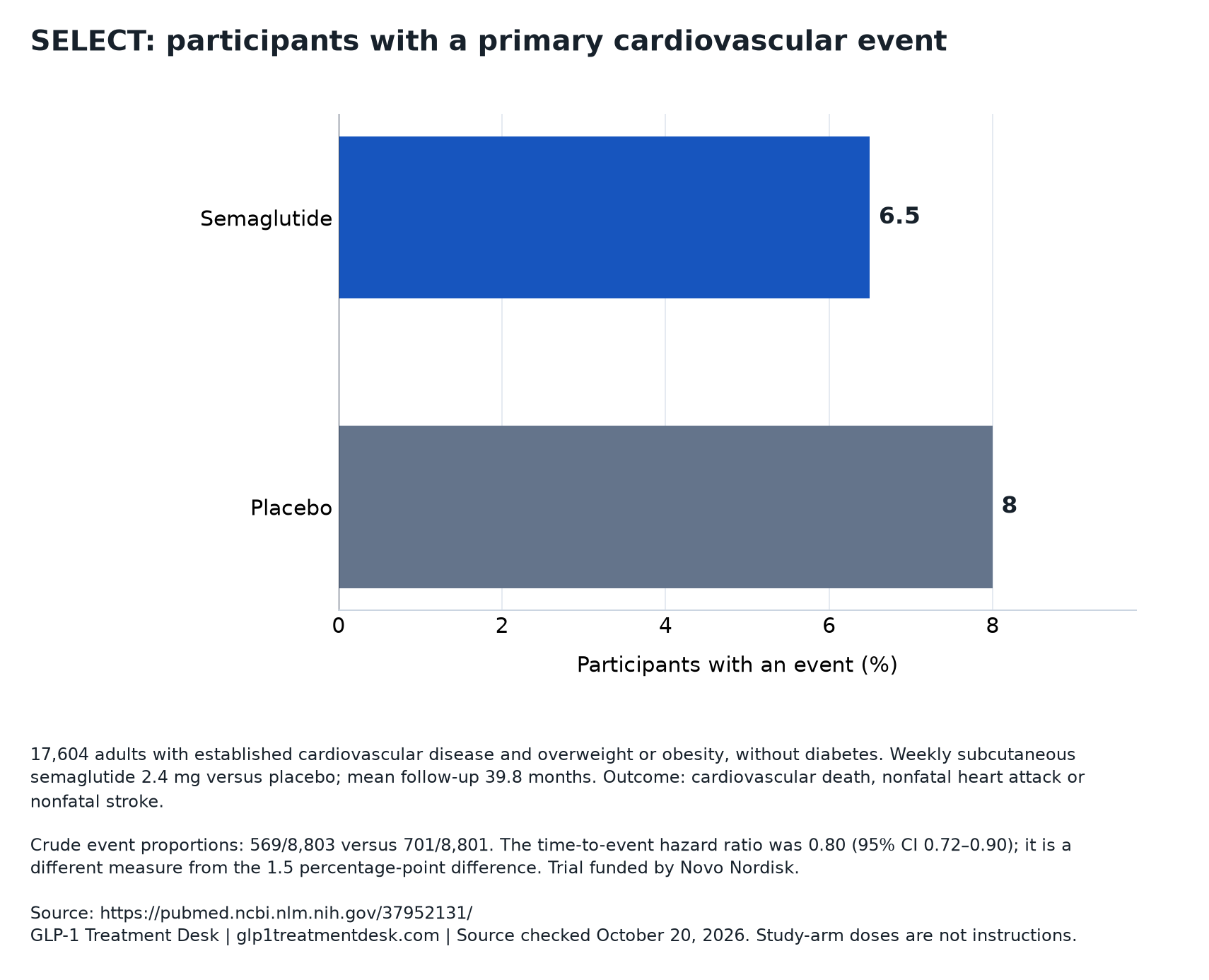
SELECT: participants with a primary cardiovascular event
17,604 adults with established cardiovascular disease and overweight or obesity, without diabetes. Weekly subcutaneous semaglutide 2.4 mg versus placebo; mean follow-up 39.8 months. Outcome: cardiovascular death, nonfatal heart attack or nonfatal stroke.
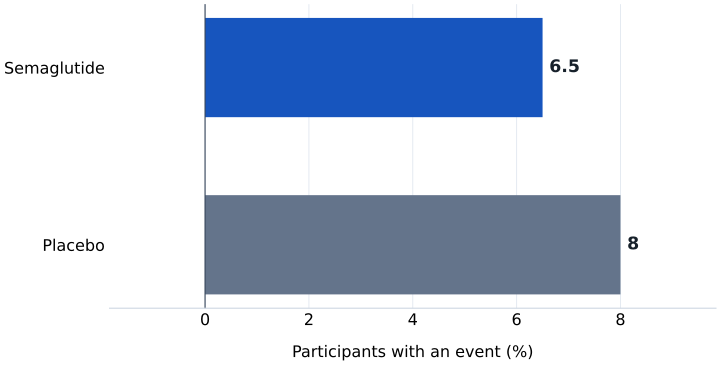
| Study group | Participants with an event (%) |
|---|---|
| Semaglutide | 6.5 |
| Placebo | 8 |
Crude event proportions: 569/8,803 versus 701/8,801. The time-to-event hazard ratio was 0.80 (95% CI 0.72–0.90); it is a different measure from the 1.5 percentage-point difference. Trial funded by Novo Nordisk.
Original visualization of published aggregate data. No individual prediction or provider performance is represented. Original research ↗
Three outcomes formed one primary endpoint
The primary endpoint combined death from cardiovascular causes, nonfatal myocardial infarction—commonly called heart attack—and nonfatal stroke. A composite endpoint treats any qualifying component as an event for the main analysis. Combining outcomes can make a trial more efficient, but it also means the headline answers a combined question rather than three independent questions.
SELECT used a time-to-first-event analysis. This considers when a participant first experiences a qualifying outcome. It does not describe the full burden of repeated events after that first event, nor does it assign equal real-world consequences to a nonfatal event and death. Those distinctions matter when translating a statistical endpoint into an understanding of illness.
The indexed abstract reports the overall composite result but does not supply individual component estimates. It therefore cannot show from this evidence alone that cardiovascular death, nonfatal heart attack, and nonfatal stroke each fell separately. A lower composite hazard can coexist with different effects across components. Reading the endpoint literally prevents a broad claim from becoming several unsupported narrower claims.
The 20% figure and the 1.5-point difference answer different questions
A first primary-endpoint event occurred in 569 semaglutide participants and 701 placebo participants, reported as 6.5% and 8.0%. Subtracting those rounded percentages gives a crude difference of 1.5 percentage points. In plain numerical terms, the observed proportions differed by approximately 15 participants per 1,000 over the trial’s follow-up—not 15% of participants.
The hazard ratio was 0.80. Subtracting 0.80 from 1 yields the commonly reported 20% relative hazard reduction. A hazard compares event occurrence over time among participants who have not yet experienced the endpoint. It is not the same calculation as subtracting the final event percentages, and the crude 1.5-point difference should not be described as a hazard reduction.
Using the rounded proportions, dividing 1.5 by 8.0 gives about a 19% relative difference in crude event proportions. Its proximity to 20% does not make the measures interchangeable: the hazard analysis incorporates event timing, whereas the simple proportion calculation does not. Nor should these group-level numbers be converted into a personal guarantee or a fixed annual benefit.
| Measure | Reported result or calculation | What it describes |
|---|---|---|
| Observed event proportions | 569/8,803 (6.5%) versus 701/8,801 (8.0%) | Participants with a first qualifying event during follow-up |
| Crude absolute difference | 8.0% − 6.5% = 1.5 percentage points | Difference between the rounded observed proportions |
| Hazard ratio | 0.80; 95% CI, 0.72–0.90 | Relative event occurrence over time in the time-to-first-event analysis |
| Relative hazard reduction | 1 − 0.80 = 20% | Relative reduction derived from the hazard ratio, not an absolute percentage-point difference |
Baseline risk and confidence intervals shape the meaning
The placebo group’s 8.0% observed event proportion anchors the absolute result to this population and follow-up. It reflects outcomes among people with established cardiovascular disease receiving background care, not the untreated natural history of obesity. People with different clinical histories may have different underlying event risks, so their absolute benefit cannot simply be read from SELECT’s percentages.
The hazard ratio’s 95% confidence interval extended from 0.72 to 0.90. Expressed on the relative-hazard-reduction scale, those bounds correspond to approximately 28% to 10% lower hazard. The interval excludes 1.0, the value representing equal hazards, and the report gave P<0.001. This supports a statistically clear group difference, while leaving uncertainty about its precise size.
That interval does not describe how much benefit every participant received. It also cannot identify which individual avoided an event because of treatment. An important unresolved question is how effects vary across clinically distinct groups; the indexed abstract does not provide subgroup estimates. Assuming that every age, disease history, or baseline-risk category had the same result would go beyond the accessible report.
Nearly 40 months of follow-up is not uninterrupted exposure
Mean follow-up was 39.8 months, with a standard deviation of 9.4 months. Mean exposure to assigned semaglutide or placebo was shorter: 34.2 months, with a standard deviation of 13.7 months. Follow-up describes the observation period; exposure describes time receiving trial product. The two clocks should not be collapsed into a claim that everyone took treatment continuously for about 40 months.
The difference between the means also cannot reveal precisely why or when each participant stopped treatment. The abstract does not provide a complete account of interruptions, adherence, or treatment after discontinuation. It reports a cardiovascular comparison across the trial period, not an experiment specifically designed to determine the effects of stopping and restarting.
This matters for continuity. SELECT does not establish a minimum effective duration, how long protection persists after stopping, or what happens during coverage interruptions. Editorial interpretation: a practical care arrangement should make responsibility for treatment questions and handoffs explicit. The guide to changing programs addresses those responsibilities, but contractual continuity itself was not an intervention tested in SELECT.
Discontinuation was a substantial tolerability finding
Adverse events leading to permanent discontinuation of the trial product occurred in 1,461 semaglutide participants, or 16.6%, compared with 718 placebo participants, or 8.2%. The absolute difference was 8.4 percentage points. Thus, the cardiovascular benefit appeared alongside a materially higher frequency of treatment cessation attributed to adverse events.
This measure is neither the rate of all adverse events nor the rate of serious adverse events. It captures events consequential enough to lead to permanent discontinuation. The indexed SELECT abstract does not give the full breakdown of causes, so it cannot support a detailed symptom profile or a comprehensive safety inventory. A blanket description of the treatment as safe would obscure this reported finding.
The 8.4-point discontinuation difference should not be subtracted from the 1.5-point cardiovascular difference to create a net-benefit score. These are different outcomes with different consequences. Editorial interpretation: care arrangements should identify who receives adverse-effect reports and who makes clinical decisions when tolerability becomes a problem. The follow-up and tolerability guide helps frame those responsibilities without prescribing a monitoring schedule.
FLOW and SUMMIT answer neighboring, not identical, questions
FLOW studied 3,533 people with type 2 diabetes and chronic kidney disease, using weekly subcutaneous semaglutide in a 1.0-mg arm versus placebo. Its primary composite combined major kidney outcomes with kidney-related or cardiovascular death. Over a median 3.4 years, first events numbered 331 versus 410, with a hazard ratio of 0.76 (95% CI, 0.66–0.88). The FLOW analysis explains why that kidney-focused population differs from SELECT.
SUMMIT instead tested tirzepatide, up to 15 mg injected weekly, in 731 people with obesity and heart failure with preserved ejection fraction. Median follow-up was 104 weeks. Cardiovascular death or worsening heart failure occurred in 9.9% versus 15.3%, with a hazard ratio of 0.62 (95% CI, 0.41–0.95). Its other primary endpoint assessed health status. The SUMMIT analysis examines this different composite.
SUMMIT also illustrates why components matter: worsening heart-failure events favored tirzepatide, but cardiovascular deaths numbered eight versus five, with a highly uncertain hazard ratio of 1.58 (95% CI, 0.52–4.83). Adverse-event discontinuation was 6.3% versus 1.4%, mainly gastrointestinal. FLOW reported serious adverse events in 49.6% versus 53.8%. Different populations, endpoints, and safety measures prevent these trials from becoming a ranking of products.
| Trial and population | Intervention versus placebo | Main outcome focus |
|---|---|---|
| SELECT: established cardiovascular disease, BMI ≥27, no diabetes history | Weekly subcutaneous semaglutide, 2.4-mg study arm | Cardiovascular death, nonfatal heart attack, or nonfatal stroke |
| FLOW: type 2 diabetes and chronic kidney disease | Weekly subcutaneous semaglutide, 1.0-mg study arm | Major kidney events or kidney-related/cardiovascular death |
| SUMMIT: obesity and heart failure with ejection fraction ≥50% | Weekly subcutaneous tirzepatide, up to 15 mg | Cardiovascular death/worsening heart failure and change in health status |
The evidence attaches to a studied formulation and context
On March 8, 2024, FDA announced a cardiovascular indication for Wegovy injection to reduce cardiovascular death, heart attack, and stroke risk in adults with cardiovascular disease and overweight or obesity, alongside reduced-calorie diet and increased physical activity. That announcement documents a regulatory action; it is not a substitute for current complete prescribing information.
SELECT tested an injectable intervention. It did not establish equivalent cardiovascular outcomes for oral semaglutide, other formulations, or compounded preparations. An ingredient name alone does not demonstrate that a different product delivers the same clinical result. Likewise, a trial result cannot be assigned to a particular provider or platform simply because that business discusses GLP-1 treatment.
FDA states that compounded drugs are not approved or reviewed before marketing for safety, effectiveness, or quality, and identifies concerns including dosing errors and semaglutide salt ingredients. Such reports do not establish event rates or causation. The formulation-check guide helps separate product, route, and pharmacy questions—distinctions that preserve rather than diminish the specificity of SELECT’s evidence.
Continuity questions should follow the clinical evidence
SELECT’s long observation period and discontinuation findings make ongoing care relevant, but they do not prove that any particular service model improves cardiovascular outcomes. The study did not randomize participants to subscription plans, telehealth companies, pharmacy arrangements, or insurance pathways. Claims about those systems require evidence separate from the drug trial.
Editorial interpretation: useful continuity questions include who confirms the cardiovascular history, who maintains the medication record, who reviews tolerability concerns, and who assumes responsibility during a handoff. These questions connect the trial’s population and safety findings to care organization without inventing required tests, appointment intervals, or treatment rules.
For documentary comparisons, the Ro review and Mochi Health review can be used to check stated terms and responsibilities. Those links do not establish that either provider offers the studied product or condition-specific care. Cost and contract language may affect access arrangements, but SELECT did not measure those arrangements, their costs, or their effects on treatment continuity.
Questions & answers
Does SELECT show that semaglutide prevents a first cardiovascular event in anyone with obesity?
No. Participants already had cardiovascular disease, were at least 45 years old, had BMI of at least 27, and had no history of diabetes. The trial supports secondary prevention in that studied setting. It does not directly establish primary-prevention benefit in people without established cardiovascular disease, even if they have overweight, obesity, or other risk factors.
Why report both a 20% hazard reduction and a 1.5-percentage-point difference?
They describe different aspects of the result. The 20% figure comes from the time-to-first-event hazard ratio of 0.80. The 1.5-point figure comes from subtracting the rounded observed proportions, 8.0% and 6.5%. Event timing contributes to the hazard analysis, so the two measures should not be treated as alternate labels for the same calculation.
Did each part of the cardiovascular composite improve?
The indexed SELECT abstract does not provide separate estimates for cardiovascular death, nonfatal heart attack, and nonfatal stroke. Its overall result supports the combined endpoint. Establishing an effect on each component requires component-specific evidence, including uncertainty estimates; a favorable composite alone cannot supply that evidence.
Does the trial show that weight loss caused the cardiovascular benefit?
Not from the evidence examined here. Randomization tested a semaglutide treatment strategy against placebo, not weight loss independently of treatment. The abstract does not establish how much benefit arose through weight change or other pathways. Describing the result as more than a weight endpoint is justified; assigning a proven biological mechanism is not.
What does SELECT tell us about stopping treatment?
It reports shorter mean treatment exposure than follow-up and more adverse-event-related permanent discontinuation with semaglutide. It does not establish how long cardiovascular benefit persists after stopping or how interruptions change outcomes. Those unanswered questions support clarifying care responsibilities, not creating stopping rules from this trial.
Our assessment
SELECT provides strong randomized evidence that weekly injectable semaglutide reduced a first major cardiovascular composite versus placebo in adults with established cardiovascular disease, overweight or obesity, and no diabetes history. Its clinical meaning rests on both relative and absolute measures, nearly 40 months of mean follow-up, and the higher rate of adverse-event-related discontinuation. The continuity implication is an editorial one: clear clinical ownership matters when history, tolerability, and handoffs shape care. The trial does not validate a provider, establish equivalence across formulations, or promise the same benefit in primary prevention.
Sources & documentation
Scientific and official sources consulted October 20, 2026. Study findings apply to the populations, products and time periods described; they are not provider outcome data.
- Semaglutide and Cardiovascular Outcomes in Obesity without Diabetes. ↗
- FDA cardiovascular indication for Wegovy, March 8, 2024 ↗
- Effects of Semaglutide on Chronic Kidney Disease in Patients with Type 2 Diabetes. ↗
- Tirzepatide for Heart Failure with Preserved Ejection Fraction and Obesity. ↗
- FDA concerns about unapproved GLP-1 drugs ↗