FLOW asked a question that goes beyond weight change: could semaglutide reduce major kidney disease events in people who already had type 2 diabetes and chronic kidney disease? Its randomized comparison found fewer primary-outcome events with semaglutide than with placebo over a median 3.4 years. But the endpoint included cardiovascular death as well as kidney outcomes, and the participants met specific kidney-function and urine-albumin criteria. Those details determine what the result means.
For clinical care continuity, the important distinction is between receiving a medicine and maintaining care that understands a person’s kidney history, other conditions, and evolving symptoms. FLOW supplies evidence about clinical outcomes, not evidence that any particular delivery service produces them. This analysis uses the indexed primary report abstracts for FLOW and SELECT and available official FDA and NIDDK material; it does not represent a review of the complete trial protocols, supplements, or full articles.
At a glance
- Population
- FLOW randomized 3,533 people with type 2 diabetes and chronic kidney disease defined by specified combinations of eGFR and urinary albumin-to-creatinine ratio.Sources: [1]
- Studied treatment
- The comparison was once-weekly subcutaneous semaglutide 1.0 mg versus placebo. This identifies the trial arms, not an individual dosing recommendation.Sources: [1]
- Primary result
- There were 331 versus 410 first primary-outcome events; the hazard ratio was 0.76, with a 95% confidence interval of 0.66–0.88.Sources: [1]
- Kidney-function trajectory
- The mean annual eGFR decline was slower with semaglutide by 1.16 mL/min/1.73 m² per year.Sources: [1]
- Safety and duration
- Serious adverse events occurred in 49.6% versus 53.8% of participants. Median follow-up was 3.4 years after early stopping was recommended at a prespecified interim analysis.Sources: [1]
FLOW enrolled a defined kidney-risk population
Everyone randomized in FLOW had both type 2 diabetes and chronic kidney disease. Eligibility depended on two measurements together: estimated glomerular filtration rate, or eGFR, and urinary albumin-to-creatinine ratio, or UACR. eGFR estimates how well the kidneys filter blood, normalized to a standard body surface area. UACR measures albumin in urine relative to creatinine, helping describe kidney damage rather than filtration alone.
The higher-eGFR group needed more albumin in the urine to qualify. Participants with eGFR from 50 to 75 needed UACR above 300 and below 5,000 mg/g. Those with eGFR from 25 to below 50 needed UACR above 100 and below 5,000 mg/g. Thus, neither a diabetes diagnosis nor a single broad description of reduced kidney function reproduces the enrolled population.
These thresholds are study boundaries, not a self-assessment tool. Scientifically, they identify the group in which the randomized estimate was established. They also explain why a history containing both filtration and albumin measurements is more informative than a statement that someone has kidney concerns.
| Eligibility group | eGFR, mL/min/1.73 m² | UACR, mg/g |
|---|---|---|
| Higher filtration range | 50–75 | Greater than 300 and less than 5,000 |
| Lower filtration range | 25 to less than 50 | Greater than 100 and less than 5,000 |
Randomization tested an injectable treatment, not a care platform
FLOW assigned 1,767 participants to once-weekly subcutaneous semaglutide 1.0 mg and 1,766 to placebo. Subcutaneous means injected under the skin. Random assignment makes the groups more comparable at the start and strengthens the inference that differences in outcomes arose from the assigned treatment rather than from people selecting treatment according to their health or resources.
The comparator matters. This was not a head-to-head comparison with another active medicine, and it did not compare telehealth with in-person care. The abstract does not provide enough detail to reconstruct all background therapies, treatment changes, adherence patterns, or follow-up procedures. It therefore cannot establish which care-delivery arrangement best reproduces trial conditions.
Novo Nordisk funded FLOW, registered as NCT03819153. Sponsorship is relevant context, while randomization and reported outcome estimates remain central to evaluating the evidence. The guide to placing trials in a care discussion helps separate a product-level research finding from assumptions about a service, subscription, or clinical pathway.
STUDY DATA · GLP-1 Treatment Desk
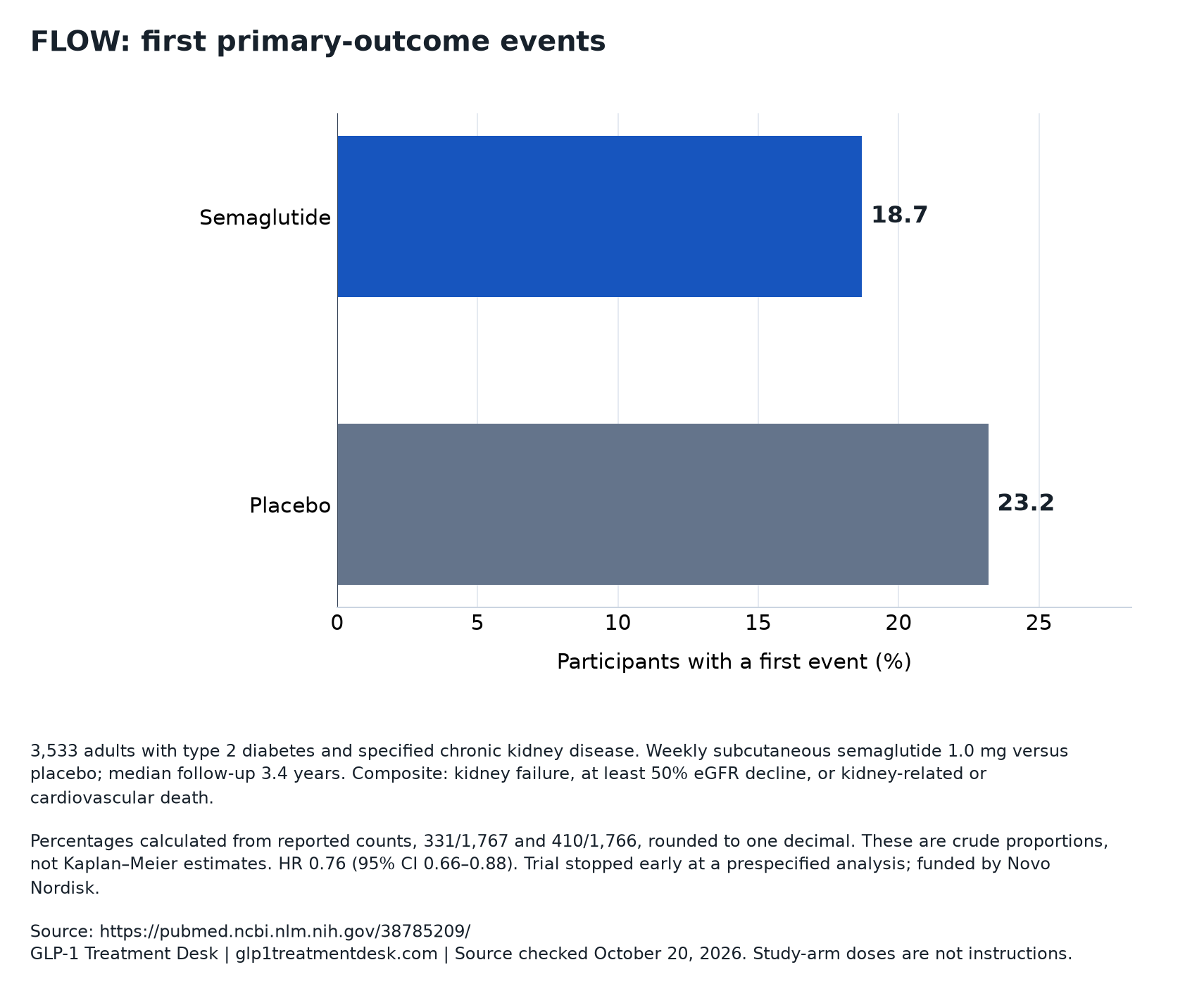
FLOW: first primary-outcome events
3,533 adults with type 2 diabetes and specified chronic kidney disease. Weekly subcutaneous semaglutide 1.0 mg versus placebo; median follow-up 3.4 years. Composite: kidney failure, at least 50% eGFR decline, or kidney-related or cardiovascular death.
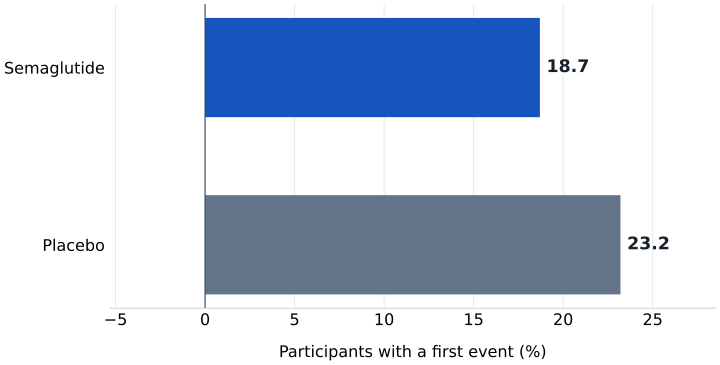
| Study group | Participants with a first event (%) |
|---|---|
| Semaglutide | 18.7 |
| Placebo | 23.2 |
Percentages calculated from reported counts, 331/1,767 and 410/1,766, rounded to one decimal. These are crude proportions, not Kaplan–Meier estimates. HR 0.76 (95% CI 0.66–0.88). Trial stopped early at a prespecified analysis; funded by Novo Nordisk.
Original visualization of published aggregate data. No individual prediction or provider performance is represented. Original research ↗
The primary endpoint combined kidney events and cardiovascular death
A composite endpoint counts several different outcomes within one primary measure. FLOW’s composite included kidney failure, a reduction in eGFR of at least 50% from baseline, or death from kidney-related or cardiovascular causes. Kidney failure could be identified by dialysis, transplantation, or eGFR below 15 mL/min/1.73 m². An event did not have to be dialysis to count.
Combining outcomes can capture a broader burden of disease and produce more events for statistical analysis. The tradeoff is interpretive: a favorable combined result does not prove that every component improved, or that they improved equally. Cardiovascular death is clearly important to patients, but it is not the same outcome as avoiding transplantation or dialysis.
FLOW also reported a kidney-specific composite excluding cardiovascular death: hazard ratio 0.79, with a 95% confidence interval of 0.66–0.94. Cardiovascular death separately had a hazard ratio of 0.71, with a confidence interval of 0.56–0.89. These findings support benefits beyond the headline composite, but the abstract does not give enough individual component counts to allocate the total effect precisely.
| Measure | What it captures | What it does not establish alone |
|---|---|---|
| Primary composite | Kidney failure, at least 50% eGFR reduction, or kidney-related or cardiovascular death | That each component improved separately |
| Kidney-specific composite | The kidney-specific components of the primary endpoint | The effect on dialysis alone |
| Annual eGFR slope | Average rate of change in estimated filtration | An individual date of kidney failure |
A 24% lower hazard is not a 24-point reduction
The primary analysis recorded 331 first events in the semaglutide group and 410 in the placebo group. The hazard ratio was 0.76, with a 95% confidence interval of 0.66–0.88. The report describes this as a 24% lower risk; more precisely, the time-to-event estimate represents a 24% lower hazard during follow-up, not a 24-percentage-point decrease in the proportion affected.
For scale, dividing the event counts by the randomized totals gives crude proportions of approximately 18.7% and 23.2%, a difference of about 4.5 percentage points. That calculation is descriptive. It does not account for event timing or differing observation time, and it should not replace a time-specific estimate from the trial’s survival analysis.
The confidence interval excludes 1.0, the value representing no difference in hazards. Its limits correspond to approximately 12%–34% lower hazard under the analysis. They describe statistical uncertainty around the treatment estimate, not the range of possible benefit for each person. The reported primary P value was 0.0003; it does not measure the size or personal importance of the benefit.
The secondary findings followed an ordered testing plan
FLOW’s prespecified confirmatory secondary outcomes were tested hierarchically. This means the investigators used an ordered testing strategy rather than treating every additional comparison as an independent opportunity to declare success. Such strategies help manage the chance of false-positive findings when a trial examines multiple outcomes. The abstract says all confirmatory secondary outcomes favored semaglutide.
The mean annual eGFR slope was less steep by 1.16 mL/min/1.73 m² with semaglutide, with P<0.001. Major cardiovascular events had a hazard ratio of 0.82, with a 95% confidence interval of 0.68–0.98 and P=0.029. Death from any cause had a hazard ratio of 0.80, with a confidence interval of 0.67–0.95 and P=0.01.
These findings broaden the outcome picture, but they answer distinct questions. All-cause death is not interchangeable with cardiovascular death, and a cardiovascular composite is not a kidney-failure endpoint. The abstract does not reproduce the complete hierarchy, all statistical assumptions, or every component definition, so the ordered strategy should not be expanded into claims about unreported analyses.
Slower eGFR decline is not a countdown to kidney failure
An eGFR slope summarizes change over time rather than whether a threshold event occurred. FLOW’s between-group difference of 1.16 mL/min/1.73 m² per year indicates slower average loss of estimated filtration with semaglutide. It does not mean filtration increased by that amount, nor does it reveal either group’s absolute annual decline from the abstract alone.
A worked interpretation helps: a difference between two slopes describes how far apart their rates of change are, not where either trajectory begins. Starting kidney function, individual variability, observation length, and the shape of change all matter. Multiplying the slope difference by several years would require assumptions about persistence and linearity that this abstract does not establish.
The event-based and slope findings are therefore complementary. The former documents fewer clinically important composite events; the latter indicates a more favorable average filtration trajectory. Neither supplies an individualized estimate of years until dialysis. The abstract also does not establish how much of the outcome difference resulted from changes in weight, glucose, blood pressure, or other pathways.
Early stopping makes the duration of evidence important
Median follow-up was 3.4 years, and early trial cessation was recommended after a prespecified interim analysis. Prespecification matters because it distinguishes a planned opportunity to evaluate accumulating evidence from an improvised decision after inspecting results. Still, the abstract does not provide the full stopping boundary or the statistical adjustments used at that analysis.
Early stopping does not negate the randomized comparison, but it limits what can be learned from additional observation. It leaves less opportunity to characterize later events, long-term tolerability, or whether the relative treatment difference changes over a longer period. A favorable estimate at the stopping point should not be projected indefinitely.
Median follow-up also is not a claim that every participant was observed for exactly 3.4 years. Some contributed shorter and others longer observation. The practical scientific question remains how durable the benefits are across longer treatment histories and changing clinical circumstances—not simply whether the trial crossed a statistical threshold.
Fewer serious adverse events is not a complete tolerability profile
Serious adverse events were reported in 49.6% of semaglutide participants and 53.8% of placebo participants, an absolute difference of 4.2 percentage points. These are substantial event burdens in both groups. The result should not be reduced to a statement that treatment was harmless, or that every type of adverse event was less common.
The FLOW abstract does not provide a detailed breakdown of specific adverse effects, their severity, treatment discontinuations, or the relationship investigators assigned between events and treatment. A serious-adverse-event total and a symptom-tolerability profile are different kinds of information. Neither can substitute for the other when considering whether treatment remains workable over time.
As editorial interpretation, care continuity should include a clear route for reporting symptoms and identifying who evaluates them; FLOW did not test that organizational model. The follow-up and tolerability guide addresses those handoffs without implying that messaging access alone replicates trial supervision. NIDDK likewise places adverse effects, health history, and other medicines within an individualized clinical assessment.
FLOW and obesity trials answer different questions
SELECT studied 17,604 adults aged at least 45 with established cardiovascular disease, BMI of at least 27, and no diabetes history. Its intervention was weekly subcutaneous semaglutide 2.4 mg, compared with placebo. Its primary endpoint combined cardiovascular death, nonfatal myocardial infarction, and nonfatal stroke—not FLOW’s kidney-centered composite.
SELECT reported primary events in 6.5% versus 8.0%, with a hazard ratio of 0.80 and 95% confidence interval of 0.72–0.90. Mean follow-up was 39.8 months. Adverse events leading to permanent trial-product discontinuation occurred in 16.6% versus 8.2%. Those safety figures describe a different outcome from FLOW’s serious-adverse-event percentages and should not be compared as if they used the same measure.
The SELECT analysis explores that cardiovascular question separately. Likewise, the STEP 1 extension analysis concerns a different research question, not a substitute kidney-outcomes population. Neither the shared ingredient nor an obesity-treatment context makes FLOW evidence automatically applicable to everyone seeking weight management.
Continuity means preserving clinical context, not just access
As editorial interpretation, FLOW makes a strong case for preserving the clinical history behind a treatment discussion: the diabetes diagnosis, kidney-function trajectory, albuminuria history, other medicines, and responsibility for reviewing changes. It does not prescribe a testing schedule. The care-journey guide separates intake, prescribing, dispensing, and follow-up responsibilities so that delivery is not mistaken for comprehensive clinical oversight.
Product identity matters too. The January 2025 FDA Ozempic label included reducing sustained eGFR decline, end-stage kidney disease, and cardiovascular death in adults with type 2 diabetes and chronic kidney disease. That historical approval is separate from a claim about the latest complete label. FLOW does not establish equivalent outcomes for oral semaglutide, other formulations, or compounded preparations; FDA notes that compounded drugs lack its premarket approval review and has identified dosing errors and semaglutide salt concerns.
For readers comparing services, the CoreAge Rx review is a place to check documented service terms, not evidence of access to the studied product or kidney-specific care. Cost and contract implications are editorial interpretation: a clinical benefit does not promise insurance coverage, uninterrupted supply, or a successful handoff. NIDDK identifies cost and coverage as separate considerations in treatment decisions.
Questions & answers
Did FLOW prove that semaglutide prevents dialysis?
Not as a stand-alone conclusion from the abstract. Dialysis was one way to meet the kidney-failure component, but the primary endpoint also included other kidney outcomes and cardiovascular death. The kidney-specific composite favored semaglutide, yet the abstract does not provide an isolated dialysis estimate. Fewer composite events cannot be translated into a precise dialysis benefit.
Does the result apply to someone with normal kidney measurements?
FLOW did not establish that. Participants had type 2 diabetes plus defined combinations of reduced eGFR and elevated urinary albumin. People outside those boundaries may differ in baseline risk and potential absolute benefit. Applying the findings to normal kidney measurements requires evidence beyond this trial, rather than assuming that the same relative or absolute effect carries over.
Can slower eGFR decline tell someone how long dialysis will be delayed?
No. The reported slope difference is a group-average comparison, not an individual forecast. Calculating a delay would require starting function, future trajectories, competing events, and assumptions about persistence of benefit. FLOW’s abstract does not supply a validated method for converting its slope result into an individual number of dialysis-free years.
Do these results establish the same benefit for compounded semaglutide?
No. A trial of a particular injectable treatment does not establish equivalence for compounded products or different routes. FDA states that compounded drugs are not FDA approved or reviewed before marketing for safety, effectiveness, or quality. Reports of problems also cannot, by themselves, establish adverse-event rates or prove causation.
What does FLOW suggest asking about when care changes hands?
As editorial interpretation, useful questions concern who retains the kidney and diabetes history, who reviews incoming clinical information, and who responds to adverse effects or treatment interruptions. FLOW did not compare handoff systems. Its findings support taking the underlying disease context seriously, not assuming that a prescription transfer automatically transfers monitoring responsibility.
Our assessment
FLOW provides randomized evidence that weekly injectable semaglutide reduced a clinically important kidney-and-cardiovascular composite in the specific population studied. Kidney-specific events, filtration slope, cardiovascular events, and mortality findings reinforce the overall result without becoming interchangeable endpoints. Its strongest practical lesson is not that every person using obesity medication receives kidney protection. It is that meaningful application depends on knowing the population, the product, the outcome definition, and the duration of observation. Continuity of care is an editorial implication of those requirements—not an outcome that FLOW itself measured.
Sources & documentation
Scientific and official sources consulted October 20, 2026. Study findings apply to the populations, products and time periods described; they are not provider outcome data.
- Effects of Semaglutide on Chronic Kidney Disease in Patients with Type 2 Diabetes. ↗
- NIDDK prescription medications for overweight and obesity ↗
- Semaglutide and Cardiovascular Outcomes in Obesity without Diabetes. ↗
- FDA Ozempic prescribing information, January 2025 kidney indication ↗
- FDA concerns about unapproved GLP-1 drugs ↗