SUMMIT tested a question that weight-loss results alone cannot answer: could tirzepatide improve heart-failure outcomes in people who had both obesity and heart failure with preserved ejection fraction? The randomized trial found fewer participants experiencing cardiovascular death or worsening heart failure with tirzepatide than with placebo. It also found greater improvement in patient-reported health status. Those findings are meaningful, but they do not establish that tirzepatide reduced cardiovascular mortality on its own.
The distinction matters when research enters an ongoing care discussion. A combined endpoint, a symptom questionnaire, and treatment discontinuations describe different aspects of benefit and burden. This analysis uses the indexed primary-report abstracts for SUMMIT and two comparison trials, alongside available official FDA material; it does not represent a review of all full texts, protocols, or supplements. The central task is to separate what SUMMIT measured from broader claims about survival, products, or care delivery.
At a glance
- Population and design
- SUMMIT randomized 731 people with heart failure, an ejection fraction of at least 50%, and BMI of at least 30 to tirzepatide or placebo.Sources: [1]
- Follow-up
- Treatment was assigned for at least 52 weeks; median follow-up was 104 weeks. Health-status change was assessed at 52 weeks.Sources: [1]
- Combined clinical endpoint
- Cardiovascular death or worsening heart failure occurred in 9.9% versus 15.3%; hazard ratio 0.62, 95% confidence interval 0.41–0.95.Sources: [1]
- Mortality remained uncertain
- Cardiovascular deaths numbered 8 versus 5; hazard ratio 1.58, 95% confidence interval 0.52–4.83. This does not establish an isolated mortality benefit.Sources: [1]
- Treatment burden
- Adverse events, mainly gastrointestinal, led to trial-drug discontinuation in 6.3% of tirzepatide participants versus 1.4% of placebo participants.Sources: [1]
Who SUMMIT studied—and why preserved ejection fraction matters
SUMMIT enrolled 731 participants with heart failure, an ejection fraction of at least 50%, and a body-mass index of at least 30. Ejection fraction describes the proportion of blood the left ventricle ejects with each contraction. A preserved percentage does not mean that heart function is normal in every respect or that symptoms are minor. Here, the threshold identifies the heart-failure population studied rather than a general measure of cardiovascular wellness.
BMI is weight in kilograms divided by height in meters squared. Its enrollment threshold placed obesity within the trial’s definition of the target population. The results therefore directly address the combination of obesity and this form of heart failure—not everyone seeking weight management, everyone with breathlessness, or every heart-failure subtype.
Clinical history matters to that distinction. Knowing that someone has obesity is not enough to establish that SUMMIT applies to them. The abstract does not provide every diagnostic or exclusion criterion, so it cannot support reconstructing eligibility from a few headline characteristics. Interpretation begins with the actual heart-failure diagnosis and the population boundaries, not simply the drug name.
Randomization tested an assigned treatment strategy
This was an international, double-blind, placebo-controlled trial. Participants were assigned in a 1:1 ratio: 364 to tirzepatide and 367 to placebo. Randomization helps prevent preexisting differences from systematically determining treatment assignment. Blinding limits the influence of knowing the assigned group on expectations and reporting, although the abstract does not document every procedure used to preserve blinding.
The tirzepatide arm used subcutaneous injections once weekly, up to 15 mg. These details identify the study intervention; they are not dosing instructions. Tirzepatide acts at glucose-dependent insulinotropic polypeptide and glucagon-like peptide-1 receptors. Naming those targets describes its pharmacology but does not establish which biological pathway caused the observed heart-failure benefit.
Assigned treatment lasted at least 52 weeks, and median follow-up was 104 weeks. A median is the midpoint of follow-up durations, not a statement that everyone was observed for exactly two years. Eli Lilly funded SUMMIT, registered as NCT04847557. Sponsorship is relevant context, while the randomized design and reported estimates remain the basis for interpreting the findings.
STUDY DATA · GLP-1 Treatment Desk
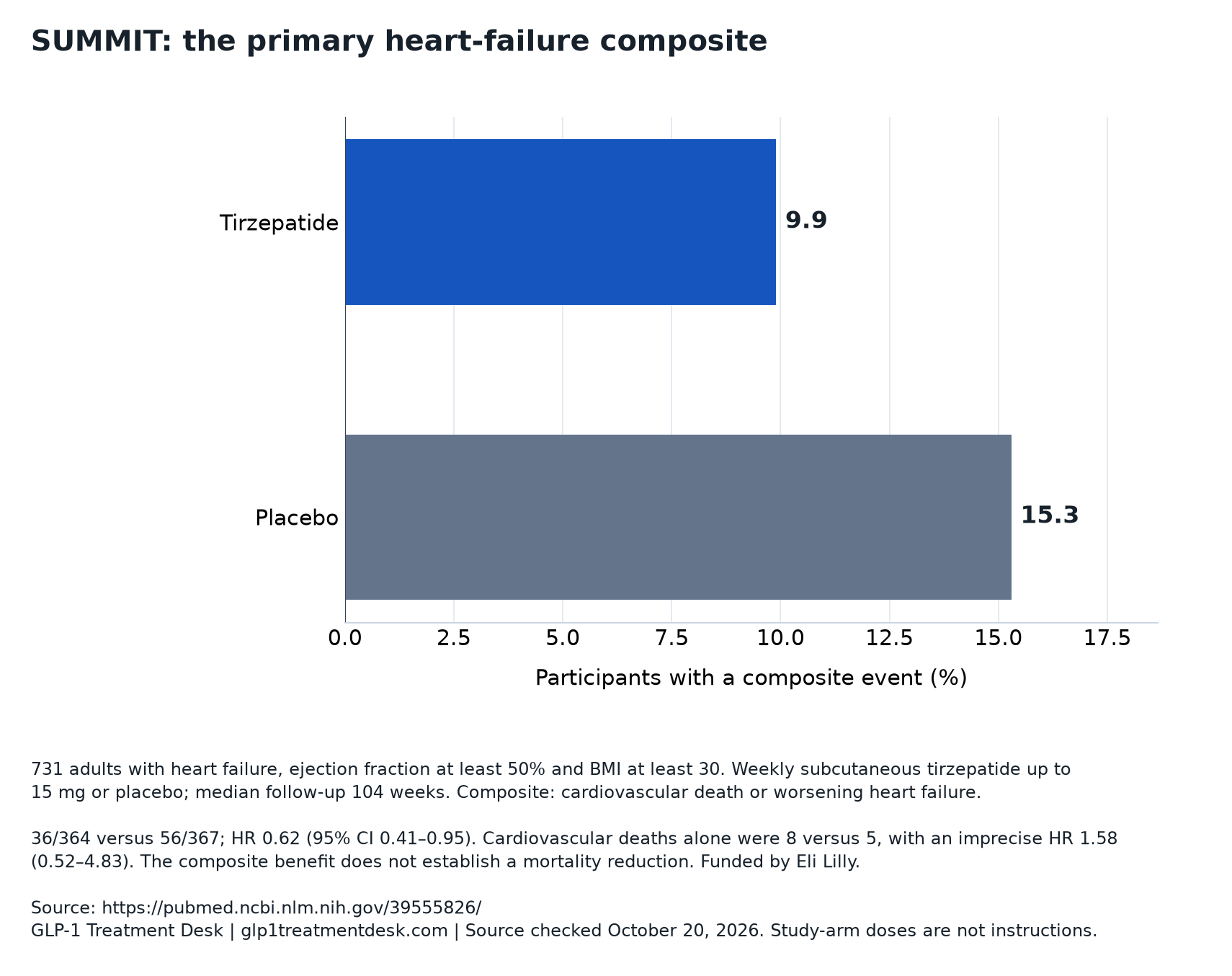
SUMMIT: the primary heart-failure composite
731 adults with heart failure, ejection fraction at least 50% and BMI at least 30. Weekly subcutaneous tirzepatide up to 15 mg or placebo; median follow-up 104 weeks. Composite: cardiovascular death or worsening heart failure.
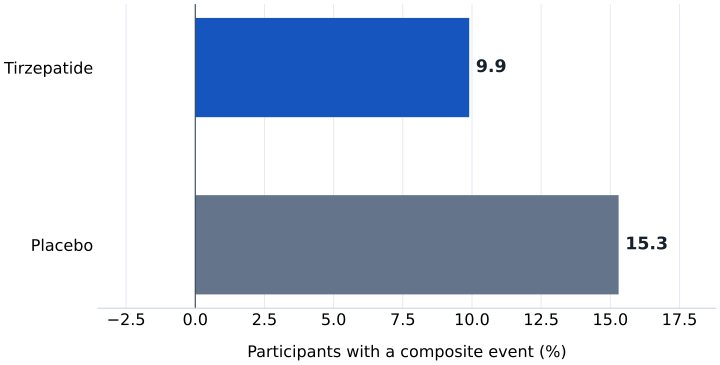
| Study group | Participants with a composite event (%) |
|---|---|
| Tirzepatide | 9.9 |
| Placebo | 15.3 |
36/364 versus 56/367; HR 0.62 (95% CI 0.41–0.95). Cardiovascular deaths alone were 8 versus 5, with an imprecise HR 1.58 (0.52–4.83). The composite benefit does not establish a mortality reduction. Funded by Eli Lilly.
Original visualization of published aggregate data. No individual prediction or provider performance is represented. Original research ↗
The composite captured a first event, not every consequence
SUMMIT had two primary endpoints. One combined adjudicated cardiovascular death with a worsening-heart-failure event in a time-to-first-event analysis. Adjudication means events were evaluated against study criteria. The other primary endpoint measured change in the Kansas City Cardiomyopathy Questionnaire clinical summary score, or KCCQ-CSS, from baseline to 52 weeks.
In the clinical composite, a participant reaches the endpoint when either qualifying outcome first occurs. Someone who experiences worsening heart failure and later dies from a cardiovascular cause does not become two separate participants in the overall composite. This structure answers whether the assigned groups differed in time to a first qualifying event; it does not, by itself, describe all recurrent episodes or the complete course after that event.
The abstract does not supply the detailed operational definition of worsening heart failure. It would therefore be inappropriate to relabel every reported event as a hospitalization. As the broader guide to placing trials in a care discussion emphasizes, the exact endpoint matters: a combined result is not interchangeable with survival, symptom relief, or total hospital use.
| Outcome | Tirzepatide versus placebo | Hazard ratio, with 95% CI |
|---|---|---|
| Cardiovascular death or worsening heart failure | 36/364 (9.9%) versus 56/367 (15.3%) | 0.62 (0.41–0.95) |
| Worsening heart-failure events | 29/364 (8.0%) versus 52/367 (14.2%) | 0.54 (0.34–0.85) |
| Cardiovascular death | 8/364 (2.2%) versus 5/367 (1.4%) | 1.58 (0.52–4.83) |
Reading 9.9% versus 15.3% without mixing measures
The combined endpoint occurred in 36 tirzepatide participants and 56 placebo participants: 9.9% versus 15.3%. Subtracting the reported percentages gives a 5.4-percentage-point difference over the trial’s observed follow-up. That is an absolute comparison of participant proportions, not a 5.4% relative reduction.
The reported hazard ratio was 0.62, with a 95% confidence interval of 0.41–0.95. On the hazard scale, the point estimate represents a 38% lower hazard of the first qualifying event. A hazard describes event occurrence over time among people who have not yet experienced that endpoint; it is not identical to the ratio of the two final percentages.
The confidence interval excludes 1, the value representing no difference in hazards, but ranges from a substantial reduction to a comparatively modest one. It communicates uncertainty about effect size even though the primary comparison favored tirzepatide. Neither the percentage difference nor the hazard ratio supplies a fixed annual benefit, a lifetime forecast, or a guarantee for an individual.
Worsening events improved; cardiovascular survival was unresolved
Worsening-heart-failure events occurred in 29 tirzepatide participants, or 8.0%, and 52 placebo participants, or 14.2%. The hazard ratio was 0.54, with a 95% confidence interval of 0.34–0.85. This component provides the clearest favorable clinical-event signal and helps explain the lower combined endpoint.
Cardiovascular deaths tell a different, much less precise story: 8 with tirzepatide and 5 with placebo, corresponding to 2.2% and 1.4%. The hazard ratio was 1.58, with a wide 95% confidence interval of 0.52–4.83. The point estimate was above 1, but the interval includes both lower and higher hazards. These sparse data establish neither a mortality benefit nor a definite mortality harm.
Component counts also cannot simply be added. In the tirzepatide arm, 29 plus 8 equals 37, although only 36 participants reached the composite; in the placebo arm, 52 plus 5 equals 57, compared with 56 in the composite. That arithmetic shows overlap between component categories. It does not reveal each person’s event sequence. The defensible conclusion is a lower combined endpoint, with fewer worsening events—not a demonstrated survival advantage.
Health status supplied a separate patient-centered result
The KCCQ-CSS ranges from 0 to 100, with higher scores indicating better health status. It captures aspects of symptoms and physical limitations rather than measuring mortality. At 52 weeks, the mean improvement was 19.5 points with tirzepatide and 12.7 points with placebo. The reported between-group difference was 6.9 points, with a 95% confidence interval of 3.3–10.6.
Both groups improved. Consequently, the 19.5-point within-group change should not be presented as the benefit attributable to tirzepatide over placebo. The between-group estimate is the relevant randomized comparison. The reported 6.9-point estimate also should not be replaced by subtracting rounded displayed means, which yields 6.8.
An average advantage does not mean that every participant felt better or experienced the same degree of change. The abstract does not provide a distribution of individual responses. Still, the questionnaire result adds a distinct finding: SUMMIT detected improvement in reported health status as well as fewer first composite events. These are complementary outcomes, not two ways of proving a mortality effect.
Discontinuations are part of the clinical result
Adverse events leading to discontinuation of the trial drug occurred in 23 tirzepatide participants, or 6.3%, versus 5 placebo participants, or 1.4%. The events were mainly gastrointestinal. The absolute difference was 4.9 percentage points. This is a meaningful tolerability finding alongside the favorable efficacy results.
That measure is narrower than all adverse events. It counts events severe or burdensome enough to lead to trial-drug discontinuation, not every symptom, every serious event, or every possible complication. Conversely, a participant who did not discontinue cannot automatically be classified as having no side effects. The abstract’s safety information does not justify a blanket claim that treatment was safe.
Editorial interpretation: these findings make clear ownership of symptom communication and treatment decisions relevant to continuity. They do not identify an optimal monitoring schedule or prove that any particular online service can manage complex heart failure. The follow-up and tolerability guide offers a framework for clarifying responsibilities without converting a trial result into an individualized treatment plan.
STEP-HFpEF and SELECT answer different questions
STEP-HFpEF randomized 529 people with preserved-ejection-fraction heart failure and BMI of at least 30 to once-weekly semaglutide 2.4 mg or placebo for 52 weeks. Its primary endpoints were health-status and weight changes, not SUMMIT’s cardiovascular-death-or-worsening-heart-failure endpoint. The KCCQ-CSS advantage was 7.8 points, with a 95% confidence interval of 4.8–10.9; the six-minute walk-distance advantage was 20.3 meters, with an interval of 8.6–32.1.
Its weight-change difference was −10.7 percentage points, and serious adverse events occurred in 13.3% versus 26.7%. Those findings belong to that trial and drug; they do not replace SUMMIT’s discontinuation results. The STEP-HFpEF analysis examines why symptom and function endpoints deserve their own interpretation. Both STEP-HFpEF and SELECT were funded by Novo Nordisk.
SELECT enrolled 17,604 people aged at least 45 with established cardiovascular disease, BMI of at least 27, and no diabetes history. Over mean follow-up of 39.8 months, semaglutide’s cardiovascular-death, nonfatal-heart-attack, or nonfatal-stroke composite occurred in 6.5% versus 8.0%; hazard ratio 0.80, 95% confidence interval 0.72–0.90. Permanent discontinuation because of adverse events occurred in 16.6% versus 8.2%. The SELECT analysis concerns a different population and endpoint. Comparing its hazard ratio with SUMMIT’s cannot rank the drugs.
| Trial | Population and comparison | Primary question |
|---|---|---|
| SUMMIT | 731 participants with heart failure, EF ≥50%, BMI ≥30; tirzepatide versus placebo | First cardiovascular death or worsening-heart-failure event, plus 52-week health status |
| STEP-HFpEF | 529 participants with HFpEF and BMI ≥30; semaglutide versus placebo | 52-week health-status and body-weight changes |
| SELECT | 17,604 participants with established cardiovascular disease, BMI ≥27, no diabetes history; semaglutide versus placebo | First cardiovascular death, nonfatal myocardial infarction, or nonfatal stroke |
What remains unanswered about mechanism and durability
Random assignment supports interpreting the between-group results as evidence about the assigned tirzepatide strategy in this trial population. It does not isolate why the benefit occurred. From the abstract alone, the respective contributions of weight change, receptor effects, or other physiological changes cannot be separated. A plausible mechanism is not the same as a demonstrated causal pathway.
The follow-up also sets a boundary. Median observation of 104 weeks is informative, but it does not establish lifetime benefit, outcomes after treatment ends, or how results evolve over many additional years. The abstract does not supply sufficient subgroup results to determine whether benefit differed by specific clinical histories. Nor does a time-to-first-event result quantify the total burden of recurrent worsening episodes.
Another unresolved question is how trial conditions translate into routine care with interruptions, changing clinicians, or incomplete records. SUMMIT did not randomize those delivery arrangements. Editorial interpretation: continuity could matter to understanding symptoms and maintaining a coherent history, but the trial cannot quantify the benefit of a particular handoff process, subscription arrangement, or follow-up service.
Translating the evidence without transferring claims
SUMMIT’s results attach to its studied population, intervention, route, comparator, and follow-up—not automatically to every product bearing an ingredient name. FDA states that compounded drugs are not FDA approved and are not reviewed before marketing for safety, effectiveness, or quality. It recommends compounded products only when a patient’s needs cannot be met by an FDA-approved drug. The agency also identifies dosing errors and concerns involving semaglutide salt ingredients.
Those reports do not establish adverse-event rates or causation, and they do not establish equivalence to trial products. Likewise, SUMMIT does not establish heart-failure outcomes for compounded preparations, oral routes, or other formulations. The product, route, and pharmacy guide addresses the documentary distinctions that an ingredient-only comparison can miss. Trial reports also are not current prescribing information.
Editorial interpretation: care-continuity questions should distinguish who holds the clinical history, who receives symptom reports, and who retains responsibility when services change. The guide to changing programs develops those handoff questions. For readers comparing service documents, the CoreAge Rx review can serve as a place to check stated terms—not as evidence that the provider offers the studied product, heart-failure care, or SUMMIT-like outcomes.
Questions & answers
Did SUMMIT show that tirzepatide prevents cardiovascular death?
No isolated mortality benefit was established. Cardiovascular deaths numbered 8 with tirzepatide and 5 with placebo. The hazard ratio of 1.58 had a wide 95% confidence interval of 0.52–4.83. The favorable primary clinical finding concerned the combined endpoint, while the worsening-heart-failure component showed a clearer reduction.
Why do the component counts exceed the composite count?
The component categories overlap: a participant can experience worsening heart failure and also die from a cardiovascular cause. The time-to-first-event composite counts that person once. Adding component counts therefore overcounts unique participants. The abstract does not provide individual event sequences, so the arithmetic cannot reconstruct exactly what happened to each person.
Does a hazard ratio of 0.62 mean 38 fewer events per 100 people?
No. It represents a 38% lower estimated hazard of a first qualifying event, not a 38-percentage-point absolute reduction. The reported event proportions were 9.9% and 15.3%, a difference of 5.4 percentage points over observed follow-up. The hazard ratio also incorporates event timing, so it is a different statistical measure.
Can SUMMIT and STEP-HFpEF show which drug works better?
Not directly. SUMMIT studied tirzepatide, while STEP-HFpEF studied semaglutide; each compared its intervention with placebo. Their primary questions and observation periods differed. Similar questionnaire findings across separate trials are informative context, but they do not provide the protection against between-study differences that a randomized head-to-head comparison would offer.
What does the trial say about choosing an online care service?
It provides no randomized comparison of providers, platforms, or service contracts. Editorial interpretation: its population and tolerability findings support asking how clinical history, symptom reports, and handoffs are handled. They do not validate a provider’s capabilities or extend efficacy findings to a different formulation. Product evidence and service documentation must be evaluated separately.
Our assessment
SUMMIT supports a specific conclusion: among participants with obesity and heart failure with ejection fraction of at least 50%, assigned tirzepatide reduced the first occurrence of cardiovascular death or worsening heart failure and improved reported health status compared with placebo. Fewer worsening events were central to the clinical result; cardiovascular mortality remained unresolved. Gastrointestinal adverse events leading to discontinuation were more frequent. The care-continuity implication is editorial, not a separately tested benefit: preserve the distinctions between diagnosis, endpoint, tolerability, product identity, and responsibility for ongoing care rather than letting one favorable headline stand in for all five.
Sources & documentation
Scientific and official sources consulted October 20, 2026. Study findings apply to the populations, products and time periods described; they are not provider outcome data.