Heart-failure treatment can matter in ways that a scale cannot capture: fewer symptoms, less physical limitation, or greater ability to walk. STEP-HFpEF tested those dimensions alongside weight change in people with heart failure with preserved ejection fraction and obesity. Its central finding was not simply that participants receiving semaglutide lost more weight. They also reported greater improvement in heart-failure symptoms and physical limitations than participants receiving placebo.
The practical question is what that evidence establishes—and what information must remain connected as care moves between clinicians, pharmacies, and payment arrangements. This analysis uses the indexed primary-report abstracts for STEP-HFpEF, SUMMIT, and SELECT, together with available official FDA material. It does not represent a review of all trial protocols, supplements, or full texts. The strongest reading distinguishes symptom improvement, measured physical function, and cardiovascular events rather than treating them as interchangeable benefits.
At a glance
- Population and duration
- STEP-HFpEF randomly assigned 529 participants with heart failure with preserved ejection fraction and BMI of at least 30 to semaglutide or placebo for 52 weeks.Sources: [1]
- Symptoms and physical limitations
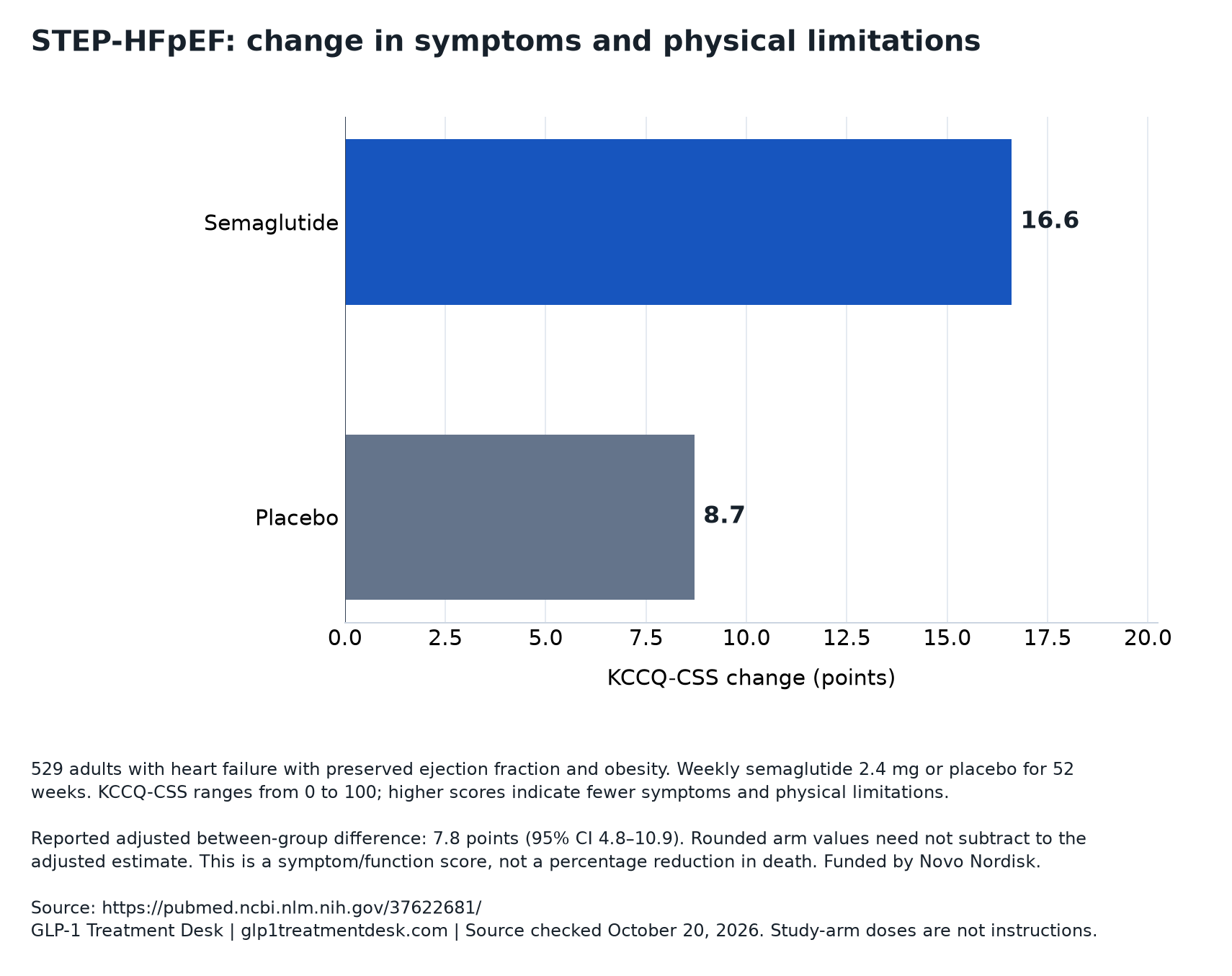
- KCCQ-CSS improved by 16.6 points with semaglutide and 8.7 with placebo; the reported estimated between-group difference was 7.8 points, with a 95% confidence interval of 4.8 to 10.9.Sources: [1]
- Weight and walking
- The estimated weight-change difference was −10.7 percentage points, while the estimated six-minute walking-distance difference was 20.3 meters in favor of semaglutide.Sources: [1]
- A composite, not a mortality estimate
- The hierarchical composite favored semaglutide with a win ratio of 1.72; this is not a hazard ratio or a percentage reduction in deaths.Sources: [1]
- Reported serious adverse events
- Serious adverse events occurred in 35 semaglutide participants, or 13.3%, and 71 placebo participants, or 26.7%. These figures do not establish that every type of adverse effect was less common.Sources: [1]
The trial studied a defined heart-failure population
STEP-HFpEF enrolled 529 people with heart failure with preserved ejection fraction, commonly shortened to HFpEF, and a body-mass index of at least 30. Preserved ejection fraction describes heart failure in which the proportion of blood pumped out with each beat remains relatively preserved; it does not mean symptoms or physical limitations are absent. The obesity requirement is central to the population studied, not an incidental characteristic.
Participants were randomly assigned to once-weekly semaglutide, with 2.4 mg identifying the study arm, or placebo for 52 weeks. Random assignment makes the between-group comparison more informative than a before-and-after account without a control group. The indexed STEP-HFpEF abstract does not specify the administration route or provide the full treatment-escalation protocol. SELECT explicitly describes its semaglutide regimen as subcutaneous, meaning injected under the skin; that separate report cannot supply missing protocol details for STEP-HFpEF.
Novo Nordisk funded STEP-HFpEF, registered as NCT04788511. Its results apply most directly to the population and regimen tested. The abstract does not provide enough eligibility detail to decide whether every person carrying an HFpEF diagnosis resembles the participants. That is why clinical history matters more than matching only the drug name or BMI category.
Two primary endpoints asked different questions
The trial had dual primary endpoints: change in the Kansas City Cardiomyopathy Questionnaire clinical summary score, or KCCQ-CSS, and change in body weight. KCCQ-CSS runs from 0 to 100, with higher scores indicating fewer symptoms and physical limitations. It is a patient-reported measure of health status, not a blood test, imaging measurement, or count of hospitalizations.
Using both endpoints allowed the study to assess whether treatment changed how participants felt and functioned as well as their weight. Those outcomes can be related without being equivalent. A weight result cannot substitute for a symptom result, and an improved questionnaire score does not by itself show that heart structure changed or that survival increased.
The additional confirmatory endpoints broadened the picture: six-minute walking distance, a hierarchical composite incorporating clinical events and functional changes, and C-reactive protein. As the guide to interpreting trials in care discussions explains, identifying the actual endpoint is the first step toward deciding which clinical question a result can answer.
| Measure | What it captures | Important boundary |
|---|---|---|
| KCCQ-CSS | Reported symptoms and physical limitations on a 0–100 scale | Not a direct measure of survival or heart structure |
| Body-weight change | Percentage change from baseline weight | Does not identify which tissue or fluid compartments changed |
| Six-minute walk distance | Measured walking performance | Does not reproduce every daily activity |
| Hierarchical composite | Prioritized comparisons incorporating events and functional changes | Win ratio is not a mortality hazard ratio |
| C-reactive protein | Change in an inflammatory marker | Does not establish the mechanism of clinical improvement |
STUDY DATA · GLP-1 Treatment Desk
STEP-HFpEF: change in symptoms and physical limitations
529 adults with heart failure with preserved ejection fraction and obesity. Weekly semaglutide 2.4 mg or placebo for 52 weeks. KCCQ-CSS ranges from 0 to 100; higher scores indicate fewer symptoms and physical limitations.
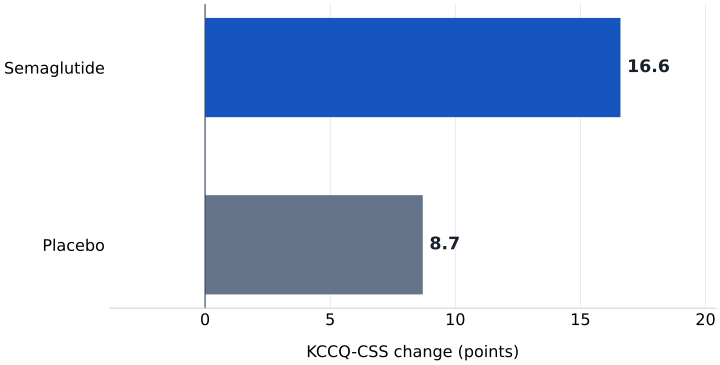
| Study group | KCCQ-CSS change (points) |
|---|---|
| Semaglutide | 16.6 |
| Placebo | 8.7 |
Reported adjusted between-group difference: 7.8 points (95% CI 4.8–10.9). Rounded arm values need not subtract to the adjusted estimate. This is a symptom/function score, not a percentage reduction in death. Funded by Novo Nordisk.
Original visualization of published aggregate data. No individual prediction or provider performance is represented. Original research ↗
Reading the 7.8-point symptom advantage
Mean KCCQ-CSS change was 16.6 points with semaglutide and 8.7 points with placebo. Both groups improved, but the reported estimated treatment difference favored semaglutide by 7.8 points. Simple subtraction of the displayed, rounded means gives 7.9; the correct result to cite is the report’s estimated difference rather than a replacement calculated from rounded numbers.
The 95% confidence interval was 4.8 to 10.9 points. That interval conveys uncertainty around the estimated average between-group effect, not the range of responses experienced by individual participants. It supports an advantage on this measure while leaving room for the true average effect to be smaller or larger than the central estimate.
The placebo improvement is also informative. Measuring only the semaglutide group’s 16.6-point gain would attribute all observed improvement to treatment, even though the comparison group improved substantially. The randomized contrast better isolates the treatment effect. The abstract does not report the distribution of individual responses, so it cannot tell readers how many participants experienced a particular degree of improvement or no improvement.
Weight loss and walking supplied complementary evidence
Mean body-weight change was −13.3% with semaglutide and −2.6% with placebo. The estimated difference was −10.7 percentage points, with a 95% confidence interval from −11.9 to −9.4. Percentage points are the appropriate unit for the difference between two percentage changes; describing this as merely “10.7% more weight loss” would blur the comparison.
Mean six-minute walking distance increased by 21.5 meters with semaglutide and 1.2 meters with placebo. The estimated difference was 20.3 meters, with a 95% confidence interval of 8.6 to 32.1. This measured-performance result complements the questionnaire finding: the evidence was not limited to participants reporting that they felt better.
Nevertheless, a standardized walking test does not describe every aspect of daily function. Nor does the weight endpoint identify how much change came from fat, lean tissue, or fluid. Taken together, the endpoints support improvement across several dimensions, but they do not establish that weight reduction alone caused the symptom and walking benefits. That causal pathway would require additional evidence.
Why a win ratio of 1.72 is not a survival claim
The hierarchical composite incorporated death, heart-failure events, and differences in changes in KCCQ-CSS and six-minute walking distance. A hierarchical analysis prioritizes outcomes rather than treating all components as identical. Its win ratio summarizes favorable versus unfavorable comparisons under the trial’s ranking rules.
The reported win ratio was 1.72, with a 95% confidence interval of 1.37 to 2.15. This supports an overall advantage within that ranked analysis. It does not mean that mortality fell by 72%, that 72% more patients benefited, or that the hazard of a heart-failure event was reduced by a corresponding amount. Those would require different estimates.
The indexed abstract does not provide the full comparison rules or enough component-level event information to attribute the win-ratio result to deaths, heart-failure events, symptoms, or walking separately. Functional improvements can contribute to a favorable hierarchical result even when a trial does not establish a survival benefit. This is an important boundary between a positive composite and a claim about every component.
The inflammation finding raises a mechanism question
C-reactive protein, or CRP, is an inflammatory marker. Its mean percentage change was −43.5% with semaglutide and −7.3% with placebo. The report gave an estimated treatment ratio of 0.61, with a 95% confidence interval of 0.51 to 0.72. That ratio is a different statistical summary from subtracting the two reported percentage changes.
The CRP result adds biological information alongside symptoms, weight, and walking. It does not, however, establish that reduced inflammation caused the clinical improvement. Treatment could affect several pathways, and changes in those pathways may occur together. Demonstrating mediation—how much one change explains another—requires analyses beyond the abstract’s reported endpoints.
An unresolved question is how much improvement arose through weight-related effects versus other effects of treatment. Another is whether the observed benefits persist beyond the 52-week study period. STEP-HFpEF’s reported results are strong evidence for its measured outcomes over one year, not a complete explanation of mechanism or long-term durability.
Serious adverse events are only one safety lens
Serious adverse events were reported in 35 participants receiving semaglutide, or 13.3%, and 71 receiving placebo, or 26.7%. The observed difference is 13.4 percentage points. These are substantial group differences, but the abstract does not supply the event categories or establish which events were caused by treatment.
Serious-event frequency should not be substituted for tolerability. A participant can experience an adverse effect that interferes with continuing treatment without that event meeting a serious-event classification. The STEP-HFpEF abstract does not provide a detailed gastrointestinal adverse-effect profile or treatment-discontinuation breakdown, so those outcomes cannot be reconstructed from the serious-event totals.
Other trials illustrate why the distinction matters. In SELECT, adverse events leading to permanent treatment discontinuation occurred in 16.6% with semaglutide and 8.2% with placebo. Those rates come from a different population and longer follow-up, not from STEP-HFpEF. The follow-up and tolerability guide offers a framework for clarifying who receives concerns and who makes clinical decisions without assuming that fewer serious events means universally easy treatment.
SUMMIT and SELECT answer different cardiovascular questions
SUMMIT randomized 731 people with heart failure, ejection fraction of at least 50%, and BMI of at least 30 to subcutaneous tirzepatide, up to 15 mg weekly, or placebo. Median follow-up was 104 weeks. Cardiovascular death or worsening heart failure occurred in 9.9% versus 15.3%, with a hazard ratio of 0.62 and 95% confidence interval of 0.41 to 0.95. A hazard ratio describes relative event occurrence over follow-up, not simply the ratio of final percentages.
The composite result did not demonstrate improvement in every component. Worsening heart-failure events favored tirzepatide, but cardiovascular deaths numbered eight versus five, with a highly uncertain hazard ratio of 1.58 and confidence interval of 0.52 to 4.83. KCCQ-CSS improved by an estimated 6.9 points more than placebo at 52 weeks. Mainly gastrointestinal adverse events led to discontinuation in 6.3% versus 1.4%. Eli Lilly funded this trial; the SUMMIT analysis examines its composite in more detail.
SELECT instead enrolled 17,604 adults aged at least 45 with established cardiovascular disease, BMI of at least 27, and no history of diabetes. Over mean follow-up of 39.8 months, cardiovascular death, nonfatal heart attack, or nonfatal stroke occurred in 6.5% versus 8.0%, with a hazard ratio of 0.80 and confidence interval of 0.72 to 0.90. Novo Nordisk funded SELECT. The SELECT outcomes analysis addresses that distinct question; neither study is a head-to-head comparison with STEP-HFpEF.
| Trial | Central population and comparison | What the headline result addresses |
|---|---|---|
| STEP-HFpEF | 529 people with HFpEF and obesity; semaglutide versus placebo for 52 weeks | Symptoms, physical limitations, and weight as dual primary endpoints |
| SUMMIT | 731 people with HFpEF and obesity; tirzepatide versus placebo; median follow-up 104 weeks | Cardiovascular death or worsening heart failure, plus 52-week health status |
| SELECT | 17,604 people with established cardiovascular disease and overweight or obesity, without diabetes; semaglutide versus placebo | Cardiovascular death, nonfatal heart attack, or nonfatal stroke |
Continuity means preserving the clinical context
Editorial interpretation: because STEP-HFpEF measured symptoms, physical limitations, and walking rather than weight alone, continuity should preserve more than a weight record. A care discussion needs the established diagnosis, relevant clinical history, current treatment information, and a clear account of changing symptoms. The study does not specify a universal monitoring schedule or authorize a platform to replace existing heart-failure care.
Responsibility is a separate issue from access. Who reviews a new symptom report, who communicates with the clinician managing heart failure, and who remains available during a service transition are organizational questions. The care-journey guide maps those roles, while the guide to changing plans focuses on what remains in place when a commercial arrangement changes.
Editorial interpretation: a membership, shipment, or payment agreement is not evidence of clinical continuity. Readers comparing services can use the CoreAge Rx review to check documentary terms about responsibilities and follow-up. That invitation does not establish that the provider supplies the studied product, treats HFpEF, or achieves trial-like outcomes.
Product identity remains part of the evidence boundary
A positive trial does not establish equivalent outcomes for every product carrying the same ingredient name. FDA states that compounded drugs are not FDA approved and are not reviewed before marketing for safety, effectiveness, or quality. It recommends compounded products only when a patient’s needs cannot be met by an FDA-approved drug.
FDA also identifies concerns involving dosing errors and semaglutide salt ingredients. These reports warrant attention, but reports alone cannot establish event rates or causation. STEP-HFpEF cannot resolve those product-specific uncertainties, and its findings do not automatically transfer to compounded preparations, oral routes, or other formulations.
The product, route, and pharmacy guide separates those identity questions. Editorial interpretation: preserving an accurate medication record through clinical and pharmacy handoffs is part of maintaining the link between evidence and actual care. Trial doses identify research arms; they are not instructions for starting, changing, or continuing an individual treatment.
Questions & answers
Did STEP-HFpEF show that semaglutide prevents death?
No mortality benefit can be concluded from the reported results. Death was included in a hierarchical composite, but the abstract does not provide a standalone mortality estimate establishing benefit. The win ratio combines prioritized comparisons involving clinical events and functional outcomes; it is not a mortality risk reduction.
Does a 7.8-point KCCQ-CSS advantage predict my improvement?
No. It is an estimated average difference between randomized groups, not an individual forecast. Participants could improve by different amounts or not improve. The confidence interval describes uncertainty in the average treatment effect, while the abstract does not provide the individual response distribution needed for a personalized prediction.
Was the improvement just a consequence of weight loss?
The trial found greater weight loss, better symptom scores, longer walking distance, and lower CRP with semaglutide. Those concurrent findings do not establish which change caused another. The abstract does not quantify how much clinical improvement was mediated by weight loss, inflammation, or other pathways.
Can SUMMIT show whether tirzepatide is better than semaglutide for HFpEF?
Not directly. SUMMIT and STEP-HFpEF compared different treatments with placebo in separate trials with different endpoints and follow-up. Their questionnaire findings cannot be treated as a randomized comparison between drugs. SUMMIT adds evidence about a heart-failure event composite, but that does not create a head-to-head ranking.
Do these results apply to compounded semaglutide?
The trial does not establish equivalence for compounded products. FDA states that compounded drugs are not FDA approved or reviewed before marketing for safety, effectiveness, or quality. Product identity, formulation, and route remain relevant; sharing an ingredient name does not demonstrate the same clinical performance.
Our assessment
STEP-HFpEF provides randomized evidence that semaglutide improved average symptom burden, physical limitations, walking performance, and weight compared with placebo over 52 weeks in people with HFpEF and obesity. Its strongest message is multidimensional clinical improvement—not a demonstrated mortality benefit. For continuity of care, the editorial implication is to keep the diagnosis, actual product, symptom history, and responsibility for follow-up connected rather than reducing the evidence to pounds lost or treating access to medication as proof of comprehensive heart-failure management.
Sources & documentation
Scientific and official sources consulted October 20, 2026. Study findings apply to the populations, products and time periods described; they are not provider outcome data.