Losing weight during treatment and keeping that loss after treatment ends are different scientific questions. SURMOUNT-4 addressed the second by giving participants tirzepatide first, then randomly assigning those who reached the maintenance phase either to continue it or switch to placebo. Substantial regain after withdrawal makes continuity of care an important discussion, but the trial does not prescribe a lifelong plan for every individual.
Its results require careful bookkeeping: 783 people entered the initial treatment period, 670 were randomized, and the headline maintenance percentages start at week 36—not at the original pretreatment weight. This analysis uses the indexed primary report abstracts for SURMOUNT-4 and SURMOUNT-MAINTAIN, the available full STEP 1 extension article, and official NIDDK and FDA material. It does not represent a review of all trial protocols or supplements.
At a glance
- Enrollment versus randomization
- SURMOUNT-4 enrolled 783 participants in a 36-week tirzepatide lead-in; 670 were subsequently randomized, 335 per group.Sources: [1]
- Initial weight reduction
- Participants reaching randomization had lost a mean 20.9% of their original weight during the lead-in.Sources: [1]
- Maintenance-phase comparison
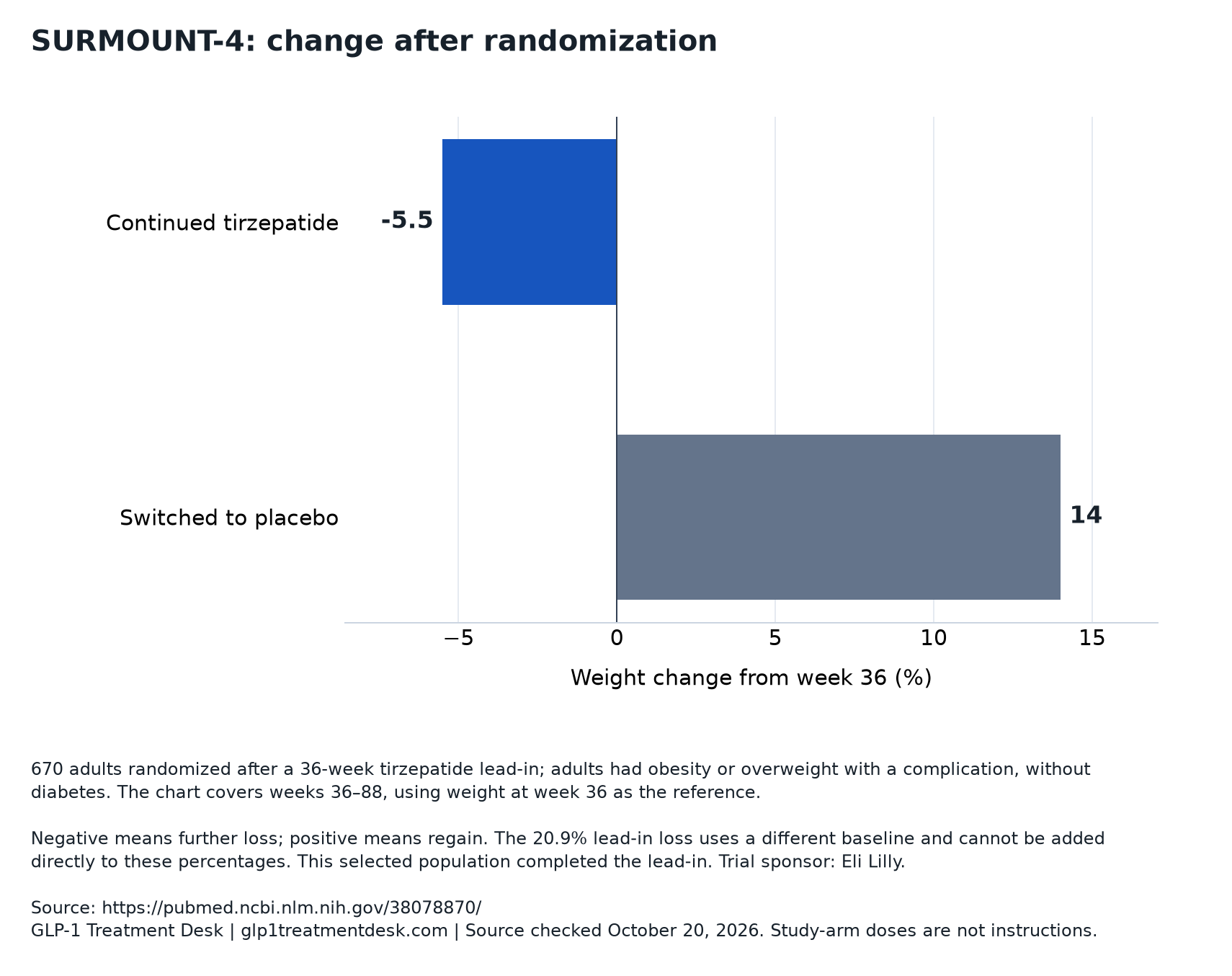
- From weeks 36 to 88, mean weight changed by −5.5% with continued tirzepatide versus +14.0% with placebo; the reported difference was −19.4 percentage points, with a 95% confidence interval of −21.2 to −17.7.Sources: [1]
- Retaining earlier weight loss
- At week 88, 89.5% continuing tirzepatide retained at least 80% of their lead-in loss, compared with 16.6% switched to placebo.Sources: [1]
- Newer maintenance-dose evidence
- SURMOUNT-MAINTAIN tested continued maximum tolerated tirzepatide, reduction to a 5-mg study arm, and placebo after a 60-week weight-loss period; it was not simply another continue-versus-stop trial.Sources: [2]
The randomized question began after 36 weeks
SURMOUNT-4 was a phase 3 trial conducted at 70 sites in four countries. Eligible adults had a body mass index, or BMI, of at least 30, or at least 27 with a weight-related complication. Diabetes was excluded. The randomized group had a mean age of 48 years, and 71% were women. These characteristics define the population behind the average result.
During the open-label lead-in, everyone received once-weekly subcutaneous tirzepatide, meaning injection beneath the skin, at a maximum tolerated study dose of 10 or 15 mg. Open-label means participants and researchers knew the treatment. After 36 weeks, 670 participants entered a 52-week double-blind comparison: continued tirzepatide versus placebo, with diet and physical activity included in the treatment approach.
This design isolates a maintenance decision among people who reached that point. It does not compare starting tirzepatide with never starting it. Nor does it compare competing medicines or different routes. Keeping those questions separate is useful when reading a direct-comparison study: a head-to-head design and a withdrawal design answer fundamentally different questions.
Why 783 starters are not 670 maintenance participants
The difference between enrollment and randomization is 113 people, approximately 14.4% of the original 783. The indexed abstract does not provide a complete breakdown of why those participants did not reach randomization. It would therefore be incorrect to count all 113 as adverse-effect withdrawals, treatment failures, or people lost to follow-up.
Nevertheless, the lead-in creates a selected population: people who completed the initial period and could proceed with the studied regimen. This is often described as selecting tolerators, although completion should not be equated with having no symptoms. The randomized evidence is particularly relevant to established treatment, rather than to predicting what every new starter will experience.
Selection does not erase the value of randomization. Once the 670 were assigned to the two groups, that comparison provided stronger evidence about continuing versus withdrawing treatment than an uncontrolled observation would. The limitation concerns how broadly the result applies, not whether the randomized contrast has meaning.
STUDY DATA · GLP-1 Treatment Desk
SURMOUNT-4: change after randomization
670 adults randomized after a 36-week tirzepatide lead-in; adults had obesity or overweight with a complication, without diabetes. The chart covers weeks 36–88, using weight at week 36 as the reference.
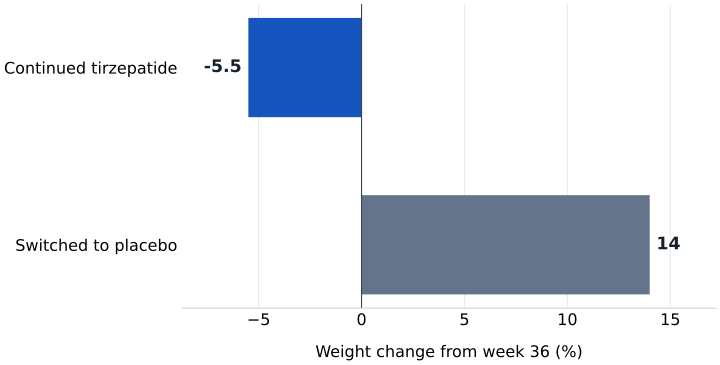
| Study group | Weight change from week 36 (%) |
|---|---|
| Continued tirzepatide | -5.5 |
| Switched to placebo | 14 |
Negative means further loss; positive means regain. The 20.9% lead-in loss uses a different baseline and cannot be added directly to these percentages. This selected population completed the lead-in. Trial sponsor: Eli Lilly.
Original visualization of published aggregate data. No individual prediction or provider performance is represented. Original research ↗
Two baselines explain the apparent arithmetic puzzle
The primary endpoint was mean percentage weight change from week 36 to week 88. An endpoint is the outcome chosen for evaluation; here, its denominator was weight at randomization. The earlier 20.9% reduction used week 0 weight instead. Adding these percentages directly would mix different denominators.
For an illustrative calculation—not an individual prediction—start with 100 weight units. A 20.9% reduction leaves 79.1. Another 5.5% loss from 79.1 leaves about 74.75, roughly 25.25% below the original weight. A 14.0% increase from 79.1 leaves about 90.17, still roughly 9.83% below the original weight. That is why substantial regain can coexist with a remaining net loss.
The report gives overall mean reductions of 25.3% and 9.9% from week 0 to week 88. The illustration closely matches them, but it is not a reconstruction of participant-level data: group averages and rounded estimates need not multiply exactly. The practical lesson is to identify the starting time point before interpreting any percentage.
| Measure | Reference point | Reported result |
|---|---|---|
| Lead-in weight change | Original weight at week 0 | Mean reduction of 20.9% among those reaching randomization |
| Primary maintenance endpoint | Weight at week 36 | −5.5% with continued tirzepatide; +14.0% with placebo |
| Total trial weight change | Original weight at week 0 | −25.3% with continued tirzepatide; −9.9% with placebo |
| Retention threshold | Weight lost during the lead-in | At least 80% retained by 89.5% versus 16.6% |
What the treatment difference establishes
The reported between-group difference in maintenance-phase weight change was −19.4 percentage points, with a 95% confidence interval from −21.2 to −17.7. The interval describes uncertainty around the estimated average difference under the analysis, not a range within which 95% of individual outcomes occurred. Its distance from zero supports a clear separation between the randomized strategies.
This is a difference in percentage weight change—not a 19.4% reduction in the risk of regain. It is also not a hazard ratio, which would compare event rates over time. Subtracting the displayed rounded group values produces 19.5 points; that small mismatch is consistent with reporting rounded estimates rather than evidence of contradictory results.
Continuing treatment both preserved and augmented the initial loss on average. Switching to placebo produced substantial average regain, but the placebo group remained below its original mean weight at week 88. Neither finding establishes what would happen after several more years, whether every participant would eventually regain everything, or whether an individual's trajectory would resemble the group mean.
Retaining 80% is not the same as never regaining
A key secondary endpoint asked whether participants retained at least 80% of the weight lost during the lead-in. At week 88, 300 participants continuing tirzepatide—89.5%—met that threshold, compared with 16.6% assigned placebo. This categorical endpoint translates the average weight curve into a different question: how many preserved most of their earlier reduction?
Suppose someone lost 20 weight units during the initial period. Retaining 80% would mean remaining at least 16 units below the original weight; regaining four units could still meet the endpoint. Thus, the maintenance percentage does not mean 89.5% had no regain, and failure to meet the threshold does not mean all previous weight loss disappeared.
The absolute separation was 72.9 percentage points for this particular threshold and follow-up. It should not be recast as a guarantee or as the percentage who benefited in every sense. Weight retention is not itself proof of fewer cardiovascular events, improved sleep apnea, or better function; those outcomes require their own measurements and study designs.
Tolerability remains part of maintenance
SURMOUNT-4 reported gastrointestinal adverse events as the most common adverse events. They were mostly mild to moderate and occurred more often with tirzepatide than placebo. That is a real safety finding, not a basis for describing continued treatment as harmless. The indexed abstract does not provide detailed event rates or a comprehensive account of uncommon serious outcomes.
SURMOUNT-MAINTAIN likewise reported predominantly mild-to-moderate gastrointestinal events with tirzepatide, mostly during dose escalation. Because both studies placed an active-treatment period before maintenance randomization, maintenance experience should not be mistaken for the full tolerability experience of starting treatment. People who never reached randomization remain clinically important even when they are outside the randomized comparison.
For care continuity, the editorial interpretation is that an earlier response and an earlier adverse effect both belong in the treatment history. A handoff that records only weight lost omits part of the evidence relevant to ongoing decisions. The follow-up and tolerability guide frames questions about who receives symptom reports and who remains responsible when care changes.
SURMOUNT-MAINTAIN tested a different maintenance choice
The newer 2026 SURMOUNT-MAINTAIN report makes it inaccurate to say maintenance-dose research does not exist. This Eli Lilly-funded phase 3b trial enrolled 441 adults across 20 US sites. After 60 weeks of once-weekly injected tirzepatide at a maximum tolerated 10- or 15-mg study dose, 378 were randomized: 140 continued that regimen, 144 entered a 5-mg arm, and 94 switched to placebo.
The primary endpoint was percentage weight change from the original baseline to week 112, not change from maintenance randomization. Model-based estimates were −21.9% with continued maximum tolerated treatment, −16.6% in the 5-mg group, and −9.9% with placebo. Their respective 95% confidence intervals were −23.5 to −20.3, −18.0 to −15.1, and −11.1 to −8.8.
Compared with placebo, the estimated differences were −12.0 percentage points for maximum tolerated treatment and −6.6 for the 5-mg arm. The reported confidence intervals were −13.8 to −10.1 and −8.3 to −5.0, respectively; the indexed abstract contains an apparent typographical artifact in the first interval. These study-arm doses identify what was tested, not instructions for changing treatment.
| Design feature | SURMOUNT-4 | SURMOUNT-MAINTAIN |
|---|---|---|
| Initial treatment period | 36 weeks; 783 enrolled | 60 weeks; 441 enrolled and treated |
| Randomized population | 670 participants | 378 participants |
| Maintenance comparison | Continue maximum tolerated treatment or placebo | Continue maximum tolerated treatment, 5-mg arm, or placebo |
| Primary weight endpoint | Week 36 to week 88 | Original baseline to week 112 |
| Additional design feature | 52-week randomized withdrawal period | 52-week maintenance period with rescue eligibility starting at week 84 |
Rescue treatment changes how newer results should be read
In SURMOUNT-MAINTAIN, participants could receive rescue tirzepatide starting at week 84—24 weeks after randomization—if they regained more than 50% of previously lost weight. Reported rescue use was 11 of 138 participants, or 8%, in the maximum tolerated group; 35 of 142, or 25%, in the 5-mg group; and 60 of 90, or 67%, in the placebo group.
The primary analysis used a modified treatment-regimen estimand. An estimand defines the treatment effect a statistical analysis is trying to estimate, including how it handles events such as stopping assigned treatment or receiving rescue. This analysis included all randomized participants and assumed those starting rescue would not gain further benefit from their originally assigned treatment.
Consequently, the placebo estimate is not a simple description of everyone remaining untreated for the entire maintenance year. Rescue was an important part of the design. The results support lower-dose maintenance as a researched alternative to discontinuation in this setting, but they do not establish equivalent outcomes across the two active arms, identify who will succeed, or test every possible reduction strategy. Overall, 345 of 378 randomized participants completed the study.
The semaglutide extension supports the pattern, not interchangeability
The STEP 1 extension examined a different medicine and a different withdrawal setting. The original trial randomized 1,961 adults without diabetes to once-weekly injected semaglutide 2.4 mg or placebo alongside lifestyle intervention. At week 68, both study treatment and structured lifestyle intervention ended. Exploratory extension analyses included 327 participants, rather than a newly randomized continue-versus-withdraw comparison.
In the extension group previously assigned semaglutide, mean weight loss was 17.3% through week 68. Participants regained 11.6 percentage points of original body weight over the following year, leaving a reported net loss of 5.6% at week 120. The roughly two-thirds regained describes the fraction of earlier loss, not a two-thirds increase in body weight. The STEP 1 extension analysis examines that distinction further.
Most cardiometabolic improvements moved back toward baseline, although not all disappeared. For example, mean systolic blood pressure in the semaglutide group went from 129 to 121 to 131 mmHg across baseline, treatment end, and extension end. The Novo Nordisk-funded extension did not systematically collect adverse events. Its selected sample and simultaneous withdrawal of lifestyle support prevent attributing every subsequent change to medication withdrawal alone.
Continuity means preserving clinical context—not just access
NIDDK describes treatment duration as depending on benefit and tolerability, considered alongside health history, other medicines, adverse effects, and cost. Interpretation: withdrawal evidence makes it reasonable to clarify who retains that clinical history and who owns follow-up when an arrangement changes. It does not turn a trial average into an individualized treatment duration or a prescribed monitoring schedule.
Cost and contracts are separate from biological efficacy. Interpretation: a payment cancellation, insurance change, or platform transfer should not be assumed to constitute a clinical handoff. The changing-plans guide organizes questions about continuing responsibility. Readers comparing services can also use the Ro review to check documentary terms; that invitation does not imply availability of the studied product, condition-specific care, or trial-like outcomes.
Product identity matters as well. FDA states that compounded drugs are not approved or reviewed before marketing for safety, effectiveness, or quality, and identifies dosing-error concerns and problems involving semaglutide salt ingredients. Results from these injected study products do not establish equivalence for compounded preparations, oral routes, other formulations, or a particular provider. The formulation-check guide separates ingredient names from product, route, and pharmacy documentation.
Questions & answers
Does SURMOUNT-4 mean everyone must stay on treatment forever?
No. It shows a strong average advantage for continued tirzepatide over withdrawal during a 52-week randomized period among participants who completed the lead-in. It does not measure lifelong outcomes or settle every individual's benefit–harm balance. NIDDK frames duration around ongoing benefit and tolerability, rather than a universal endpoint.
Did the placebo group regain all its lost weight?
Not on average by week 88. Despite a 14.0% increase relative to week 36 weight, the placebo group remained a mean 9.9% below original weight. Those percentages use different denominators. The group average also cannot tell how many individuals returned to their original weight.
Has a lower maintenance dose actually been studied?
Yes. SURMOUNT-MAINTAIN randomized participants after 60 weeks of initial treatment to continued maximum tolerated tirzepatide, a 5-mg arm, or placebo. Both active strategies had greater model-estimated total weight reduction than placebo at week 112. This is evidence about specific trial strategies, not a tapering protocol or proof that responses are interchangeable.
Do these studies show that regain causes every metabolic improvement to reverse?
No. The STEP 1 extension observed weight regain alongside movement of many cardiometabolic measures toward baseline, but some improvements remained. Its observational withdrawal phase cannot establish every causal pathway. SURMOUNT-4's principal endpoint was weight change, so its headline result should not be converted into an unmeasured cardiovascular or metabolic outcome.
What information matters when transferring care?
As an editorial interpretation, the studies support preserving both the pretreatment and recent weight history, prior treatment exposure, response, and tolerability—not merely a current weight or subscription status. Responsibility for reviewing concerns and maintaining records should be explicit. These are continuity questions, not instructions to change treatment or promises about coverage.
Our assessment
SURMOUNT-4 provides persuasive randomized evidence that continued injected tirzepatide maintained and extended initial weight reduction better than withdrawal over the following year in selected participants. SURMOUNT-MAINTAIN adds genuine evidence about a lower-dose maintenance strategy, while rescue treatment and different endpoint timing complicate direct comparisons. The strongest continuity-of-care interpretation is not that every patient needs an identical plan. It is that prior response, tolerability, treatment history, and responsibility for follow-up remain clinically relevant after weight loss has been achieved.
Sources & documentation
Scientific and official sources consulted October 20, 2026. Study findings apply to the populations, products and time periods described; they are not provider outcome data.
- Continued Treatment With Tirzepatide for Maintenance of Weight Reduction in Adults With Obesity: The SURMOUNT-4 Randomized Clinical Trial. ↗
- Tirzepatide for maintenance of bodyweight reduction in people with obesity in the USA (SURMOUNT-MAINTAIN): a multicentre, double-blind, randomised, placebo-controlled trial. ↗
- Weight regain and cardiometabolic effects after withdrawal of semaglutide: The STEP 1 trial extension. ↗
- NIDDK prescription medications for overweight and obesity ↗
- FDA concerns about unapproved GLP-1 drugs ↗