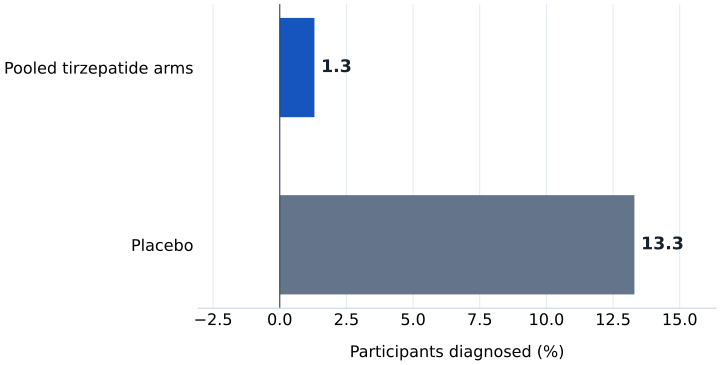
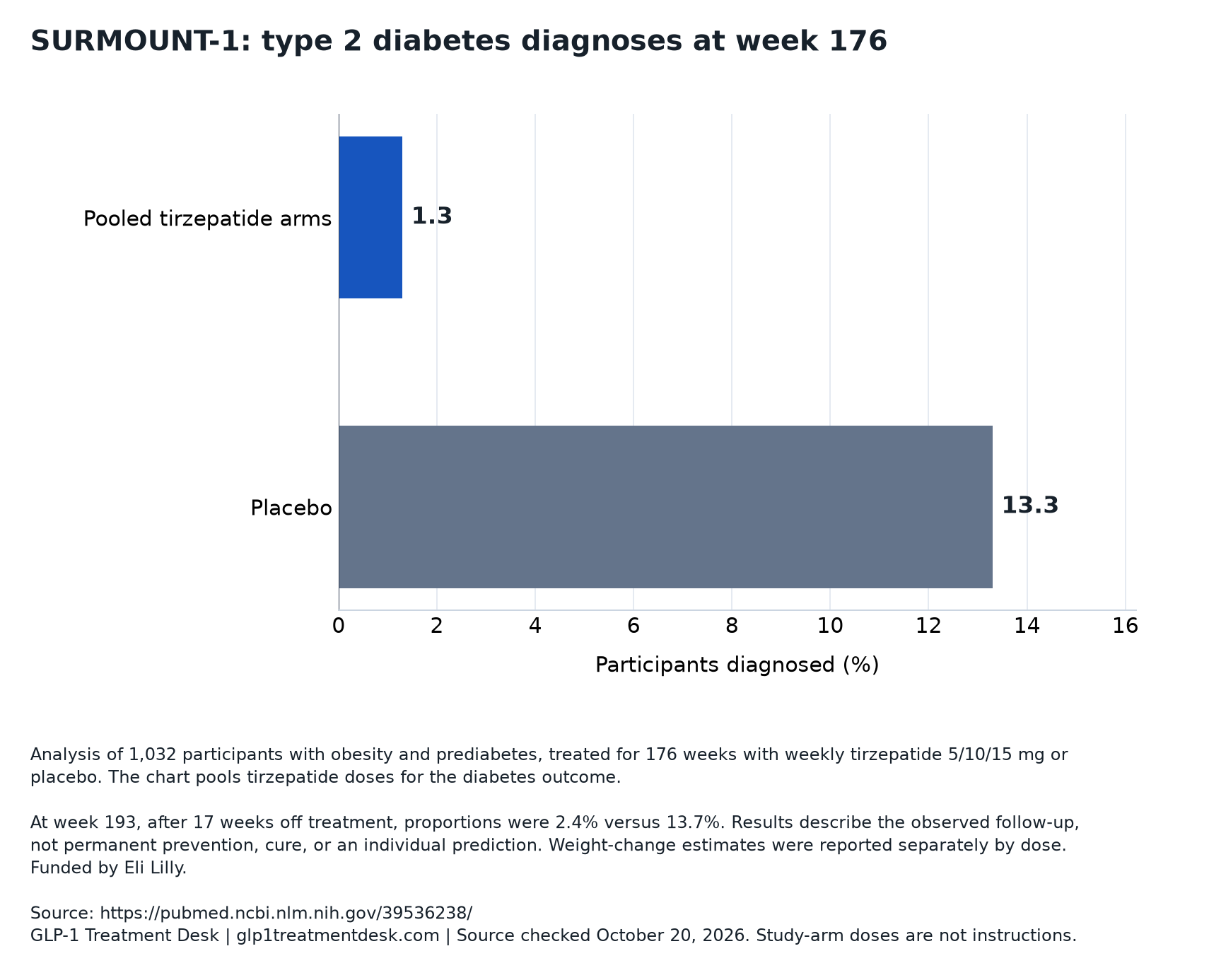
A diabetes-prevention result asks a different question from a weight-loss result: not simply how much weight changed, but whether fewer people developed a disease over time. The three-year SURMOUNT-1 analysis addressed that question in 1,032 participants who entered the trial with both obesity and prediabetes. At 176 weeks, 1.3% of participants assigned to tirzepatide had developed type 2 diabetes, compared with 13.3% assigned to placebo.
That large difference supports prevention or delay during the period studied, not a claim of cure or permanent protection. Participants were also observed for 17 weeks after their assigned treatment ended, providing a limited view of what followed withdrawal. For people evaluating a long-term care arrangement, the scientific distinction matters: a treatment result measured over years cannot be reduced to a prescription transaction or a promise about what happens after care ends.
At a glance
- Population
- The three-year analysis included 1,032 participants with obesity and prediabetes from the 2,539-person SURMOUNT-1 trial.
- Study treatment
- Participants were assigned to once-weekly subcutaneous tirzepatide at 5 mg, 10 mg, or 15 mg, or placebo. These doses identify research arms, not treatment instructions.
- Diabetes at 176 weeks
- Diabetes occurred in 1.3% of pooled tirzepatide participants versus 13.3% with placebo; the reported hazard ratio was 0.07.Sources: [1]
- After treatment ended
- At week 193, after 17 weeks off assigned treatment, cumulative diabetes proportions were 2.4% versus 13.7%; the reported hazard ratio was 0.12.Sources: [1]
- Safety findings
- Apart from COVID-19, gastrointestinal events were the most common adverse events; most were mild to moderate and concentrated during early dose escalation.Sources: [1]
A defined prediabetes population—not everyone seeking weight treatment
SURMOUNT-1 was a phase 3 randomized, double-blind, placebo-controlled trial. Randomization assigned participants to treatment by chance, while blinding concealed assignments during treatment. The original trial enrolled 2,539 adults without diabetes who had a body mass index of at least 30, or at least 27 with a weight-related complication. Body mass index relates weight to height; it does not directly measure body composition.
The longer diabetes-progression analysis concerned the 1,032 participants who had both obesity and prediabetes at entry. Prediabetes indicates blood glucose above the normal range but below the diagnostic range for diabetes. This was therefore a population already at elevated risk, not a trial of universal diabetes prevention or treatment of established diabetes.
The indexed abstract does not provide detailed baseline characteristics specifically for these 1,032 participants. The original trial’s mean body mass index of 38.0 describes the full cohort, not necessarily this subgroup. Keeping those populations separate prevents a common interpretive error: assigning the characteristics or outcomes of an entire trial to one selected analysis.
What the 176-week comparison actually tested
Participants were originally assigned in equal proportions to three tirzepatide arms or placebo. Tirzepatide was administered once weekly by subcutaneous injection, meaning under the skin. Participants in the obesity-and-prediabetes analysis continued their assigned treatment for 176 weeks, followed by 17 weeks off treatment or placebo. The study therefore combined a long treatment comparison with a much shorter post-treatment observation.
The original 72-week report had two coprimary endpoints: percentage weight change and the proportion losing at least 5% of baseline weight. In the three-year report, weight change at week 176 and diabetes onset through weeks 176 and 193 were three key secondary endpoints. They were controlled for type I error, meaning the statistical testing addressed the chance of false-positive findings across these specified comparisons.
Both reports identify Eli Lilly as the funder. This analysis uses the indexed primary report abstracts and available official NIDDK and FDA material; it does not represent examination of all full texts, protocols, or supplements. The abstracts establish the main design and findings, but leave some diagnostic, missing-data, and follow-up details unavailable.
| Window | What was compared | What it can establish |
|---|---|---|
| Baseline to week 176 | Assigned tirzepatide versus placebo during treatment | Diabetes progression and weight change during roughly three years of assigned treatment |
| Baseline to week 193 | Cumulative outcomes including 17 weeks off assigned treatment | Whether the between-group difference remained over a short post-treatment interval |
STUDY DATA · GLP-1 Treatment Desk
SURMOUNT-1: type 2 diabetes diagnoses at week 176
Analysis of 1,032 participants with obesity and prediabetes, treated for 176 weeks with weekly tirzepatide 5/10/15 mg or placebo. The chart pools tirzepatide doses for the diabetes outcome.
| Study group | Participants diagnosed (%) |
|---|---|
| Pooled tirzepatide arms | 1.3 |
| Placebo | 13.3 |
At week 193, after 17 weeks off treatment, proportions were 2.4% versus 13.7%. Results describe the observed follow-up, not permanent prevention, cure, or an individual prediction. Weight-change estimates were reported separately by dose. Funded by Eli Lilly.
Original visualization of published aggregate data. No individual prediction or provider performance is represented. Original research ↗
Reading 1.3% versus 13.3% without confusing the measures
At 176 weeks, the reported diabetes proportions differed by 12.0 percentage points: 13.3% minus 1.3%. Expressed as a simple illustration, those percentages correspond to approximately 13 versus 133 diagnoses per 1,000 comparable participants over that observation period. This translation explains scale; it is not a prediction for any particular group of 1,000 patients.
The reported hazard ratio was 0.07, with a 95% confidence interval printed in the abstract as 0.0 to 0.1. A hazard ratio compares the rate at which events arise over time, rather than merely dividing the final percentages. Its point estimate corresponds to a 93% lower hazard. The rounded lower confidence limit should not be interpreted as proof that the true hazard could literally be zero.
By contrast, dividing 1.3 by 13.3 gives an approximate end-of-period risk ratio of 0.098, or about a 90% relative reduction in the reported proportions. That differs from the hazard reduction because the measures answer different questions and the percentages are rounded. The trial reported P<0.001 for the diabetes comparison, but statistical strength does not determine how long protection will last.
Diabetes results were pooled; weight results were dose-specific
The three-year diabetes percentages combine participants assigned to the three tirzepatide doses. Weight outcomes, however, were reported separately: mean changes were −12.3% with 5 mg, −18.7% with 10 mg, and −19.7% with 15 mg, compared with −1.3% with placebo. Each weight comparison with placebo had P<0.001. The abstract does not give confidence intervals for these week-176 weight estimates.
This reporting structure matters. The pooled 1.3% diabetes result cannot be assigned separately to each dose, nor does it establish that higher doses prevented more diabetes than lower doses. The numerical weight differences between tirzepatide arms also do not, by themselves, establish statistically significant differences between those arms.
Percentage weight change is relative to each participant’s starting weight; it is not a percentage-point change in body mass index or a direct measure of fat loss. Readers interested in that separate measurement question can consult the SURMOUNT-1 body-composition analysis. The diabetes analysis itself does not establish how changes in fat and lean tissue contributed to progression.
| Assigned arm | Mean weight change at week 176 | Diabetes reporting |
|---|---|---|
| Tirzepatide 5 mg | −12.3% | Included in pooled tirzepatide estimate |
| Tirzepatide 10 mg | −18.7% | Included in pooled tirzepatide estimate |
| Tirzepatide 15 mg | −19.7% | Included in pooled tirzepatide estimate |
| Placebo | −1.3% | 13.3% diagnosed by week 176 |
Seventeen weeks off treatment is informative—but short
By week 193, after 17 weeks off assigned treatment, cumulative diabetes proportions were 2.4% in the tirzepatide groups and 13.7% with placebo. The reported hazard ratio was 0.12, with a 95% confidence interval of 0.1 to 0.2 and P<0.001. These are outcomes through the full 193-week period, not a hazard ratio confined to the 17 weeks after withdrawal.
The reported cumulative proportion increased by 1.1 percentage points in the tirzepatide groups between the two time points, compared with 0.4 percentage points with placebo. Those arithmetic differences describe the published percentages. They should not be converted into precise post-withdrawal incidence rates without the relevant denominators, event timing, and analysis details.
The between-group separation clearly remained at week 193, but this observation cannot establish lifelong prevention. Some diagnoses may have been avoided within the study window; others may have been postponed beyond it. Distinguishing those possibilities requires much longer observation. The study also does not show whether all participants retained the same degree of protection once treatment stopped.
Why the trial cannot separate weight-related and other effects on diabetes progression
Randomization supports attributing the overall difference between assigned tirzepatide and placebo to the treatment strategy under study. It does not separate every pathway through which that difference arose. Tirzepatide acts at glucose-dependent insulinotropic polypeptide and glucagon-like peptide-1 receptors, commonly abbreviated GIP and GLP-1. The trial simultaneously observed substantial weight reduction and fewer diabetes diagnoses.
Those parallel findings do not establish how much of the diabetes effect resulted from weight loss versus other metabolic effects. A mechanistic explanation would require additional analyses designed to distinguish those pathways. The pooled diabetes reporting and dose-specific weight reporting are not enough to calculate a dose-by-dose relationship between pounds lost and diabetes prevented.
Nor is a diabetes diagnosis interchangeable with a heart, kidney, or survival outcome. This report does not establish reductions in those complications. Prevention of progression is clinically meaningful on its own, but extending it into claims about every downstream consequence would go beyond the measured findings.
The safety record includes tolerability problems
In the three-year report, gastrointestinal events were the most common adverse events other than COVID-19. Most were mild to moderate and occurred primarily during the first 20 weeks, when doses were being escalated. Investigators reported no new safety signals. That means no newly identified pattern was reported; it does not mean adverse effects were absent or that every participant tolerated treatment.
The original 72-week report provides numerical discontinuation data: adverse events led to treatment discontinuation in 4.3%, 7.1%, and 6.2% of participants assigned to 5 mg, 10 mg, and 15 mg, respectively, versus 2.6% with placebo. Those figures concern the original full trial population and observation period, not specifically the three-year prediabetes subgroup.
The longer abstract does not provide detailed rates for individual gastrointestinal events or a complete serious-adverse-event breakdown. Consequently, benefit and tolerability cannot be reduced to a single reassuring label. The concentration of symptoms during escalation also makes early treatment experience relevant to whether a years-long treatment strategy remains workable.
Maintenance trials ask a related, not identical, question
SURMOUNT-MAINTAIN examined weight maintenance rather than three-year diabetes prevention. After a 60-week open-label tirzepatide period, 378 participants were randomized to continue their maximum tolerated study dose, reduce to 5 mg, or switch to placebo for another 52 weeks. This selected population had already completed an initial treatment period, unlike a trial starting with untreated participants.
Estimated weight changes from the original baseline to week 112 were −21.9% with continued maximum tolerated dosing, −16.6% with 5 mg, and −9.9% with placebo. Corresponding 95% confidence intervals were −23.5 to −20.3, −18.0 to −15.1, and −11.1 to −8.8. Rescue treatment was allowed after substantial regain, and the analysis used assumptions to account for rescue rather than treating it as uncomplicated continued assigned therapy.
These results add evidence about maintaining weight reduction, not proof that a particular maintenance dose preserves SURMOUNT-1’s diabetes effect. The SURMOUNT-4 withdrawal discussion offers another place to examine why continuation and withdrawal designs need separate interpretation. Findings from different trials should not be assembled into an untested dose-reduction or diabetes-prevention plan.
Translating a multiyear endpoint into continuity questions
Editorial interpretation: the care implication is accountability over time, not a prescribed monitoring schedule. Because the study began with documented prediabetes and measured progression over years, a meaningful clinical discussion needs an accurate history and clarity about who interprets changing health information. A weight record alone does not reproduce the trial’s diabetes endpoint.
NIDDK advises that medication decisions consider health history, other medicines, benefits, adverse effects, and cost; duration depends on benefit and tolerability. Its guidance also recognizes that weight regain can occur after stopping. The care-journey guide and changing-plans guide frame practical questions about who remains responsible for follow-up and handoffs when an arrangement changes.
Editorial interpretation: clinical continuity and payment continuity are different issues. A trial result is not an insurance guarantee or a promise that a service maintains responsibility after cancellation. Readers comparing arrangements can use the CoreAge Rx review to check documentary terms; that invitation does not imply access to the studied product, diabetes-specific care, or trial-like outcomes.
Product identity and missing details limit transferability
The intervention studied was injected tirzepatide, not an oral formulation or any product carrying a similar ingredient description. FDA states that compounded drugs are not FDA approved or reviewed before marketing for safety, effectiveness, or quality. It recommends compounded products only when a patient’s needs cannot be met by an FDA-approved drug.
SURMOUNT-1 therefore cannot establish equivalence for compounded preparations, other routes, or other formulations. The product-and-route guide explains why those distinctions belong in a care discussion. The same boundary applies to service providers: a drug trial does not test a platform’s intake, dispensing, or follow-up system.
Important unresolved details include the subgroup’s full demographic profile, diabetes-confirmation procedures, missing-data handling, and treatment persistence over three years. Their absence from the accessible abstract limits independent assessment, even with a large reported effect. Most importantly, the 17-week withdrawal observation cannot answer what happens over several subsequent years or identify whose diabetes progression was durably prevented.
Questions & answers
Does this show that tirzepatide cures prediabetes?
No. The report shows fewer diagnoses of type 2 diabetes over defined observation periods among participants who began with obesity and prediabetes. It does not establish permanent normalization of glucose regulation or lifelong protection. Prevention and delay remain difficult to distinguish when follow-up ends before the rest of participants’ lives.
Does the 93% figure mean 93 out of every 100 people avoided diabetes?
No. It describes the relative reduction in the reported hazard, based on a hazard ratio of 0.07. The observed proportions were 1.3% versus 13.3%, an absolute difference of 12.0 percentage points at 176 weeks. Relative and absolute measures describe different aspects of the same comparison.
Can the study identify the best dose for preventing diabetes?
Not from the reported abstract. Diabetes outcomes were pooled across the three tirzepatide arms, while weight changes were reported separately. Greater average weight reduction in one arm does not establish superior diabetes prevention in that arm. The research doses should not be read as individualized treatment instructions.
Did protection disappear immediately after treatment ended?
The cumulative difference remained substantial after 17 weeks off treatment: 2.4% versus 13.7% had developed diabetes by week 193. But cumulative outcomes include the preceding treatment years. They do not isolate protection during withdrawal, and the short interval cannot establish how long the separation would persist.
What should a care-continuity discussion clarify?
It can clarify who holds the clinical history, reviews outcomes and adverse effects, and remains responsible during a handoff. Those are accountability questions, not a testing schedule or treatment plan. Costs and coverage also need separate clarification because a clinical trial’s results do not determine insurance benefits or a service’s contractual obligations.
Our assessment
SURMOUNT-1 provides strong randomized evidence that assigned tirzepatide substantially reduced progression to type 2 diabetes over roughly three years in participants with obesity and prediabetes. The size of the absolute difference makes this more than a weight-loss finding, while the pooled diabetes analysis prevents dose-specific prevention claims. Persistence of the cumulative difference after 17 weeks off treatment is informative but insufficient to establish permanent protection. The practical interpretation is longitudinal: clinical history, tolerability, outcome assessment, and clear responsibility for care matter when the demonstrated benefit was measured over years.
Sources & documentation
Scientific and official sources consulted October 20, 2026. Study findings apply to the populations, products and time periods described; they are not provider outcome data.
- Tirzepatide for Obesity Treatment and Diabetes Prevention. ↗
- Tirzepatide Once Weekly for the Treatment of Obesity. ↗
- NIDDK prescription medications for overweight and obesity ↗
- FDA concerns about unapproved GLP-1 drugs ↗
- Tirzepatide for maintenance of bodyweight reduction in people with obesity in the USA (SURMOUNT-MAINTAIN): a multicentre, double-blind, randomised, placebo-controlled trial. ↗