SURMOUNT-OSA tested a concrete question: could tirzepatide reduce the frequency of disrupted breathing during sleep in adults with obesity and moderate-to-severe obstructive sleep apnea? Across two 52-week trials, the medication produced larger improvements than placebo. The differences were measured in breathing events per hour of sleep—not events per night, pounds lost, or a percentage of participants cured.
The findings also raise an important care-continuity question. A lower sleep-apnea index does not, by itself, establish that an individual’s disease has resolved or that existing treatment can end. One trial enrolled people not using positive airway pressure, or PAP, while the other enrolled PAP users. This analysis uses the indexed primary report abstract and available official FDA and NIDDK material; it does not represent a review of all protocols, supplements, or full trial texts.
At a glance
- Study population
- The FDA describes 469 adults with obesity and moderate-to-severe obstructive sleep apnea, without type 2 diabetes, across two randomized trials.Sources: [2]
- Two distinct PAP histories
- Trial 1 enrolled participants not receiving PAP at baseline; trial 2 enrolled participants receiving PAP.Sources: [1]
- Primary measurement
- The primary endpoint was the change at 52 weeks in the apnea-hypopnea index, or AHI: breathing interruptions per hour of sleep.Sources: [1]
- Placebo-adjusted results
- The estimated AHI differences favored tirzepatide by 20.0 events per hour in trial 1 and 23.8 events per hour in trial 2.Sources: [1]
- Safety and sponsorship
- The most frequent adverse events were gastrointestinal and mostly mild to moderate. Eli Lilly funded SURMOUNT-OSA.Sources: [1]
Two trials answered related—but different—questions
SURMOUNT-OSA consisted of two phase 3, double-blind, randomized, placebo-controlled trials. Random assignment helps separate a treatment effect from differences that might otherwise determine who receives medication. Double blinding means that treatment allocation was concealed from participants and investigators, reducing the potential for expectations to influence reporting or management.
PAP history determined trial enrollment. Trial 1 included people not receiving PAP at baseline; the FDA describes this population as unable or unwilling to use it. Trial 2 included people already receiving PAP. These are clinically distinct starting points, even though both trials studied obesity and moderate-to-severe obstructive sleep apnea.
Within each trial, participants were assigned in a 1:1 ratio to tirzepatide or placebo. Neither trial was described as a direct comparison of tirzepatide against PAP. The design therefore supports conclusions about medication versus placebo within each population, not a ranking of medication and PAP as interchangeable treatments. Keeping the two trials separate is essential to understanding what the results actually establish.
| Design feature | Trial 1 | Trial 2 |
|---|---|---|
| PAP status at baseline | Not receiving PAP | Receiving PAP |
| Mean baseline AHI | 51.5 events per hour | 49.5 events per hour |
| Mean baseline BMI | 39.1 | 38.7 |
| Randomized comparison | Tirzepatide versus placebo | Tirzepatide versus placebo |
| Primary follow-up point | 52 weeks | 52 weeks |
What was studied, and who the findings describe
The FDA’s account gives a combined enrollment of 469 adults without type 2 diabetes. All had obesity and moderate-to-severe obstructive sleep apnea. Mean baseline body-mass index, a weight-to-height measure, was 39.1 in trial 1 and 38.7 in trial 2. These population characteristics matter: results in this group do not automatically establish the same benefit in people without obesity, those with milder apnea, or other unstudied populations.
The intervention was a weekly tirzepatide injection, using a maximum tolerated dose of 10 or 15 mg, compared with placebo for 52 weeks. Those doses identify the research arms; they are not instructions for starting or changing treatment. The abstract does not provide enough detail to reconstruct dose escalation, individual dose histories, or every adjustment made during follow-up.
On December 20, 2024, the FDA announced approval of Zepbound, the tirzepatide product, for moderate-to-severe obstructive sleep apnea in adults with obesity, alongside reduced-calorie diet and increased physical activity. That announcement establishes the historical approval context. It is not a substitute for current complete prescribing information or an individual eligibility assessment.
STUDY DATA · GLP-1 Treatment Desk
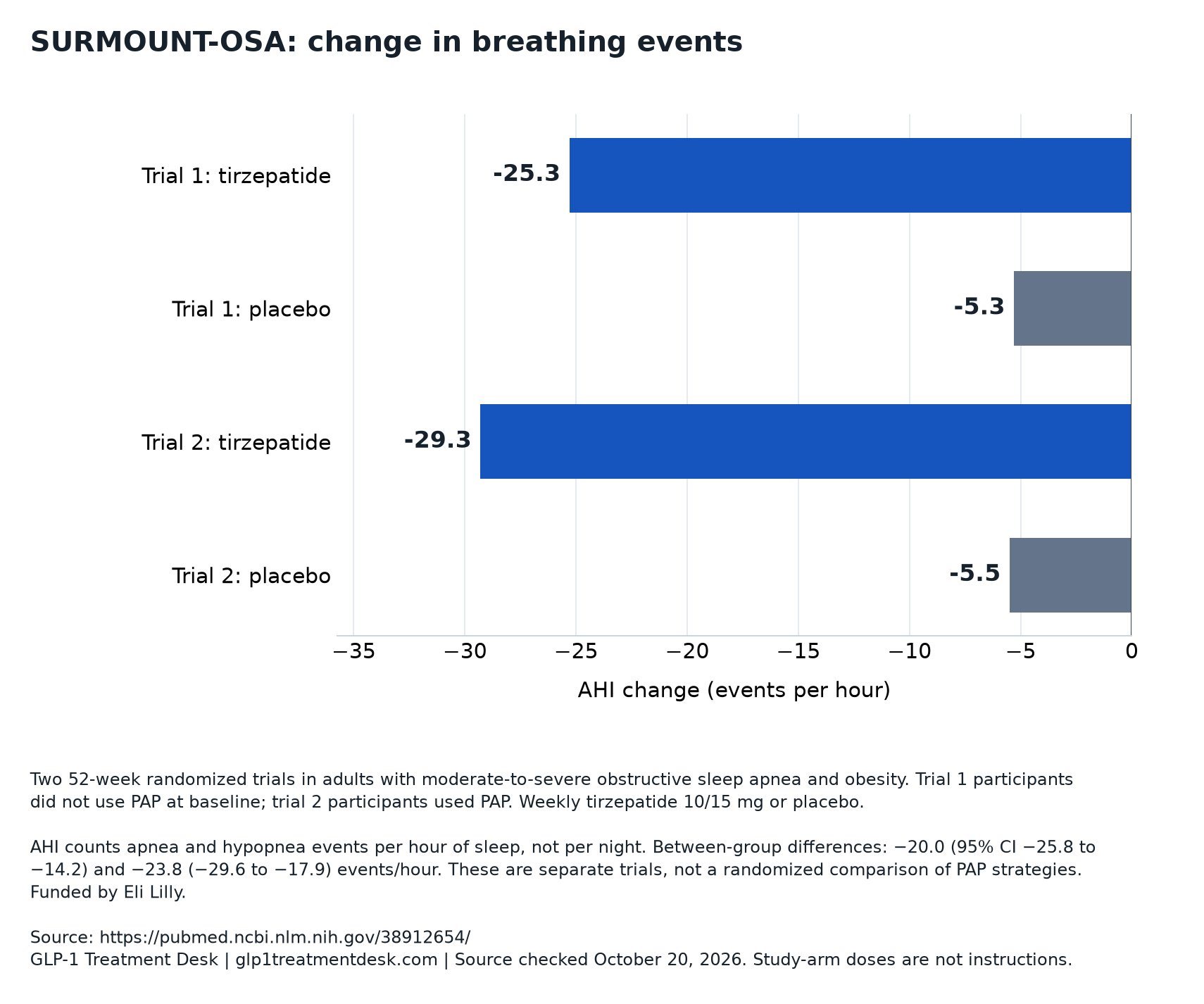
SURMOUNT-OSA: change in breathing events
Two 52-week randomized trials in adults with moderate-to-severe obstructive sleep apnea and obesity. Trial 1 participants did not use PAP at baseline; trial 2 participants used PAP. Weekly tirzepatide 10/15 mg or placebo.
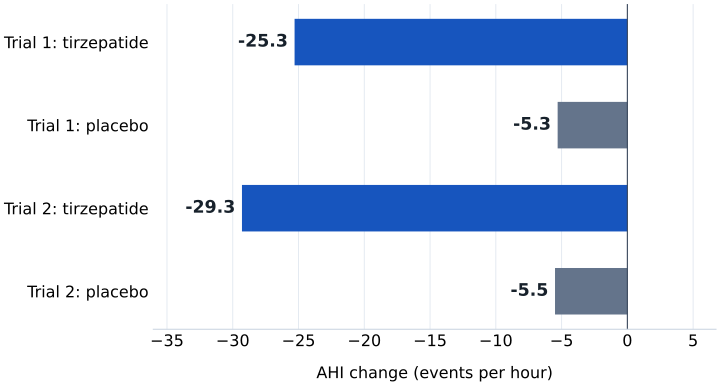
| Study group | AHI change (events per hour) |
|---|---|
| Trial 1: tirzepatide | -25.3 |
| Trial 1: placebo | -5.3 |
| Trial 2: tirzepatide | -29.3 |
| Trial 2: placebo | -5.5 |
AHI counts apnea and hypopnea events per hour of sleep, not per night. Between-group differences: −20.0 (95% CI −25.8 to −14.2) and −23.8 (−29.6 to −17.9) events/hour. These are separate trials, not a randomized comparison of PAP strategies. Funded by Eli Lilly.
Original visualization of published aggregate data. No individual prediction or provider performance is represented. Original research ↗
AHI is an hourly rate, not a nightly total
The apnea-hypopnea index counts apneas and hypopneas during an hour of sleep. In plain language, it measures the frequency of breathing interruptions, including episodes of absent or reduced breathing. AHI is a rate: 20 fewer events per hour is neither 20 fewer events over an entire night nor a 20% reduction.
For an arithmetic illustration, an AHI of 50 events per hour sustained over six hours of sleep corresponds to about 300 recorded events. A reduction of 20 events per hour over that same hypothetical duration corresponds to about 120 fewer events. This is an explanation of units, not a reported nightly result; actual sleep duration and event frequency vary.
Participants began with mean AHIs of approximately 50 events per hour, indicating a high frequency of disrupted breathing. AHI was the primary endpoint because it directly addresses that frequency. It does not capture everything about sleep apnea, however. The depth and duration of oxygen reductions, symptoms, and functional effects provide additional information that an event count alone cannot supply.
The treatment effect is the difference between changes
In trial 1, mean AHI fell by 25.3 events per hour with tirzepatide and by 5.3 with placebo. Subtracting the placebo change from the medication change yields the estimated treatment difference: −20.0 events per hour. In trial 2, the corresponding reductions were 29.3 and 5.5, yielding a difference of −23.8 events per hour.
The placebo comparison matters because the full improvement observed in a medication group cannot automatically be attributed to the medication. Changes also occurred in the comparison groups. Randomization allows the between-group difference to serve as the more informative estimate of the medication’s added effect under trial conditions.
The 95% confidence intervals for those differences were −25.8 to −14.2 events per hour in trial 1 and −29.6 to −17.9 in trial 2. Both intervals lie entirely on the side favoring tirzepatide. They describe uncertainty around the estimated average treatment difference, not the range of responses an individual should expect. The larger numerical effect in trial 2 does not establish that PAP users benefit more; the trials were not a randomized comparison of PAP histories.
| Reported measure | Trial 1 | Trial 2 |
|---|---|---|
| Tirzepatide mean change, 95% CI | −25.3 (−29.3 to −21.2) | −29.3 (−33.2 to −25.4) |
| Placebo mean change, 95% CI | −5.3 (−9.4 to −1.1) | −5.5 (−9.9 to −1.2) |
| Treatment difference, 95% CI | −20.0 (−25.8 to −14.2) | −23.8 (−29.6 to −17.9) |
Large average improvements can leave residual apnea
A substantial reduction and complete disease resolution are different outcomes. Someone starting with frequent breathing interruptions can improve considerably while still having clinically important sleep apnea. The abstract reports average changes, but it does not supply the individual trajectories needed to determine who had persistent disease, who crossed a diagnostic threshold, or who experienced little improvement.
It is also inappropriate to subtract a treatment-group change from the overall trial’s baseline mean and present the result as that group’s exact final AHI. The baseline figures reported here describe each trial population, not necessarily the precise baseline value underlying each treatment estimate. Such arithmetic can illustrate scale but cannot reconstruct an unreported endpoint.
For PAP users, another important missing detail is the complete sleep-testing and PAP-handling protocol. Baseline PAP use alone does not reveal how each endpoint measurement was obtained. Improvement is therefore not permission to stop PAP. Diagnostic follow-up remains relevant because symptoms, treatment history, and objective breathing measurements answer different questions about residual disease.
Oxygen burden and reported sleep problems add context
The investigators also prespecified secondary endpoints covering percentage change in AHI, body weight, hypoxic burden, sleep impairment and disturbance reported by participants, high-sensitivity C-reactive protein, and systolic blood pressure. Hypoxic burden describes the burden of low oxygen associated with sleep-disordered breathing. High-sensitivity C-reactive protein is a blood marker of inflammation.
The abstract reports statistically significant improvements versus placebo for all key secondary endpoints, using an analysis that accounted for testing multiple outcomes. That strengthens the evidence beyond a single favorable measure. However, the accessible abstract does not give the numerical estimates or confidence intervals for these secondary results, so their magnitudes cannot be independently explained here.
These outcomes are complementary rather than interchangeable. Patient-reported improvement speaks to experienced sleep problems; AHI measures breathing-event frequency; hypoxic burden addresses oxygen consequences. Improvements across them support a broader treatment effect, but do not prove that every participant improved in every domain. Nor does simultaneous weight loss establish exactly how much of the sleep benefit was caused by weight change rather than other pathways.
Tolerability is part of interpreting a year-long result
Gastrointestinal adverse events were the most frequently reported adverse events with tirzepatide and were mostly mild to moderate in severity. That is a meaningful safety finding, but it is not equivalent to saying treatment was harmless or easy for everyone. Severity categories and a person’s ability to continue treatment are related but distinct considerations.
The indexed SURMOUNT-OSA abstract does not provide event-specific rates, discontinuation percentages, or enough information to characterize uncommon harms. It would be misleading to fill those gaps with percentages from another tirzepatide study. Different populations, follow-up periods, and trial procedures can produce different observed tolerability patterns.
NIDDK places benefits, adverse effects, other medicines, and health history within the same treatment discussion. The practical implication is that symptom reporting needs a clinical destination, not just a customer-service channel. The guide to follow-up and tolerability responsibilities explains that care distinction. This is an organizational interpretation of the evidence, not a claim that any particular follow-up model was tested in SURMOUNT-OSA.
Sleep improvement is not proof of fewer cardiovascular events
SURMOUNT-OSA measured breathing, sleep-related outcomes, weight, and selected physiological markers. It did not establish a reduction in heart attacks, strokes, cardiovascular death, or heart-failure events. Better blood pressure or inflammatory measurements cannot be substituted for direct evidence about those clinical outcomes.
SUMMIT was a separate Eli Lilly–funded trial in 731 people with obesity and heart failure with preserved ejection fraction. Over a median 104-week follow-up, cardiovascular death or worsening heart failure occurred in 9.9% with tirzepatide and 15.3% with placebo: hazard ratio 0.62, with a 95% confidence interval of 0.41 to 0.95. The 5.4-percentage-point difference in observed proportions is distinct from the hazard ratio, which compares event hazards over time.
The composite also did not mean every component improved. Cardiovascular deaths numbered eight versus five, with a highly uncertain hazard ratio of 1.58 and confidence interval of 0.52 to 4.83. Adverse events leading to discontinuation occurred in 6.3% versus 1.4%, mainly gastrointestinal. The separate SUMMIT analysis explains that composite. Likewise, SURMOUNT-4’s withdrawal design addresses a different question from the 52-week sleep-apnea comparison.
Clinical history needs to travel across care handoffs
The scientific distinction between the two trials makes prior treatment history especially important. Knowing that someone has sleep apnea is not the same as knowing the original diagnostic findings, whether PAP is being used, or what symptoms persist. SURMOUNT-OSA provides group-level evidence; applying that evidence requires an accurate account of the person’s existing care.
Editorial interpretation: continuity means making responsibilities visible. Useful questions concern who holds sleep-study records, who evaluates persistent symptoms, who receives medication-related concerns, and who coordinates with an existing sleep clinician. These are questions about ownership of care, not prescriptions for particular tests or follow-up intervals. The care-journey guide maps those roles.
Financial arrangements can change while clinical needs remain. NIDDK notes that coverage varies and that a favorable clinical result is not an insurance promise. The guide to changing programs without losing track of care separates those issues. For a concrete document-reading exercise, the Ro review can help readers inspect stated service terms; that invitation does not imply availability of the studied product, sleep-apnea care, or trial-like outcomes.
The evidence belongs to a specific intervention and timeframe
SURMOUNT-OSA supports a 52-week comparison involving injected tirzepatide in the studied population. It does not establish that oral products, other formulations, or compounded preparations produce the same sleep outcomes. Sharing an ingredient name is not enough to demonstrate equivalent product quality, delivery, exposure, or clinical effect.
FDA states that compounded drugs are not FDA approved and are not reviewed before marketing for safety, effectiveness, or quality. Its concerns about unapproved GLP-1 products include dosing errors; reports alone cannot establish event rates or causation. The product, route, and pharmacy guide helps distinguish those documentary questions without treating an alternative preparation as trial-equivalent.
Important scientific questions remain after one year: how durable are the breathing improvements, how do individual responses evolve, and what happens when treatment changes or ends? NIDDK notes that weight regain can occur after stopping weight-management medication, but that general observation does not quantify recurrence of sleep apnea after SURMOUNT-OSA. Long-term sleep outcomes require their own evidence rather than extrapolation from weight alone.
Questions & answers
Does a 20-event improvement mean 20 fewer interruptions each night?
No. The estimated trial 1 treatment difference was 20.0 fewer events per hour of sleep compared with placebo. A nightly count depends on sleep duration and the pattern of events. It is also an average between-group difference, not a guaranteed reduction for each participant.
Did the trials show that tirzepatide can replace PAP?
They did not directly compare tirzepatide with PAP as alternative treatments. One trial enrolled nonusers and the other PAP users, with medication versus placebo comparisons inside each trial. An improved AHI does not authorize stopping PAP; existing treatment decisions require the treating clinician and appropriate evaluation of residual disease.
Were people with type 2 diabetes included?
The FDA’s description specifies that the 469 participants did not have type 2 diabetes. That limits direct generalization. It does not establish that people with diabetes cannot benefit; it means this particular trial population does not directly answer that question.
Can better sleep symptoms confirm that apnea has resolved?
Symptom improvement is valuable, but it is not the same measurement as breathing-event frequency or oxygen burden. SURMOUNT-OSA assessed these separately. The abstract’s average results cannot establish an individual’s diagnostic status, so feeling better alone cannot demonstrate that residual sleep apnea is absent.
Does the research establish which online provider to use?
No. The trials evaluated a medication intervention, not commercial platforms, contracts, pharmacies, or care-handoff systems. Editorially, the evidence makes clear responsibility for history, adverse effects, and ongoing sleep care worth examining. It does not establish provider-specific availability, quality, coverage, or outcomes.
Our assessment
SURMOUNT-OSA provides strong randomized evidence that injected tirzepatide reduced average sleep-apnea event frequency over 52 weeks in adults with obesity and moderate-to-severe disease, both among baseline PAP users and nonusers. The placebo-adjusted effects were substantial, and complementary sleep and physiological measures improved. The evidence does not establish universal resolution, replacement of PAP, or cardiovascular-event prevention in this population. Its practical value is greatest when the numerical result is connected to accurate clinical history, assessment of residual disease, tolerability, and clear responsibility for continuing care.
Sources & documentation
Scientific and official sources consulted October 20, 2026. Study findings apply to the populations, products and time periods described; they are not provider outcome data.
- Tirzepatide for the Treatment of Obstructive Sleep Apnea and Obesity. ↗
- FDA approval of Zepbound for obstructive sleep apnea, December 20, 2024 ↗
- NIDDK prescription medications for overweight and obesity ↗
- Tirzepatide for Heart Failure with Preserved Ejection Fraction and Obesity. ↗
- FDA concerns about unapproved GLP-1 drugs ↗