The ESSENCE trial offers evidence that weekly injectable semaglutide can improve liver tissue findings in people with metabolic dysfunction-associated steatohepatitis, or MASH, and moderate or advanced scarring. At 72 weeks, more participants assigned semaglutide than placebo met each of the study’s two primary biopsy endpoints. Those findings supported an FDA accelerated approval for Wegovy injection in adults with MASH and moderate-to-advanced fibrosis. They do not, by themselves, establish fewer liver transplants or deaths.
The research pathway matters as much as the headline percentages: participants entered with biopsy-defined disease, underwent randomized treatment assignment, and were assessed against specific tissue-based criteria. This analysis uses the indexed primary research abstract and available official FDA material, rather than a review of all trial protocols, supplements, or full texts. Its focus is the reported 72-week analysis and the distinction between demonstrated tissue improvement and the longer-term clinical outcomes the trial was designed to investigate.
At a glance
- Trial population and assignment
- ESSENCE randomized 1,197 participants with biopsy-defined MASH and F2 or F3 fibrosis in a 2:1 ratio to weekly subcutaneous semaglutide 2.4 mg or placebo.Sources: [1]
- Planned interim analysis
- The 72-week report covered the first 800 participants: 534 assigned semaglutide and 266 assigned placebo.Sources: [1]
- MASH resolution endpoint
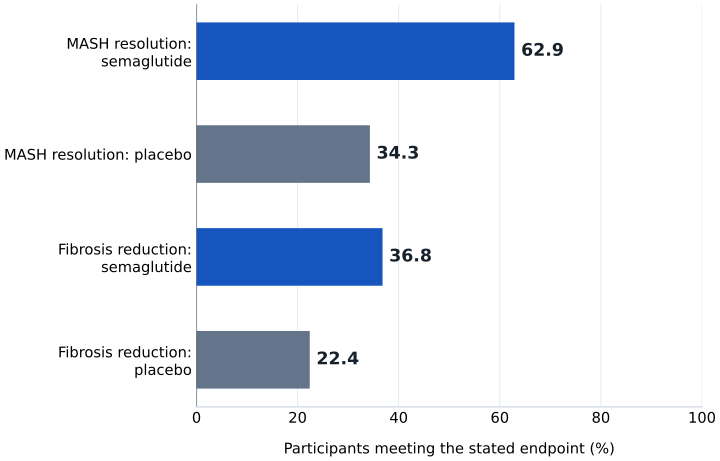
- Resolution without worsening fibrosis occurred in 62.9% versus 34.3%; the reported estimated difference was 28.7 percentage points, with a 95% confidence interval of 21.1 to 36.2.Sources: [1]
- Fibrosis improvement endpoint
- Fibrosis reduction without worsening steatohepatitis occurred in 36.8% versus 22.4%; the estimated difference was 14.4 percentage points, with a 95% confidence interval of 7.5 to 21.3.Sources: [1]
Entry required a defined liver disease—not simply excess weight
MASH involves liver fat accumulation accompanied by inflammation and tissue injury; fibrosis means scar tissue. ESSENCE enrolled people whose disease was established by liver biopsy and whose fibrosis was classified as stage 2 or 3, commonly shortened to F2 or F3. These are moderate or advanced fibrosis stages, not cirrhosis. The population therefore represented a specific point along the liver-disease spectrum rather than everyone with obesity, elevated liver enzymes, or fatty liver.
That distinction determines where the results apply most directly. A study requiring biopsy-defined MASH cannot establish the same response rate in people identified only through symptoms or an online intake questionnaire. Conversely, the entry requirement is a description of research eligibility, not an instruction that every person considering treatment must undergo the same diagnostic process.
FDA notes that MASH may remain without symptoms until substantial liver damage develops. This helps explain why symptom reports alone would be an inadequate substitute for the trial’s tissue-based eligibility. The central scientific question was whether treatment changed established liver pathology in this selected population—not whether weight loss alone identified who had MASH.
Randomization separated the drug comparison from background care
ESSENCE was a multicenter, randomized, double-blind, placebo-controlled phase 3 trial funded by Novo Nordisk. Its 1,197 participants were assigned in a 2:1 ratio to once-weekly subcutaneous semaglutide 2.4 mg or placebo, with treatment planned for 240 weeks. Subcutaneous means injected under the skin. The dose identifies the study arm; it is not an individualized treatment instruction.
Random assignment strengthens causal interpretation because treatment selection was not left to participants or clinicians. Double blinding reduces the opportunity for expectations about assignment to influence treatment behavior or evaluation. The unequal allocation placed roughly twice as many participants in the semaglutide arm, but a larger active-treatment group does not itself create an efficacy advantage: outcomes still had to be compared with placebo.
According to FDA’s account, both groups also received lifestyle intervention, and participants were on stable doses of lipid-lowering, glucose-management, and weight-loss medications. The comparison was therefore semaglutide versus placebo within that background—not medication versus no care. For a broader explanation of this distinction, see where GLP-1 trials fit into a care discussion.
STUDY DATA · GLP-1 Treatment Desk
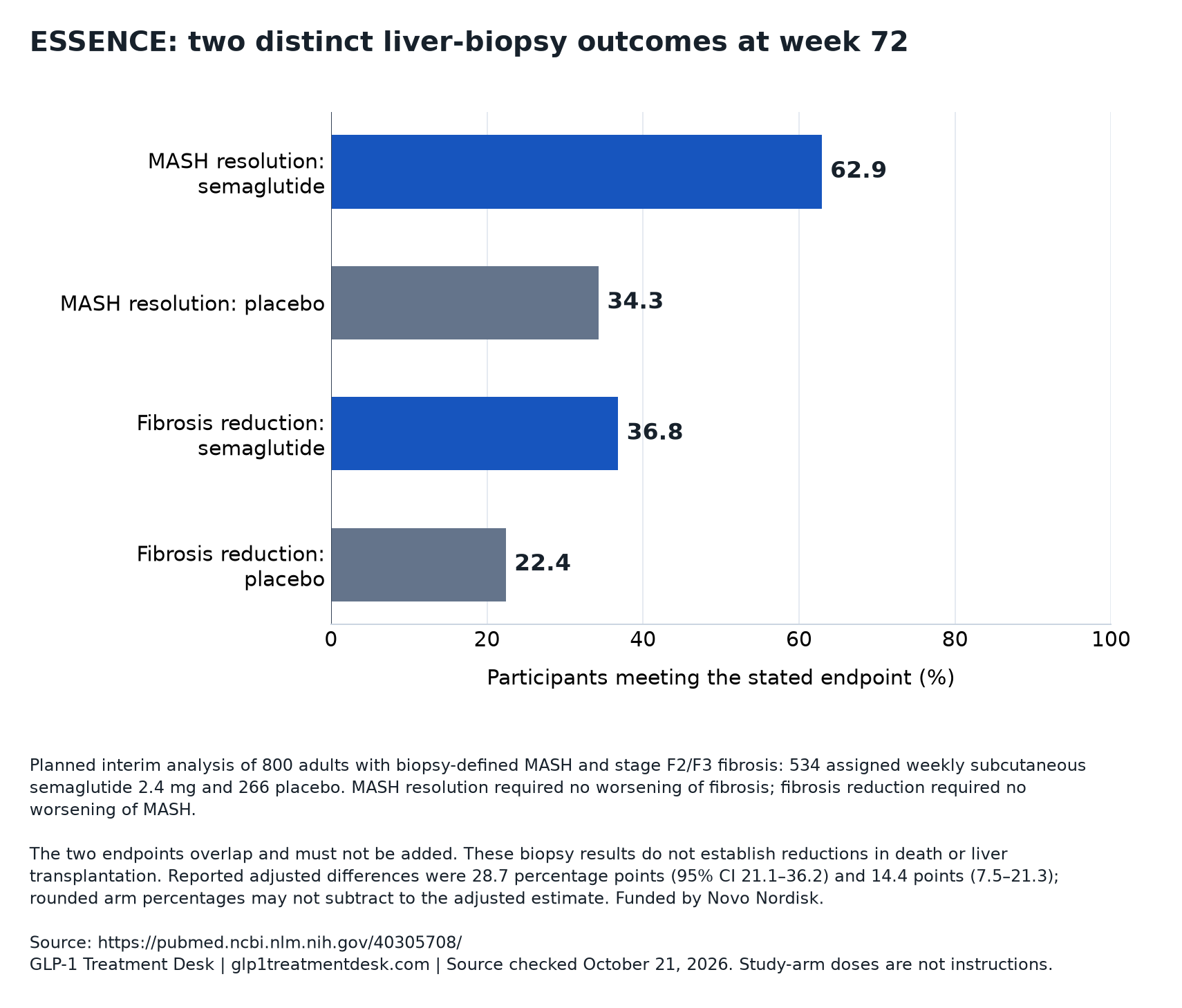
ESSENCE: two distinct liver-biopsy outcomes at week 72
Planned interim analysis of 800 adults with biopsy-defined MASH and stage F2/F3 fibrosis: 534 assigned weekly subcutaneous semaglutide 2.4 mg and 266 placebo. MASH resolution required no worsening of fibrosis; fibrosis reduction required no worsening of MASH.
| Study group | Participants meeting the stated endpoint (%) |
|---|---|
| MASH resolution: semaglutide | 62.9 |
| MASH resolution: placebo | 34.3 |
| Fibrosis reduction: semaglutide | 36.8 |
| Fibrosis reduction: placebo | 22.4 |
The two endpoints overlap and must not be added. These biopsy results do not establish reductions in death or liver transplantation. Reported adjusted differences were 28.7 percentage points (95% CI 21.1–36.2) and 14.4 points (7.5–21.3); rounded arm percentages may not subtract to the adjusted estimate. Funded by Novo Nordisk.
Original visualization of published aggregate data. No individual prediction or provider performance is represented. Original research ↗
The 72-week report was a planned look at the first 800 participants
The published abstract reports part 1: a planned interim analysis at week 72 involving the first 800 participants, including 534 assigned semaglutide and 266 assigned placebo. The full randomized population was 1,197. Keeping these denominators separate prevents a common reading error: the headline biopsy percentages describe the interim analysis population, not a completed 240-week assessment of everyone randomized.
A planned interim analysis is a scheduled evaluation before the longer trial finishes. It can provide meaningful evidence for its specified endpoints without answering every question in the overall research program. Here, the primary part 1 endpoints concerned liver histology—the appearance of tissue under microscopic assessment—rather than transplantation, liver failure, or survival.
The accessible abstract does not detail visit schedules, biopsy-reading procedures, treatment escalation, or how every missing assessment was handled. Those omissions limit an independent reconstruction of the full measurement pathway. They do not justify assuming that a routine commercial follow-up program uses the same procedures, or that any particular biopsy result guarantees a later clinical outcome.
Resolution and fibrosis improvement answered different questions
The first primary endpoint required resolution of steatohepatitis without worsening fibrosis. Steatohepatitis refers to the inflammatory liver disease process; fibrosis refers to scarring. A participant could meet this endpoint while still having existing scar tissue. Resolution in this setting should therefore not be translated into a claim that the liver became entirely normal or that all future liver risk disappeared.
The second primary endpoint reversed the emphasis: it required a reduction in fibrosis without worsening steatohepatitis. This guarded against calling a scar-stage improvement a success if the inflammatory disease worsened. The two endpoints examine related but distinct dimensions of disease, and neither requires the same pattern of change as the other.
The combined secondary endpoint required both steatohepatitis resolution and fibrosis reduction. Its lower response percentage is consistent with a more demanding joint requirement. These are overlapping response categories, not separate groups to be added together. Adding 62.9%, 36.8%, and 32.7% would count some people repeatedly and produce no meaningful overall success rate.
| Endpoint | Required improvement | Important boundary |
|---|---|---|
| Resolution without worsening fibrosis | Steatohepatitis resolved; fibrosis did not worsen | Does not require fibrosis reduction |
| Fibrosis reduction without worsening steatohepatitis | Fibrosis improved; steatohepatitis did not worsen | Does not require steatohepatitis resolution |
| Combined response | Steatohepatitis resolved and fibrosis improved | Overlaps with the primary response categories |
Reading the response differences without changing their meaning
For steatohepatitis resolution without worsening fibrosis, the reported proportions were 62.9% with semaglutide and 34.3% with placebo. The trial reported an estimated difference of 28.7 percentage points, with a 95% confidence interval from 21.1 to 36.2. Subtracting the displayed rounded percentages gives 28.6 points; the appropriate figure to retain is the report’s estimated 28.7-point difference rather than replacing it with arithmetic on rounded values.
A percentage-point difference compares two percentages on an absolute scale. As an interpretation of the estimate, roughly 29 more people per 100 met this tissue endpoint in the semaglutide group than in the placebo group under the trial conditions. It does not mean each person’s disease improved by 29%, nor is it a 29% relative reduction in liver failure.
For fibrosis reduction without worsening steatohepatitis, the difference was 14.4 percentage points, with a 95% confidence interval of 7.5 to 21.3. Both primary intervals excluded zero. Their widths still matter: the data support an advantage, while leaving uncertainty about its exact magnitude. These intervals describe treatment contrasts, not the range of possible responses for an individual.
| Outcome | Semaglutide versus placebo | Reported estimated difference, 95% CI |
|---|---|---|
| Resolution without worsening fibrosis | 62.9% versus 34.3% | 28.7 percentage points; 21.1 to 36.2 |
| Fibrosis reduction without worsening steatohepatitis | 36.8% versus 22.4% | 14.4 percentage points; 7.5 to 21.3 |
| Combined resolution and fibrosis reduction | 32.7% versus 16.1% | 16.5 percentage points; 10.2 to 22.8 |
| Mean body-weight change | −10.5% versus −2.0% | −8.5 percentage points; −9.6 to −7.4 |
Weight and pain findings did not tell the same story
Combined steatohepatitis resolution and fibrosis reduction occurred in 32.7% of semaglutide participants and 16.1% of placebo participants. The reported estimated difference was 16.5 percentage points, with a 95% confidence interval of 10.2 to 22.8. As with the first primary endpoint, subtraction of rounded displayed percentages does not exactly reproduce the reported estimate. The joint outcome strengthens the evidence that both disease dimensions improved in some participants.
Mean body weight declined 10.5% with semaglutide and 2.0% with placebo, an estimated between-group difference of −8.5 percentage points, with a 95% confidence interval of −9.6 to −7.4. These are group averages, not predictions for every participant. The report included the joint biopsy outcome, weight change, and bodily pain among secondary outcomes covered by its multiple-testing adjustment plan.
Bodily pain scores did not differ significantly between groups. That result prevents a broad claim that the biopsy findings were accompanied by demonstrated pain relief. Nor does simultaneous weight loss establish that weight loss alone caused the liver improvement. FDA describes weight loss and potentially other, incompletely understood mechanisms; the reported treatment comparison does not isolate their individual contributions.
Safety observation showed a gastrointestinal trade-off
The ESSENCE abstract reports that gastrointestinal adverse events were more common with semaglutide. It does not provide event counts, severity distributions, or discontinuation percentages. That supports identifying a tolerability disadvantage but not calculating its frequency or describing it as uniformly mild. A favorable biopsy result and an adverse treatment experience can occur in the same participant.
FDA’s approval announcement lists nausea, diarrhea, vomiting, constipation, and abdominal pain among common adverse effects, along with other reactions. It also identifies restrictions involving personal or family history of medullary thyroid cancer, multiple endocrine neoplasia type 2, and known sensitivity to semaglutide or product excipients. The announcement is not complete current prescribing information, and its general safety list should not be presented as ESSENCE-specific event rates.
Safety follow-up serves a different purpose from measuring weight or liver response: it records treatment burden and possible harm during exposure. The guide to follow-up and tolerability explains that care distinction. Editorially, an advertised check-in is not evidence that a service provides the same safety observation as a blinded trial, and the abstract does not establish any commercial provider’s monitoring performance.
Accelerated approval leaves a specific clinical question open
FDA has approved Wegovy injection for adults with MASH and moderate-to-advanced fibrosis through the accelerated approval pathway. Calling the treatment wholly investigational for this indication would be incorrect. Accelerated approval allows earlier access for serious conditions based on a surrogate endpoint, with additional evidence required to confirm clinical benefit.
A surrogate endpoint is a measurement used to stand in for a patient-important outcome. Liver histology provides direct information about sampled tissue, but tissue improvement is not the same observation as avoiding liver transplantation, hepatic decompensation, or death. The reported 72-week findings establish the histologic comparison; they do not establish reductions in those later events.
FDA describes the continuing 240-week trial as testing whether the inflammation and scarring improvements translate into fewer deaths, transplants, and other liver-related events. The distinction is not that biopsy findings are unimportant. It is that their long-term predictive value must be tested against actual clinical events. This is the specific unresolved question in the analysis reviewed here, not a claim about every possible later publication.
SELECT, FLOW, and oral-drug research answer other questions
SELECT studied 17,604 people with established cardiovascular disease, overweight or obesity, and no diabetes, using weekly subcutaneous semaglutide 2.4 mg. Over a mean 39.8 months of follow-up, its cardiovascular composite occurred in 6.5% versus 8.0%; the hazard ratio was 0.80, with a 95% confidence interval of 0.72 to 0.90. This time-to-event comparison is not interchangeable with ESSENCE’s biopsy response difference. The SELECT evidence analysis explores that separate endpoint.
FLOW enrolled 3,533 people with type 2 diabetes and chronic kidney disease and tested weekly subcutaneous semaglutide 1.0 mg. At median follow-up of 3.4 years, its kidney-related and cardiovascular-death composite had 331 versus 410 first events, with a hazard ratio of 0.76 and a 95% confidence interval of 0.66 to 0.88. Neither trial’s lower composite hazard proves that every component improved, and neither supplies an ESSENCE-specific liver-event estimate.
ATTAIN-1 instead tested daily oral orforglipron against placebo for weight loss in 3,127 adults with obesity without diabetes. Its primary endpoint was percentage weight change, not biopsy-defined MASH improvement. The oral orforglipron trial analysis addresses those findings. Shared GLP-1 receptor activity does not make different drugs, routes, doses, populations, and endpoints interchangeable.
Translating trial evidence into care-pathway questions
ESSENCE linked defined eligibility, assigned study treatment, follow-up, and biopsy measurement within one research program. A clinical service may divide responsibilities among a platform, prescriber, pharmacy, and other clinicians. Editorial interpretation: the useful comparison is who owns each responsibility, not whether a service repeats a trial percentage in its marketing. The care-journey guide maps those handoffs without implying that routine care reproduces ESSENCE.
Product identity is another boundary. FDA states that unapproved compounded GLP-1 products do not undergo its premarket review for safety, effectiveness, and quality, and reports dosing errors, some requiring hospitalization. ESSENCE does not validate compounded preparations, oral semaglutide, or another formulation simply because an ingredient name is similar. The formulation-check guide explains why product and route deserve separate attention.
Editorial interpretation: provider comparisons can help examine documentary terms, but they cannot establish liver-treatment efficacy. Readers consulting the Ro review can use it to check documented service responsibilities and terms—not as evidence that the provider offers the studied product, MASH-specific care, or ESSENCE-like outcomes. Approval, payment arrangements, and access to a platform remain separate from the trial’s measured treatment effect.
Questions & answers
Does 62.9% resolution mean the liver was cured?
No. It means participants met the study’s steatohepatitis-resolution criterion without worsening fibrosis at the reported assessment. Existing fibrosis could remain. The endpoint did not require a normal liver, establish permanent remission, or measure freedom from future liver complications. The separate combined endpoint required both resolution and fibrosis reduction.
Why did a substantial share of the placebo group improve?
The placebo group was not untreated: FDA describes lifestyle intervention in both groups and stable background medications. The abstract does not determine how much of the placebo response arose from those factors, disease variation, or measurement-related factors. Randomization makes the between-group comparison more informative than attributing every improvement in the active-treatment arm to semaglutide.
Does the weight result explain the liver benefit?
It offers a plausible part of the explanation, but does not prove the mechanism. Participants assigned semaglutide had greater average weight loss and better biopsy outcomes. The reported analysis does not separate weight-mediated effects from other possible drug effects or establish how much weight change was necessary for a liver response.
Did this analysis show fewer transplants or deaths?
No such reduction was established by the reported 72-week biopsy analysis. FDA describes the planned 240-week continuation as assessing whether tissue improvements translate into fewer deaths, liver transplants, and other liver-related events. Accelerated approval recognizes the surrogate evidence while retaining the need to confirm clinically meaningful benefit.
Can the results be applied to any semaglutide service or preparation?
No. The trial tested a specified weekly subcutaneous intervention in a defined MASH population. It did not compare telehealth providers or validate compounded products and alternative routes. FDA’s concerns about unapproved products include quality uncertainty and dosing errors; those issues are separate from the efficacy demonstrated with the trial intervention.
Our assessment
ESSENCE provides persuasive randomized evidence of improved liver histology at 72 weeks in people with biopsy-defined MASH and F2 or F3 fibrosis. Both primary endpoints favored semaglutide, and the combined endpoint showed that some participants achieved improvement in both inflammation-related disease and scarring. Greater weight loss accompanied those findings, while bodily pain did not significantly improve and gastrointestinal adverse events were more common. The appropriate interpretation is a demonstrated tissue-level benefit supporting an accelerated-approved indication—not a demonstrated reduction in transplantation or death in this interim report. For care-pathway comparisons, eligibility, product identity, measurement, and responsibility for follow-up matter more than borrowing the headline response rate.
Sources & documentation
Scientific and official sources consulted October 21, 2026. Study findings apply to the populations, products and time periods described; they are not provider outcome data.
- Phase 3 Trial of Semaglutide in Metabolic Dysfunction-Associated Steatohepatitis. ↗
- FDA approves treatment for serious liver disease known as MASH ↗
- Semaglutide and Cardiovascular Outcomes in Obesity without Diabetes. ↗
- Effects of Semaglutide on Chronic Kidney Disease in Patients with Type 2 Diabetes. ↗
- Orforglipron, an Oral Small-Molecule GLP-1 Receptor Agonist for Obesity Treatment. ↗
- FDA concerns with unapproved GLP-1 drugs used for weight loss ↗